Executive Summary
Search is splitting in two. One half still looks like ten blue links. The other half is a synthesized paragraph written by an AI model that read a handful of sources and decided which of them deserved to be mentioned. Industry analysts at Gartner project that AI assistants will handle roughly a quarter of global search volume in 2026, climbing past half of all search activity by 2028. ChatGPT alone now processes billions of queries and reaches hundreds of millions of weekly users. Google's AI Overviews already sit above traditional results for a large share of searches.
That second half of search doesn't work like the first. There's no page ten to hide on and no ad budget that guarantees a mention. A generative engine reads the web, breaks a question into smaller sub-questions, retrieves a short list of sources for each one, and writes an answer that cites two to seven of them. If your business isn't one of those two to seven, you don't exist in that conversation — no matter how good your product is.
This guide explains, in practical terms, what Generative Engine Optimization (GEO) and Answer Engine Optimization (AEO) actually are, how the underlying technology decides what to cite, and what a business — local or international, enterprise or boutique — needs to do differently in 2026. It's written the way we approach this discipline at Brand Multimedia: grounded in the actual research behind GEO, not recycled marketing hype, with a clear framework you can start applying this week.
Picture a founder in US, or Dubai, or Toronto, or Addis Ababa, typing a question into ChatGPT instead of Google: "Who are the best web development agencies for a university RFP in the US?" or "Which digital marketing agency should I hire for a mid-market SaaS company?"
Twenty-four months ago, that question would have triggered a search results page, and a business with decent SEO had a fighting chance to show up. Today, it triggers a synthesized answer — a short paragraph naming two or three companies, built from sources the AI model decided were trustworthy enough to cite. If your business isn't one of those sources, the founder never sees your name. There's no page two. There's just the answer, and whoever is or isn't in it.
That's the shift this guide is about. It has a name — Generative Engine Optimization, or GEO — and a close cousin, Answer Engine Optimization (AEO). Both describe the same underlying reality: the unit of competition in search is no longer "the page that ranks." It's "the source that gets cited." That's a genuinely different game, with different rules, and most businesses — including plenty of large, well-funded ones — haven't adjusted yet. One 2026 industry analysis estimated that nearly half of brands still have no GEO strategy at all. That gap is the opportunity this article is written to help you close.
We're going to move past definitions quickly and spend most of this guide on mechanics: how these systems actually retrieve and select sources, what the peer-reviewed research says works, the technical and editorial framework we use, and a realistic roadmap for the next 90 days — whether you're running an in-house marketing team or evaluating an agency partner for exactly this kind of work.
Generative Engine Optimization is the practice of structuring a brand's content, data, and web presence so that generative AI systems — ChatGPT, Google AI Overviews and AI Mode, Perplexity, Gemini, Microsoft Copilot, and Claude — retrieve that content, trust it, and cite it when producing an answer to a user's question.
The term isn't marketing jargon invented by an agency. It was coined in a 2023 research paper titled "GEO: Generative Engine Optimization," produced by a Princeton-affiliated team and later presented at KDD 2024, one of the leading data science and machine learning conferences. The researchers built a benchmark called GEO-bench — 10,000 real user queries spanning multiple domains — and systematically tested nine different content optimization strategies to see which ones actually moved the needle on whether a source got cited by a generative engine.
Three findings from that research still shape how GEO is practiced in 2026:
- Citing credible sources, adding statistics, and including expert quotations were the three strongest individual techniques, each capable of lifting a page's visibility in AI-generated answers by up to roughly 40%.
- Combining techniques outperformed any single technique, though not simply by adding the gains together — the researchers found meaningful additional lift from pairing methods like source citation with fluency optimization.
- The effect was strongest for lower-ranked, smaller sites. In their tests, a site ranked fifth in traditional search saw visibility in AI answers jump by more than 100% after applying GEO techniques, while the top-ranked incumbent in the same query actually lost some of its share. Traditional search rewards backlink accumulation, which favors large, established domains. Generative engines evaluate content quality more directly once a source is in the retrieval pool — which means a well-structured page from a smaller or newer domain can out-cite a much bigger competitor.
That last point matters enormously for small and mid-size businesses, and for agencies and companies based outside the traditional US/UK marketing hubs. GEO doesn't erase the advantage of domain authority — you still need to be retrievable in the first place, which is where SEO fundamentals still apply — but it meaningfully narrows the gap between an established brand and a newer, sharper competitor once both are in the running.
Key takeaway: GEO is not a replacement for SEO. It's what happens after SEO gets you into the retrieval set. SEO earns you a seat at the table; GEO decides whether the AI model actually quotes you once you're there.
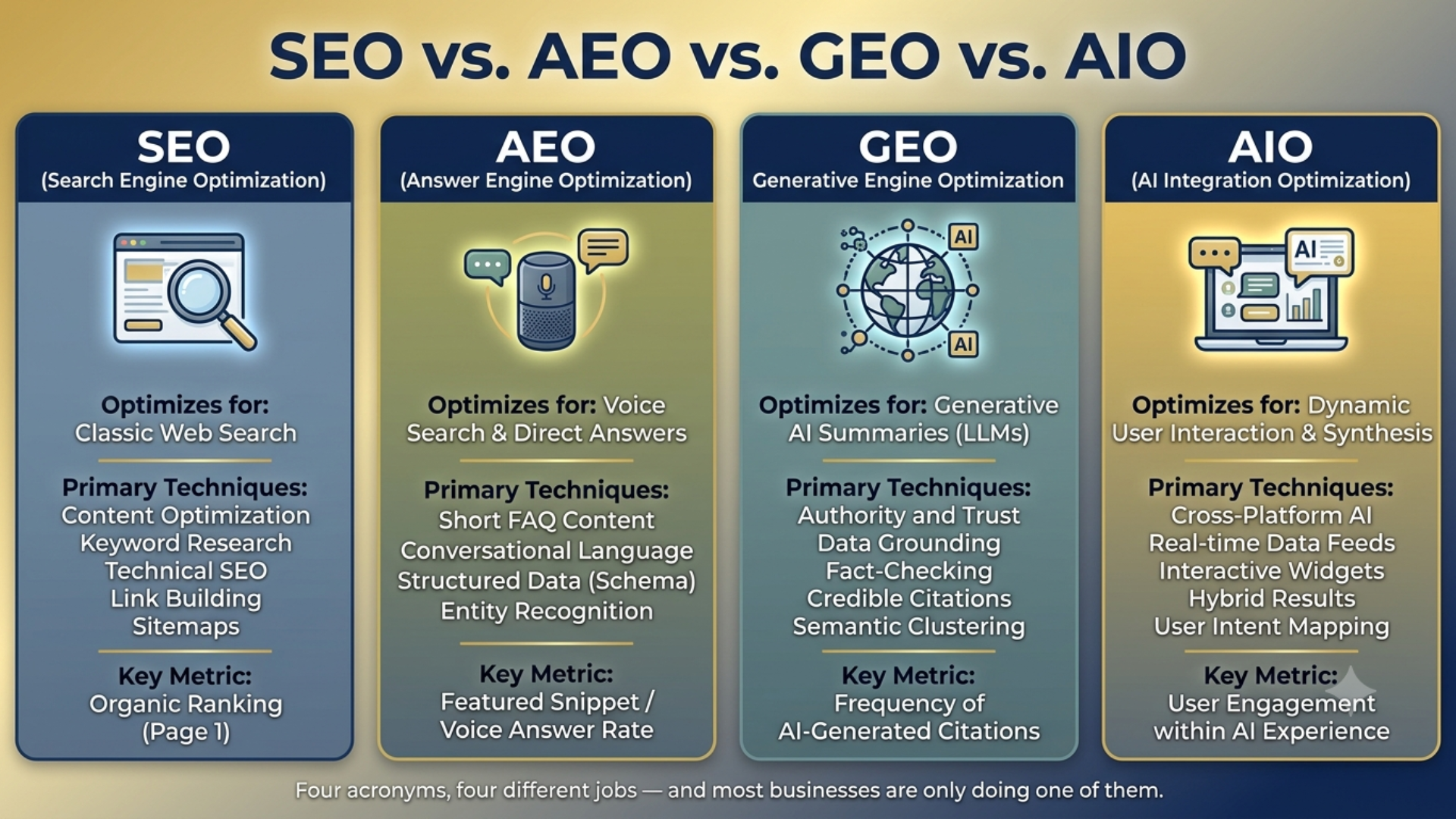
The terminology in this space is genuinely inconsistent — different agencies and platforms use GEO, AEO, AI SEO, and LLMO (large language model optimization) to describe overlapping ideas. Rather than pretend there's a single settled taxonomy, here's how the terms are most commonly used in 2026 and where they actually diverge in practice.
In practice, these four overlap heavily and reinforce each other.
Content structured for AEO — direct answers, clear headings, FAQ formatting — is also exactly what GEO needs, because generative engines extract and cite in the same way answer engines do. And none of it works without the technical SEO foundation: if an AI crawler can't access or parse your page, no amount of GEO polish matters.
The distinction that matters most for planning purposes is this one: SEO gets you found. AEO and GEO get you quoted. A page can rank on page one of Google and still never appear in a single AI-generated answer, because ranking and citation are evaluated by different mechanisms. That's the gap most businesses haven't closed yet.
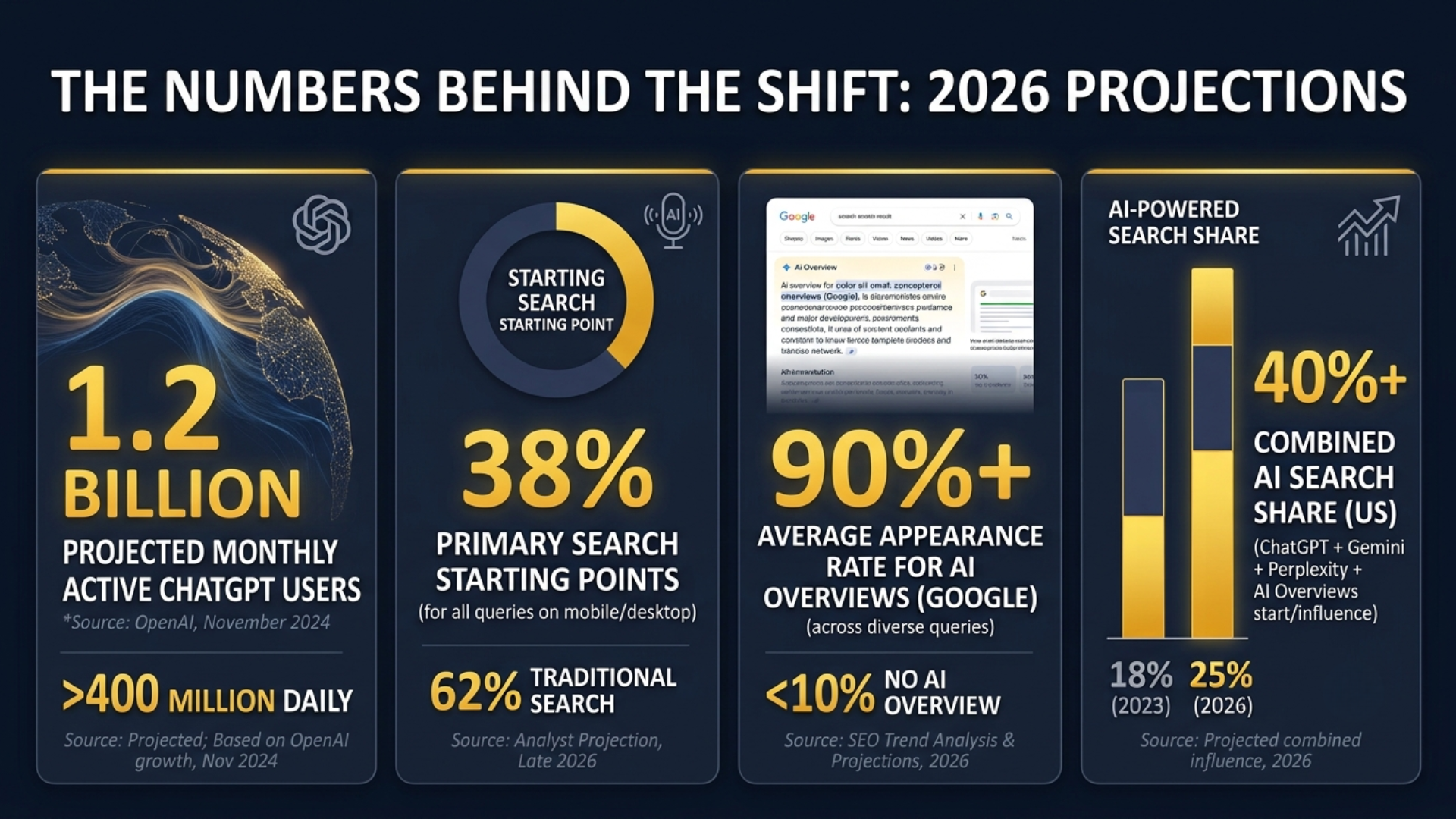
This isn't a hypothetical trend piece. The underlying user behavior has already moved, and the numbers back it up.
- AI assistants are handling a fast-growing share of search volume. Gartner's widely cited projection puts AI assistants and chatbots at roughly a quarter of global search activity in 2026, on a trajectory toward more than half by 2028.
- ChatGPT's scale alone now rivals traditional search engines for certain query types. Weekly active users are estimated in the hundreds of millions, with daily query volume reported in the billions.
- Google's AI Overviews already sit above the traditional results for a meaningful share of searches, with estimates varying by source and query category — generally somewhere between roughly one in four and over half of searches, depending on how informational the query is.
- Zero-click behavior is accelerating. Multiple industry analyses report that a majority of Google searches now end without a click to any website, because the answer was already visible on the results page.
- AI-referred traffic is growing explosively off a small base. Several 2026 industry reports point to AI-referred sessions to websites growing several hundred percent year-over-year, even though total volume is still a fraction of traditional organic traffic.
- Being cited pays off even without a click. Analysis from Seer Interactive found that organic click-through rates fell sharply on queries where an AI Overview appeared — but brands who were cited within that AI Overview still earned significantly more clicks per impression than brands on the same results page who weren't cited. Visibility inside the answer is becoming its own currency, separate from the traditional ranking.
Put together, these numbers describe a genuine structural shift, not a fad. Businesses that treat GEO as optional in 2026 are making the same bet that businesses made about mobile-responsive websites around 2013, or about having a Google Business Profile around 2016 — technically survivable to ignore for another year or two, but a compounding disadvantage every quarter it's delayed.
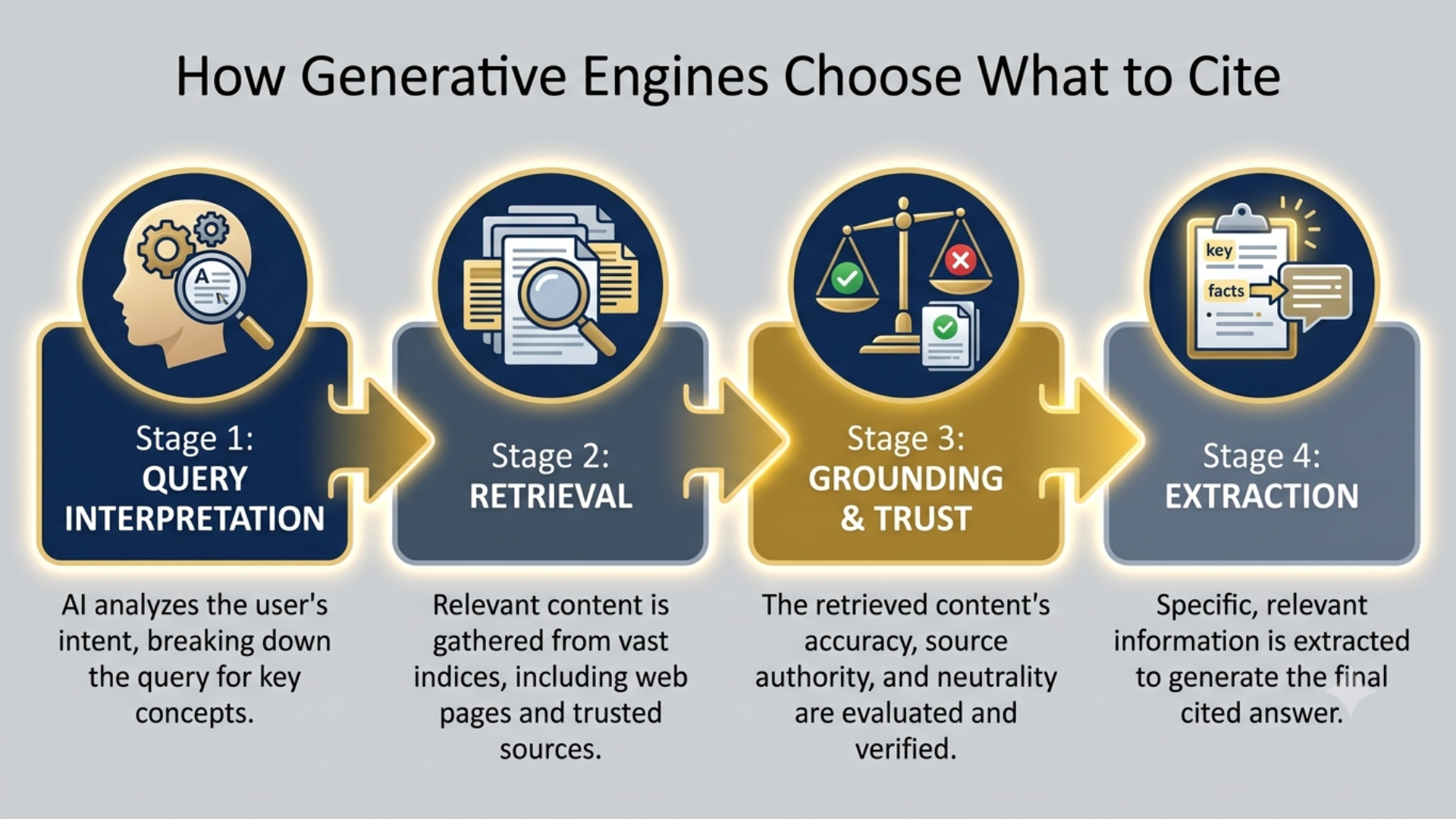
Understanding the mechanics here is the difference between guessing at GEO and actually doing it well. Most generative search systems — whether it's ChatGPT with browsing enabled, Perplexity, or Google's AI Overviews — follow a broadly similar pipeline built on a technique called Retrieval-Augmented Generation (RAG).
Step 1: Query interpretation and fan-out
The AI doesn't take your question and run it as a single search. It parses your intent and often breaks a complex question into several smaller sub-queries, sometimes called "fan-out" queries, each searched independently. Ask "which is the best CRM for a 20-person sales team on a budget," and the system may separately search for CRM comparisons, pricing pages, budget-CRM roundups, and reviews — then assemble an answer from across all of those results.
Why this matters for GEO: your content needs to win not just the obvious head-term query, but the cluster of sub-questions a real buyer's question decomposes into. This is why comprehensive topical coverage consistently beats a single, narrowly optimized page.
Step 2: Retrieval
The engine pulls a short list of candidate sources for each sub-query — typically drawing from its own search index (Bing powers a meaningful share of what ChatGPT retrieves, for instance) or, for Google's systems, its own web index and Knowledge Graph.
Why this matters for GEO: if your content isn't indexed, crawlable, and reasonably well-ranked in traditional search in the first place, it's never in the pool the AI is choosing from. Technical SEO is the gate you have to pass through before GEO techniques can do anything.
Step 3: Grounding and trust evaluation
From the retrieved candidates, the model evaluates which sources to trust enough to cite. This is where entity recognition and E-E-A-T (Experience, Expertise, Authoritativeness, Trustworthiness) signals come in. The model favors sources it recognizes as established entities — consistently named, cross-referenced across multiple credible platforms, backed by structured data that clearly identifies who is publishing and why they're qualified to.
Why this matters for GEO: consistency is a ranking factor in its own right. If your company name, description, and key facts vary across your website, LinkedIn, directory listings, and press mentions, you're making it harder for the model to confidently identify you as a single, trustworthy entity.
Step 4: Extraction and synthesis
Finally, the model extracts specific passages, facts, or statistics from the trusted sources and synthesizes them into a coherent answer, typically citing two to seven sources per response. Notably, models tend to extract from the parts of a page that most directly and concisely answer the question — research from Search Engine Land found that a majority of AI Overview citations were drawn from roughly the first third of a page's content.
Why this matters for GEO: burying your best answer under three paragraphs of scene-setting is a direct liability. If the concise, extractable answer isn't near the top of the section, the model may never reach it.
Expert tip: Write every major section as if it will be read in isolation, stripped of the rest of your page. Open with a two-to-three-sentence direct answer, then build out supporting depth underneath. That single habit — "answer first, elaborate second" — is the single highest-leverage structural change most businesses can make.
Here's the practical system we apply, built directly on the research above. It works whether you're producing a single cornerstone guide or restructuring an entire content library.
Step 1 — Build a real question inventory
Start from actual buyer questions, not keyword-tool guesses. Pull from sales call transcripts, support tickets, "People Also Ask" boxes, and — increasingly usefully — by asking ChatGPT, Perplexity, and Gemini your own target questions and noting who currently gets cited and why. Map each question to a funnel stage: informational, comparison/commercial investigation, or transactional.
Step 2 — Lead every section with a direct answer
Structure content so the first 40–80 words of any section stand alone as a complete, citable answer. Save context, nuance, and caveats for after the answer, not before it.
Before (buries the answer):
"In today's rapidly evolving digital landscape, many business owners find themselves asking important questions about how their marketing budgets should be allocated across various channels..."
After (answer-first):
"A reasonable digital marketing budget for a small business is 7–12% of gross revenue. Here's how that typically breaks down across channels..."
Step 3 — Write in self-contained, extractable chunks
Generative engines parse and cite at the section level, not the page level. Each H2 or H3 should function as a standalone unit — a single concept, fully explained, without depending on the reader having absorbed three paragraphs above it.
Step 4 — Densify with facts, not adjectives
This is where the Princeton research is most actionable. Replace vague claims with specific, verifiable numbers, named sources, and (sparingly) expert quotations. "Many businesses are moving to AI search" is forgettable. "Gartner projects AI assistants will handle roughly a quarter of global search volume in 2026" is citable.
Step 5 — Cover the full topic cluster, not just the head term
A page that only discusses your product will lose to a competitor's page that also covers the surrounding category — comparisons, definitions, adjacent problems, common objections. AI models reward comprehensiveness because it reduces the number of separate sources they need to retrieve to answer follow-up questions.
Step 6 — Build entity consistency across the web
Your company name, description, founder credentials, and core facts should be identical — not just similar — across your website, LinkedIn company page, Google Business Profile, directory listings, and any press or guest-post mentions. This consistency is a trust signal that compounds over time.
Step 7 — Refresh on a visible cadence
AI systems weight content recency. Several 2026 industry analyses found that pages left unrefreshed lose AI citation share meaningfully faster than pages updated on a regular cycle. A quarterly refresh — updated statistics, a visible "last updated" date, and a quick relevance check — is the practical minimum for any page you're actively trying to keep citable.
Great writing alone isn't enough. AI crawlers and retrieval systems also read the structural signals on your page, and this is the layer most businesses skip entirely.
Priority schema types for GEO/AEO
Practical implementation note: stack multiple schema types together inside a single @graph structure on important pages, rather than scattering separate, disconnected schema blocks. This gives the model a clearer, unified picture of the page. (A full working example is included in the Schema Markup section below.)
Other technical fundamentals that matter for AI retrieval
- Crawlability: keep core content in real HTML, not hidden behind JavaScript rendering or locked inside images — AI crawlers are far less forgiving of client-side-only content than modern Googlebot is.
- Page speed and Core Web Vitals: still relevant, because a slow or broken page reduces the odds it gets indexed and retrieved at all.
- Clean heading hierarchy: one H1, logically nested H2s and H3s — this is literally the map an AI model uses to understand your content's structure.
- Tables for comparisons: structured HTML tables are extracted far more reliably than prose when a query calls for a comparison.
- An llms.txt file: an emerging (not yet universal) convention that gives AI crawlers a clean, curated summary of your most important content — worth adding for larger sites, low-cost to implement.
Mistake 1 — Treating GEO as a rewrite of existing SEO copy. Simply adding more keywords to an existing page does nothing for GEO. The fix is structural: answer-first sections, extractable facts, and genuine topical depth — not keyword density.
Mistake 2 — No consistent entity signals. Company name spelled three different ways across the web, inconsistent founder bios, mismatched addresses. AI models penalize this uncertainty by simply not citing the source at all.
Mistake 3 — Chasing every AI platform identically. ChatGPT, Perplexity, and Google AI Overviews don't behave the same way — one 2026 platform analysis found the same brand's citation volume could differ by several hundred times between two different AI engines. A single, one-size-fits-all content strategy leaves real visibility on the table.
Mistake 4 — Publishing and never updating. Static, unrefreshed content steadily loses citation share as AI models favor more recently verified information.
Mistake 5 — No FAQ or schema implementation. Skipping structured data means relying entirely on the AI model correctly inferring structure from prose — a much less reliable path to citation.
Mistake 6 — Writing for the algorithm instead of the reader. Overly mechanical, keyword-stuffed writing is detectable by both AI models and human readers, and it actively hurts trust signals. The Princeton research and every serious practitioner guide converge on the same point: content that is genuinely useful and well-organized for a human reader is also what generative engines prefer to cite.
Mistake 7 — Ignoring third-party mentions. One 2026 analysis of high-purchase-intent AI search queries found that a large majority of brand mentions came from third-party sources — reviews, comparison sites, press coverage — rather than a brand's own website. GEO isn't just an on-site content exercise; digital PR and earned coverage matter as much as, or more than, your own blog.
The following is a hypothetical, illustrative scenario designed to show how the GEO framework applies in practice. It is not a real client engagement, and the figures are representative estimates for teaching purposes, not documented results.
Scenario: A 30-person B2B professional services firm has strong traditional SEO — page one rankings for its core service terms — but discovers, after manually testing its own target questions in ChatGPT and Perplexity, that it is never mentioned. Three regional competitors are, consistently.
Diagnosis using the framework above:
- The firm's core service pages open with company history and mission statements before addressing the buyer's actual question — a classic "answer buried" structure.
- No FAQ schema exists anywhere on the site, despite a genuinely useful FAQ page.
- The founder's bio, company description, and even the registered business name are worded differently across the website, LinkedIn, and two major directory listings.
- Content hasn't been updated in over eighteen months, with statistics referencing outdated figures.
Applied fixes:
- Rewrote the top ten highest-intent pages using the answer-first, extractable-section structure.
- Added FAQPage, Organization, and Article schema across the core site, unified into a single @graph per page.
- Standardized entity information — name, description, founder credentials — identically across the website, LinkedIn, and every directory listing.
- Instituted a quarterly content refresh cycle with visible "last updated" dates.
- Pursued two pieces of earned, third-party coverage (an industry roundup and a guest contribution) to build citation signals beyond the firm's own domain.
Illustrative outcome pattern: consistent with the ranges reported in the research and industry data cited throughout this guide, a firm making these changes could reasonably expect meaningful improvement in AI citation frequency within 4–8 weeks for its most-optimized pages, with more durable, cross-platform gains building over 3–6 months as entity consistency and earned mentions compound. Actual results vary substantially by industry, competitive density, and starting domain authority — which is exactly why measurement (see the checklist below) matters more in GEO than in traditional SEO, where ranking tools are far more mature.
Days 1–30: Foundation and audit
- Manually test 15–25 of your highest-value buyer questions across ChatGPT, Perplexity, Google AI Overviews, and Gemini. Document who gets cited and why.
- Audit entity consistency: company name, description, founder bios, and contact details across your website, LinkedIn, Google Business Profile, and top directories.
- Identify your 10 highest-intent existing pages and diagnose them against the framework in Section 20.
- Implement baseline schema (Organization, Article) sitewide.
Days 31–60: Restructure and build
- Rewrite your top 10 pages using the answer-first, extractable-section structure.
- Add FAQPage schema to every page with genuine Q&A content.
- Build 2–3 comprehensive topic-cluster pieces covering full buyer question sets, not just head terms.
- Standardize entity information across every external platform identified in the audit.
Days 61–90: Authority and measurement
- Pursue 2–4 pieces of earned, third-party coverage — guest contributions, expert roundups, comparison-site inclusion — since third-party mentions carry disproportionate weight in AI citation decisions.
- Re-run your Day 1 question set and compare citation results.
- Establish a quarterly content refresh cadence with visible update dates.
- Set up ongoing monitoring — manual spot-checks at minimum, or a dedicated AI-visibility tracking tool if budget allows — since native analytics platforms don't yet track AI citations the way Google Search Console tracks rankings.
There's a detail in the original Princeton research worth returning to: when a lower-ranked site applied GEO techniques, its visibility in AI-generated answers jumped by more than 100% in testing — while the top-ranked incumbent in the same query actually lost ground. Traditional SEO rewards accumulated backlinks and domain age, which structurally favors large, long-established players, often headquartered in a handful of markets. Generative engines evaluate retrieved content more directly on clarity, structure, and factual density.
That's a meaningfully more level playing field — and it matters most for exactly the kind of business that has historically struggled to compete for international attention on backlink volume alone: a boutique agency or specialist firm based outside the traditional US/UK/Western Europe marketing hubs, bidding for global RFPs and international clients on the strength of its expertise rather than its domain age.
For an internationally-facing business built on deep specialist knowledge and hands-on delivery experience, the practical implication is this: winning international visibility no longer requires decades of accumulated backlinks from a US-based domain. It requires being genuinely well-structured, well-sourced, and consistently represented — the same requirements a well-run boutique firm anywhere in the world is equally capable of meeting. The technical and editorial playing field described throughout this guide doesn't care what country your headquarters is registered in. It cares whether your content answers the question clearly, cites its sources, and stays current.
That's precisely the opportunity for agencies and specialist firms building international credibility from outside the traditional hubs: applied correctly, GEO rewards clarity and expertise over legacy domain authority — which is a genuinely different competitive equation than the one SEO alone created.
A few trends worth planning around, based on the trajectory the research and platform data already show:
- Agentic search will raise the stakes further. As browsers and assistants (Gemini in Chrome, agentic ChatGPT features, and similar tools) begin acting on multi-step tasks rather than just answering single questions, being cited becomes a precondition for being acted on — booked, purchased from, or recommended — not just mentioned.
- Measurement tooling will mature. The current lack of a "Search Console for AI citations" is a temporary gap, not a permanent one; expect first-party and third-party tracking to close much of this measurement blind spot over the next 12–18 months.
- Cross-platform divergence will keep widening. Different AI engines are already citing meaningfully different source sets for the same query. A single-platform GEO strategy will increasingly leave visibility on the table.
- "Share of Model" becomes a boardroom metric. Much as "share of voice" became a standard marketing KPI, expect citation frequency across major AI platforms to become a tracked, budgeted metric alongside traditional rankings and traffic.
- The content-quality bar keeps rising, not falling. As more businesses adopt GEO techniques, the early-mover advantage narrows. The durable advantage won't be knowing the tactics — it'll be genuine subject-matter depth that's hard to replicate quickly.
What is Generative Engine Optimization (GEO)? GEO is the practice of structuring content, data, and brand presence so generative AI platforms like ChatGPT, Google AI Overviews, Gemini, and Perplexity retrieve and cite your business when generating answers to user questions.
What is Answer Engine Optimization (AEO)? AEO is the practice of structuring content to be extracted as a direct answer — in featured snippets, People Also Ask boxes, voice assistant responses, and AI answer boxes. It's closely related to GEO and often treated as one component of a broader GEO strategy.
Is GEO the same as SEO? No. SEO optimizes for ranking position in a traditional results page. GEO optimizes for citation inside an AI-generated answer. They share technical foundations — crawlability, authority, quality content — but SEO alone doesn't guarantee AI citation, and vice versa.
Do I need to abandon SEO to focus on GEO? No. GEO builds on top of SEO. Your content generally has to be retrievable through standard search indexing before an AI model can consider citing it, so a strong SEO foundation remains essential.
Which AI platforms should I optimize for? At minimum: ChatGPT, Google AI Overviews and AI Mode, Perplexity, and Gemini. Different platforms retrieve from different sources and behave differently, so genuinely broad visibility requires monitoring more than one engine.
How long does GEO take to show results? Based on the research and industry data referenced throughout this guide, early citation improvements on well-optimized pages can appear within roughly 4–8 weeks, with more consistent, durable results typically building over 3–6 months, especially where earned, third-party mentions are involved.
What's the single highest-impact change I can make first? Restructure your highest-intent pages so each major section opens with a direct, self-contained answer in the first 40–80 words, rather than building up to the point with introductory context.
Does schema markup actually matter for AI citation? Yes. Structured data — particularly FAQPage, Article, and Organization schema — helps AI systems parse your content's meaning and relationships more reliably than prose alone, and several practitioner analyses report it correlating with improved citation accuracy.
Can a small business realistically compete with large brands in AI search? Yes, more so than in traditional SEO. Research from the original Princeton GEO study found that lower-ranked, smaller sites saw disproportionately larger gains from GEO techniques than top-ranked incumbents did — because generative engines weigh content quality and structure more directly than link-based domain authority.
What role do third-party mentions play? A significant one. Industry analysis of high-purchase-intent AI queries found that a large majority of brand mentions in AI answers came from third-party sources — reviews, comparisons, press — rather than a brand's own website. Earned coverage and digital PR are part of a serious GEO strategy, not optional extras.
How often should I update my content for GEO? A quarterly refresh cycle, with a visible "last updated" date and current statistics, is a reasonable practical minimum. Several 2026 industry analyses found that stale, unrefreshed content loses AI citation share meaningfully faster than regularly updated content.
What is "Share of Model"? An emerging metric describing how often your brand appears in AI-generated answers relative to your competitors across a defined set of target questions — the GEO equivalent of "share of voice."
Do AI Overviews reduce my website traffic? Often, yes, for queries where the AI Overview fully answers the question — click-through rates on those queries have fallen significantly according to multiple industry analyses. However, being cited within the AI Overview appears to partially offset this, with cited brands earning meaningfully more clicks per impression than uncited brands on the same results.
Is voice search part of GEO? Yes, functionally. Voice assistants rely on the same structured, concise, answer-first content that AEO and GEO already prioritize, so optimizing for one generally benefits the other.
What is Retrieval-Augmented Generation (RAG) and why does it matter for GEO? RAG is the technical process most AI search systems use: retrieving relevant sources from a search index, then generating an answer grounded in those sources. Understanding this pipeline — query interpretation, retrieval, trust evaluation, extraction — is what makes GEO tactics targeted rather than guesswork.
Should every page on my website be optimized for GEO? No. Prioritize your highest-intent, highest-value pages first — service pages, comparison content, and pillar guides that already influence business outcomes — rather than attempting a full-site rewrite at once.
Can I track whether I'm being cited by AI platforms? Partially. Native analytics tools for AI citation tracking are less mature than tools like Google Search Console, but manual spot-checking of target questions, referral traffic analysis in GA4, and a growing set of third-party AI-visibility tools can all help you measure progress.
Does GEO apply to local businesses, or only large companies? It applies to both, though the tactics differ slightly. Local businesses benefit most from tight entity consistency (name, address, and description matching exactly across platforms) combined with genuinely useful, locally specific content that answers real customer questions.
What's the biggest myth about GEO? That it's a set of hidden AI-manipulation tricks. In reality, the research consistently shows that genuinely well-structured, well-sourced, useful content — the same content a careful human reader would value — is what generative engines prefer to cite. GEO rewards real quality more than it rewards clever workarounds.
How does GEO apply to an internationally-facing business bidding on cross-border work? Because GEO weighs content clarity and structure more heavily relative to accumulated domain authority than traditional SEO does, a well-run specialist business anywhere in the world has a genuinely competitive shot at AI-search visibility against larger, longer-established competitors in bigger markets — provided the fundamentals in this guide are applied consistently.
The uncomfortable truth about this shift is that most of the "AI search optimization" advice circulating right now is recycled SEO copy with a new label stapled on. What actually works is narrower and more disciplined than that: content that answers clearly, cites its sources, states real numbers instead of vague claims, stays consistent about who you are across the web, and gets refreshed on a schedule instead of left to go stale. None of that is a trick. It's just a higher bar for doing the work well — which is exactly why the businesses that commit to it now, while nearly half the market still has no strategy at all, have a real window to build a durable lead.
If you're evaluating whether to build this in-house or bring in outside expertise, the honest answer is that GEO rewards the same thing it always has in good marketing: genuine subject-matter depth, applied consistently, over time. Brand Multimedia is an AI powered full-service digital marketing and web development agency headquartered in Addis Ababa, Ethiopia, built specifically around that kind of cross-border, AI first approach — combining hands on US market experience with the technical discipline this guide describes, for clients across Ethiopia and internationally. If you'd like a second set of eyes on where your business currently stands in AI search — that's a conversation worth having before your competitors have it first.
Ready to grow your business? Reach out to our team today on WhatsApp and let’s discuss how we can help. Click here to chat with us