Executive Summary
Here's the uncomfortable part first: you cannot pay Google to add your business to its Knowledge Graph, and you cannot prompt-engineer your way into ChatGPT trusting your brand. Entity SEO is not a switch you flip. It's the accumulated, verifiable evidence — structured data, consistent naming, third-party corroboration, clear relationships — that tells algorithms your business is a real, distinct, credible "thing" in the world, not just a collection of web pages hoping to rank.
That distinction matters more in 2026 than it ever has. Google's Knowledge Graph now holds well over a trillion facts about tens of billions of entities, and Google's own Gemini models are trained directly on that graph — meaning a business with a strong, clear entity presence has a structural advantage in AI-generated answers that has nothing to do with traditional keyword rankings. A 75,000-brand study from Ahrefs found that unlinked branded web mentions correlate with AI citation more than three times as strongly as backlinks do. The signal that used to matter most — links — is being overtaken by a signal most businesses have never deliberately managed: entity clarity.
This guide covers what Entity SEO actually is, how Google's Knowledge Graph works, how AI platforms decide which businesses to trust and recommend, and a practical, step-by-step framework for building a strong digital entity — whether you're a local business trying to earn a Knowledge Panel or an internationally-facing company trying to be the name ChatGPT gives when someone asks for a recommendation.
Google's Knowledge Graph now holds well over a trillion facts about tens of billions of entities — people, places, organizations, products, and ideas, all connected by defined relationships. Your business is either one of them, clearly and correctly, or it's invisible to the systems now deciding who gets recommended.
That's not an exaggeration of how search has changed — it's a description of the plumbing. For most of SEO's history, the unit of competition was the keyword: match the words in a search query, rank the page, win the click. That model is dying, not because keywords stopped mattering, but because search engines and AI platforms got much better at understanding things instead of words. Google stopped asking "does this page contain the phrase 'digital marketing agency Addis Ababa'" and started asking "is this a real, distinct, trustworthy organization that offers digital marketing services, and how confident am I in that assessment?"
That second question is what Entity SEO answers. It's the difference between a page that ranks and a brand that gets recognized, cited, and recommended — by Google's AI Overviews, by Gemini, by ChatGPT, by Perplexity, and by whatever comes next. This guide walks through exactly how that recognition works, and exactly what to do about it.
Direct answer: Entity SEO is the practice of optimizing your website and broader digital presence so search engines and AI systems recognize your business as a distinct, well-defined entity — a specific organization with clear attributes and verifiable relationships to other known entities — rather than treating your content as isolated pages competing for keyword matches.
Definition box: An entity, in Google's terminology, is any uniquely identifiable "thing" — a person, place, organization, product, event, or concept — that can be clearly distinguished from every other entity. Your business, its founder, its services, and even its city of operation are all entities that can be connected inside Google's Knowledge Graph.
A short history
Entity-based search didn't arrive overnight. It's the product of a decade of Google algorithm changes that moved the company from lexical matching (matching words) toward semantic understanding (matching meaning): Hummingbird in 2013 introduced conversational query understanding, RankBrain in 2015 brought machine learning into ranking, BERT in 2019 improved contextual language understanding, and MUM in 2021 extended that understanding across formats and languages. Each step made Google less dependent on the literal words on your page and more dependent on whether it could confidently identify what — and who — your page was actually about.
Why it matters now
The payoff of that decade-long shift is showing up directly in 2026's search results. AI Overviews are estimated to appear on somewhere around a fifth to a third of Google searches depending on the study and query category, and each one compresses the top of the results page into a synthesized answer that cites a small handful of sources. Google's Gemini models are trained directly on the Knowledge Graph, which means a business with strong, correctly-connected entity data has a structural advantage in Gemini-generated answers that has nothing to do with traditional page-level SEO.
A simple example
Search "Marie Curie" and Google doesn't just find pages containing that name — it pulls a pre-built entity profile: physicist, chemist, Nobel Prize winner, radioactivity research. That profile exists independently of any single web page, built from corroborated facts across many trusted sources. Entity SEO is the process of building that same kind of independently-verifiable profile for your business.
Key takeaway: Entity SEO doesn't replace keyword SEO — it works underneath it. Keyword SEO helps a page rank. Entity SEO helps an algorithm trust that the organization behind the page is real, credible, and worth recommending.
2. The Evolution From Keywords to Entities
Direct answer: Search has moved through four overlapping stages — traditional keyword matching, semantic search, entity-based understanding, and now generative AI search — each one making search engines less dependent on exact words and more dependent on verified meaning and identity.
Traditional SEO (pre-2013): Search engines matched the words in a query to the words on a page. Keyword density, exact-match domains, and backlink volume were the dominant signals.
↓
Semantic Search (2013 onward, Hummingbird): Google began interpreting the intent and context behind a query, not just its literal words — understanding that "best place for pizza near me" is a request, not a string to match.
↓
Entity SEO (2012 onward, accelerating through the 2020s): Google's Knowledge Graph connects real-world entities — people, places, organizations — and their relationships, letting search engines answer questions using verified facts rather than crawled text alone.
↓
AI Search (2023 onward): Generative engines like ChatGPT, Gemini, and Perplexity synthesize answers by retrieving and citing a small set of trusted sources, drawing heavily on the same entity-recognition signals that power Knowledge Panels and AI Overviews.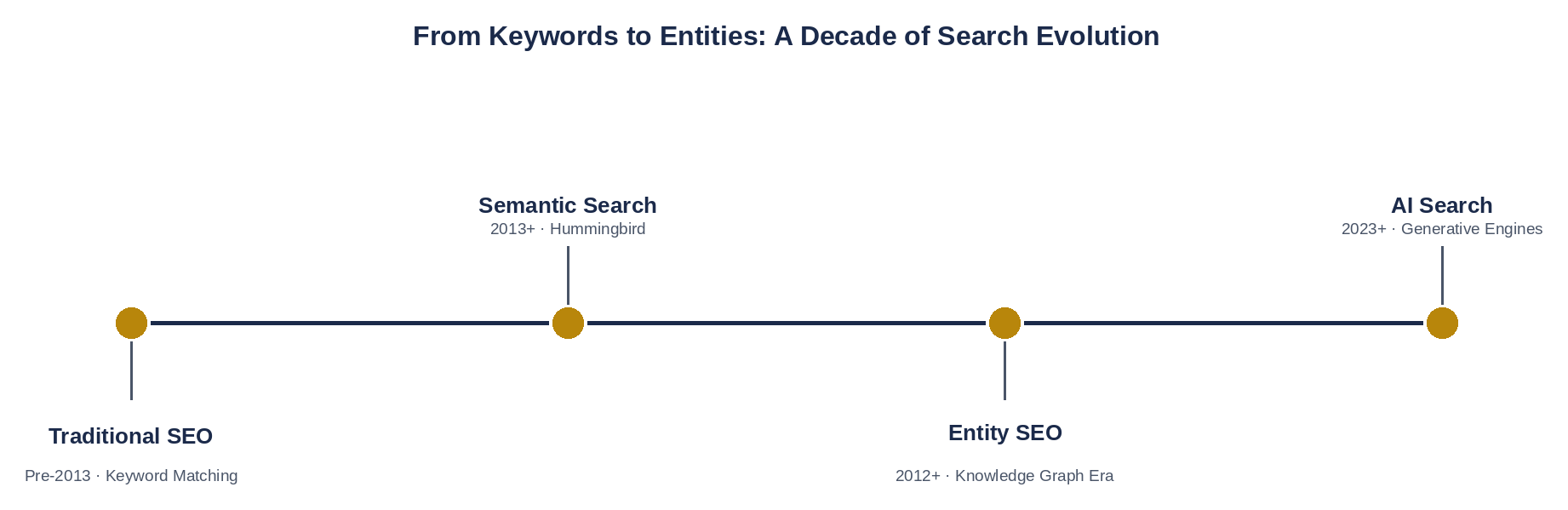
Expert tip: Most businesses are still optimizing entirely for stage one while their competitors are quietly building stage-three and stage-four signals. That gap is exactly where the visibility opportunity sits in 2026.
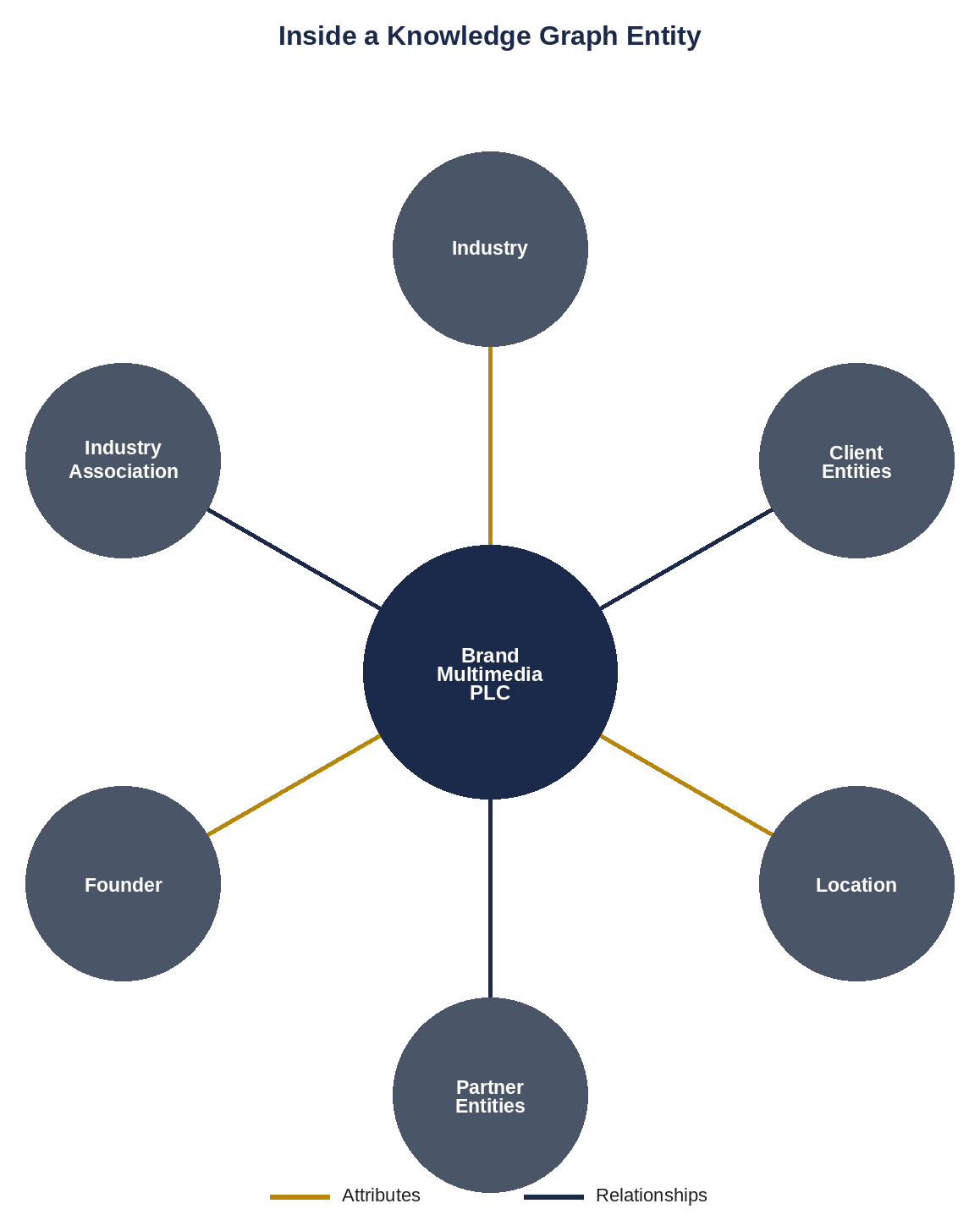
Direct answer: Search engines build an understanding of an entity through six interconnected components: the entity itself, its attributes, its relationships to other entities, the context it appears in, its relevance to a given query, and its accumulated authority.
A practical example: when Google encounters the phrase "Brand Multimedia PLC" on a third-party website, it doesn't just index the text — it attempts to resolve which entity that phrase refers to, cross-checking it against existing Knowledge Graph data, the company's own Organization schema, and other corroborating mentions. The clearer and more consistent those signals are, the more confidently Google (and by extension, Gemini) can make that connection — and the more likely an AI system is to surface that entity correctly when someone asks a related question.
Direct answer: Google's Knowledge Graph is a structured database of real-world entities and the verified relationships between them, launched in 2012, that Google uses to understand search queries, populate Knowledge Panels, ground AI Overviews in fact, and train its Gemini AI models.
What it is
According to Search Engine Land's guide to the Knowledge Graph, Google's Knowledge Graph contains more than 1.6 trillion facts about roughly 54 billion entities — though the exact figures vary by source and continue to grow. Rather than storing web pages, it stores facts: Marie Curie is a physicist, won the Nobel Prize, studied at the University of Paris. Those facts are connected as a network, or graph, which is what lets Google answer complex, multi-step questions without needing a single web page to contain the full answer.
How it works
When someone searches a query, Google checks whether it can resolve the query to a known entity in the graph. If it can, it can enrich the results with verified facts — a Knowledge Panel, a direct answer, an entity carousel — pulled from the graph rather than solely from crawled content. This is also how Google grounds AI Overviews in verifiable fact: rather than relying entirely on what it finds across crawled pages, it can cross-check claims against established Knowledge Graph relationships.
Why businesses should care
You cannot directly submit your business to the Knowledge Graph — there's no form to fill out. You can only influence whether Google recognizes and includes your entity, primarily through four channels: Organization schema markup (particularly with sameAs properties linking to your verified profiles), consistent brand information across your website and social platforms, third-party mentions on authoritative sites, and — where your business qualifies — a Wikidata entry, which several practitioner analyses note requires no notability threshold, unlike Wikipedia.
Being recognized in the Knowledge Graph compounds in value because it feeds every downstream AI surface: Knowledge Panels, AI Overviews, Featured Snippets, People Also Ask boxes, voice search answers, and — critically — Gemini's own generated responses, since Gemini is trained directly on Knowledge Graph data.
Direct answer: Traditional SEO optimizes individual pages to rank for specific keywords; Entity SEO optimizes your brand as a whole to be recognized, trusted, and connected across the entire web. In 2026, businesses need both — but Entity SEO increasingly determines whether keyword-optimized content ever gets the chance to be seen.
That's why our SEO services and this deeper entity-level approach have to work together, not compete.
Neither approach replaces the other. A page can be perfectly keyword-optimized and still fail to be cited in an AI Overview if the entity behind it isn't clearly established — and a well-established entity still needs individual pages that are genuinely useful and well-structured to rank for specific queries.
Direct answer: ChatGPT, Gemini, Claude, Perplexity, and Copilot each identify trustworthy businesses through a combination of training-data exposure, live retrieval from search indexes, and — increasingly — structured entity data, rewarding businesses with consistent, corroborated, well-documented identities over those that simply rank well.
- Gemini has a distinct advantage here: it's trained directly on Google's Knowledge Graph, so a business with a strong Knowledge Graph presence carries that advantage directly into Gemini's answers, not just into traditional search results.
- ChatGPT, when browsing is active, retrieves from a live search index (with Bing powering a meaningful share of that retrieval) and evaluates which sources to trust largely through the same signals that matter for any retrieval-based system: consistency, corroboration, and structured clarity.
- Perplexity is built around citation-first answers, explicitly showing its sources — which makes clean entity signals (a canonical About page, consistent naming, clear structured data) directly visible in how confidently and how often it cites a given business.
- Claude and Copilot similarly rely on retrieval-grounded answers when search or browsing tools are engaged, evaluating retrieved sources for the same trust markers: does this source clearly identify who it's talking about, and is that identity corroborated elsewhere.
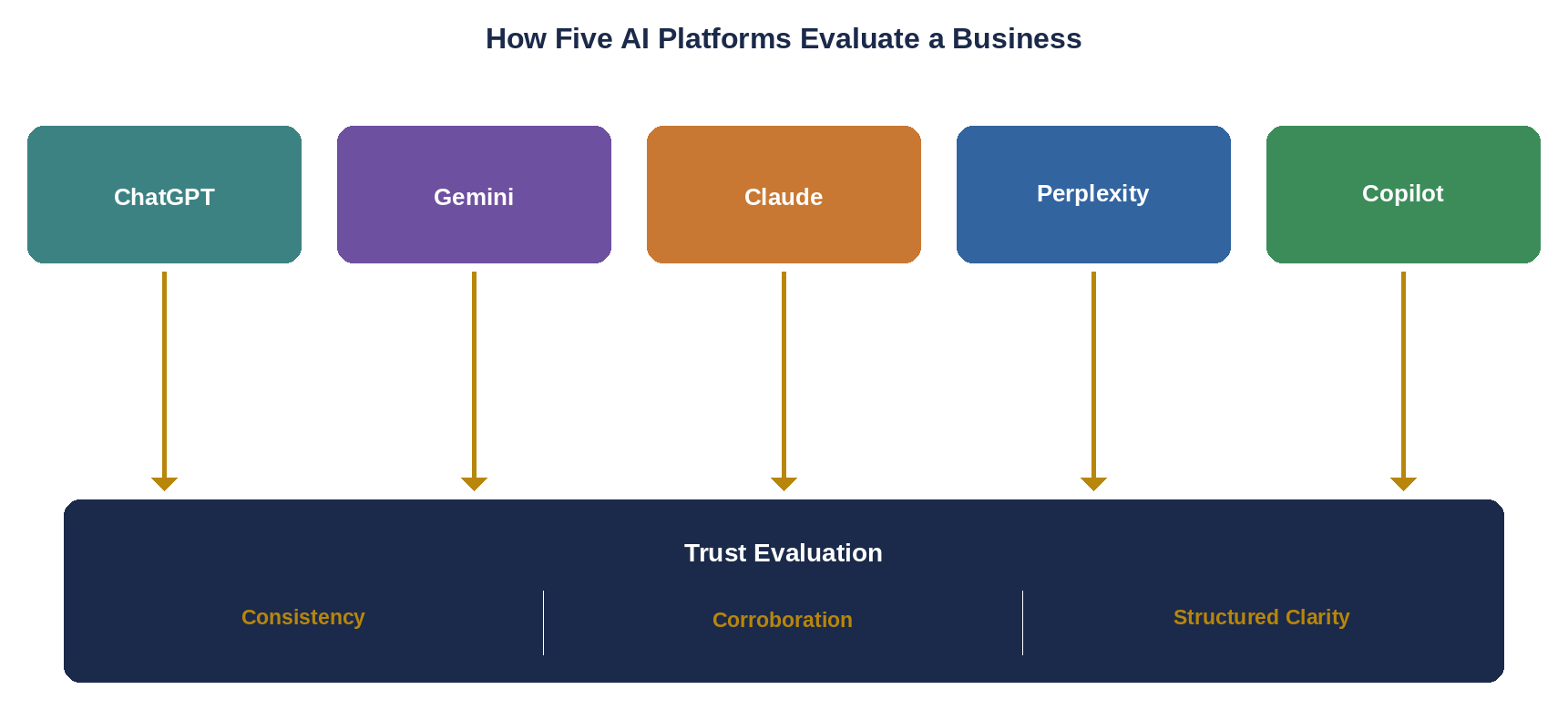
Across all five platforms, one pattern holds: inconsistency is the enemy of trust. If your business is "Brand Multimedia PLC" on your website, "Brand Multimedia" on LinkedIn, and "BrandMultimedia Digital" on a directory listing, an AI system's entity-disambiguation process may treat these as three separate, weaker signals instead of one strong one. Ahrefs' study of 75,000 brands found that unlinked branded web mentions correlate with AI citation at 0.664, versus just 0.218 for traditional backlinks — a meaningful signal that entity consistency and corroboration are outweighing link-building as a trust mechanism for AI-era visibility.
For a deeper look at how these same platforms decide what to cite and retrieve in the first place, see our Generative Engine Optimization guide.
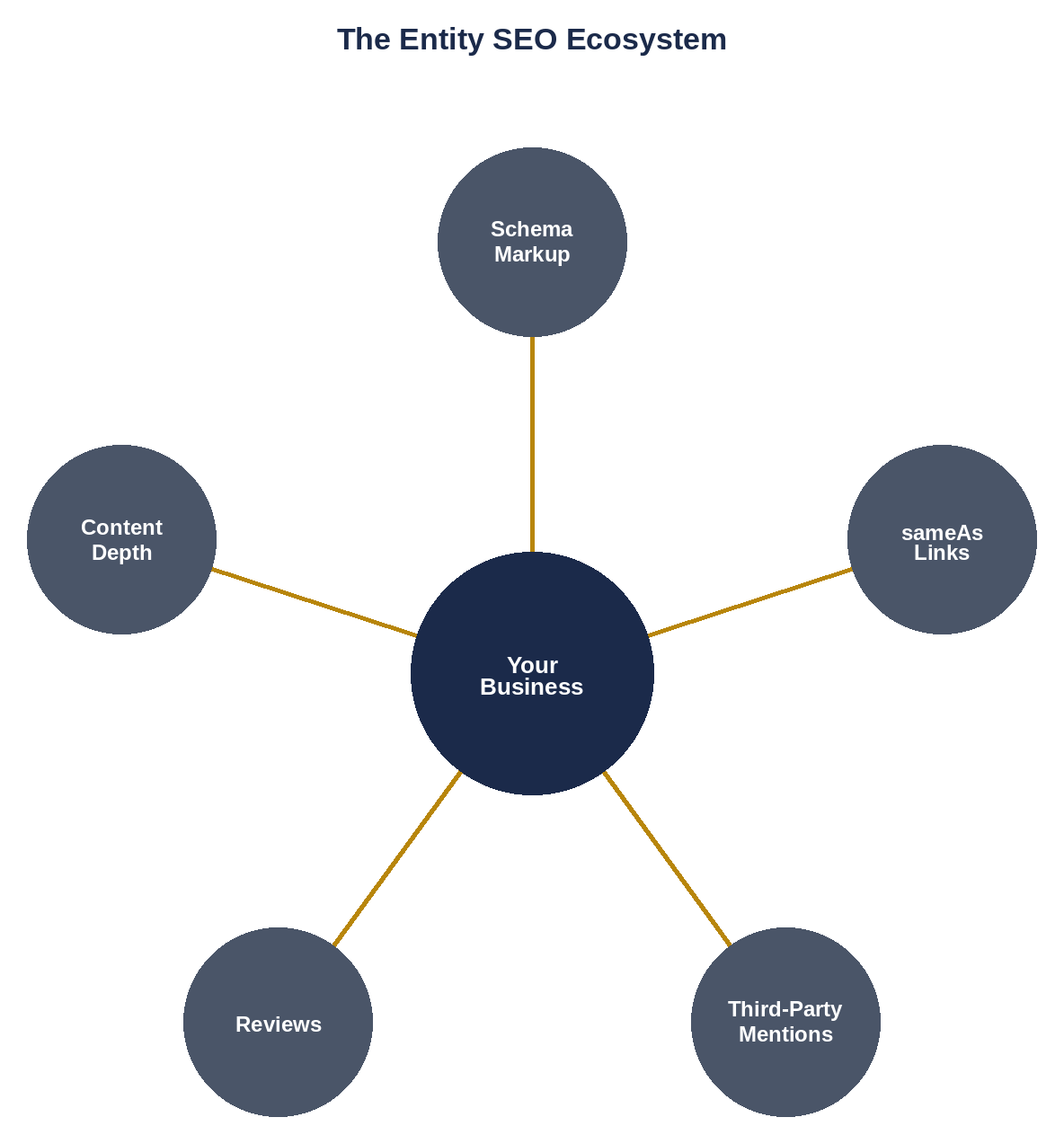
Direct answer: Building a strong digital entity is a seven-step process: establish brand consistency, build website authority, implement structured data, develop a content ecosystem, earn digital mentions, manage reviews and reputation, and demonstrate expertise signals.
Step 1 — Brand consistency
Pick one canonical version of your business name, description, and founder credentials — and use it identically everywhere: your website, LinkedIn, Google Business Profile, directories, and press mentions. Inconsistent naming is the single most common entity SEO failure, because it fragments a signal that should be unified.
Step 2 — Website authority
Your website needs a clear entity home — almost always your About page — that anchors how algorithms and people understand your brand. This is the URL that should carry your primary Organization schema block.
Step 3 — Structured data
Implement Organization schema with an @id pointing to your canonical domain, plus sameAs properties linking to every verified external profile (LinkedIn, Crunchbase, industry directories). This is officially supported by Google as an entity-disambiguation signal.
Step 4 — Content ecosystem
Publish content that fully covers your area of expertise, not just isolated service pages. Topical depth — multiple connected pieces covering a subject area from different angles — signals authority far more effectively than a single well-optimized page.
Step 5 — Digital mentions
Pursue mentions of your business on authoritative third-party sites — press coverage, industry roundups, guest contributions. Notably, a mention doesn't need a link to help; unlinked brand mentions still contribute to entity corroboration, because they reinforce that independent sources recognize your business as a real, named thing.
Step 6 — Reviews and reputation
Consistent, genuine reviews across Google Business Profile and relevant industry platforms reinforce trust signals that feed both traditional local search and AI-generated recommendations.
Step 7 — Expertise signals
Establish named individuals — founders, senior team members — as their own connected entities using Person schema and consistent author bios. Knowledge Panels for corporate entities became significantly more available starting in early 2025, and the number of people with individual Knowledge Panels reportedly quadrupled between mid-2023 and mid-2024, according to research from Kalicube — meaning both the organization and its key people are worth establishing as distinct, connected entities.
Direct answer: Schema markup is the structured-data language that lets you explicitly tell search engines and AI systems what your entities are, using standardized vocabulary from Schema.org — and it's the single most direct lever a business has for improving entity recognition.
If implementing this correctly feels like a technical lift, that's exactly what our schema markup and technical SEO services are built to handle.
Structured data doesn't guarantee inclusion in the Knowledge Graph or a citation in an AI Overview — but it removes ambiguity. Without it, an algorithm has to infer who you are from unstructured text. With it, you're telling the system directly, in a format it's built to trust. For the full technical specification, see Google Search Central's structured data guidelines.
Direct answer: For local businesses, Entity SEO means consistent Name, Address, and Phone (NAP) information across every platform, a complete and verified Google Business Profile, and genuine local reviews — the combination that determines whether a business shows up not just in local search, but in AI-generated local recommendations.
Local entity signals compound in a way many small business owners underestimate. A restaurant, clinic, or agency with identical NAP data across its website, Google Business Profile, and every directory listing gives Google — and by extension, AI systems trained on or retrieving from that data — a single, unambiguous signal to work from. A business with three slightly different addresses or phone numbers across the web forces the algorithm to guess which one is current, which weakens confidence in the entity as a whole.
The payoff extends beyond Google's local pack: when someone asks ChatGPT or Gemini "what's a good [service] near [location]," the underlying retrieval and grounding process leans on the same entity clarity that powers traditional local SEO. A locally-consistent entity is a locally-recommendable entity, across both search paradigms at once.
- Inconsistent business naming across the website, social profiles, and directories — "Acme Software," "Acme Software, Inc.," and "AcmeSoft" can be treated as separate, weaker entities instead of one strong one.
- No Organization schema at all, leaving Google to infer identity from unstructured text alone.
- Missing sameAs properties, which fail to connect your website to your verified LinkedIn, Crunchbase, or industry profiles.
- No clear "entity home." Without a canonical About page carrying your primary schema, there's no single anchor for your identity.
- Mismatched NAP data across Google Business Profile, directories, and the website footer.
- Treating reviews as an afterthought rather than an ongoing trust-signal channel.
- Publishing thin, disconnected content instead of building topical depth around a core area of expertise.
- Ignoring founder and team entity building — never establishing key people with Person schema or consistent bios.
- Chasing backlinks while ignoring unlinked brand mentions, which also contribute meaningfully to entity corroboration.
- Never checking what Google or AI platforms currently say about the business, missing outdated or inaccurate information quietly sitting in a Knowledge Panel or AI answer.
- Assuming Wikipedia is required. Many businesses skip Wikidata entirely, unaware it carries no notability threshold and is one of the lower-cost entity signals available.
- Duplicate or conflicting schema markup across pages, confusing rather than clarifying entity signals.
- No internal linking strategy connecting related content, weakening the topical relationships that reinforce entity relevance.
- Rebranding without updating legacy entity signals, leaving old business names or logos live across directories and cached data.
- Treating entity SEO as a one-time project rather than an ongoing monitoring task — Knowledge Panel accuracy and AI-answer accuracy both drift over time without active maintenance.
- Confusing entity SEO with basic on-page SEO, and assuming keyword optimization alone will eventually produce entity recognition.
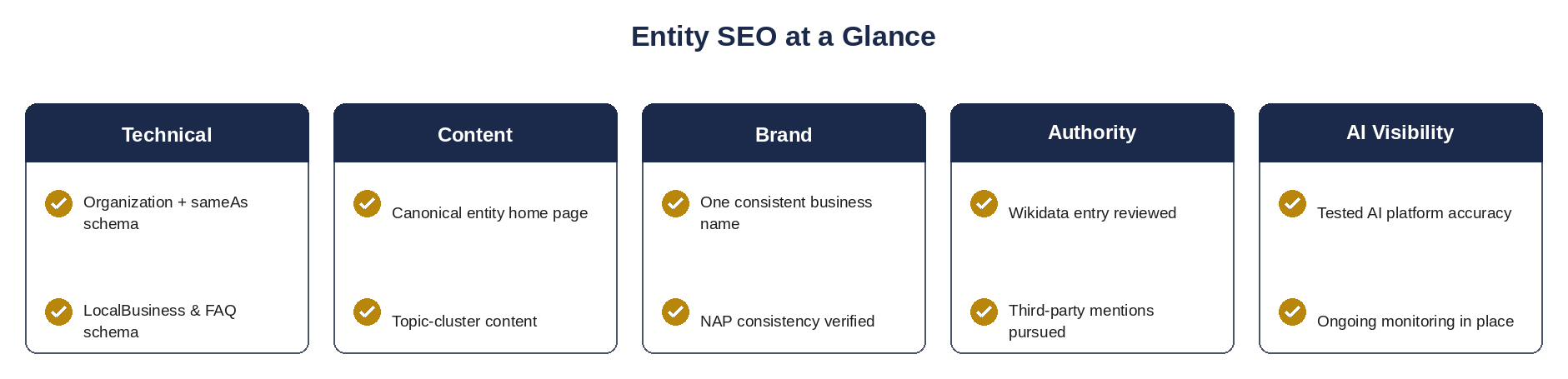
Direct answer: Entity SEO is moving from an optional advantage to a baseline requirement, as AI search agents increasingly act on entity data directly, entity monitoring becomes a continuous operational task rather than a one-time project, and the businesses with the clearest verified identities compound an advantage that's difficult for competitors to quickly replicate.
Businesses that want a head start on these shifts can lean on our AI visibility and AI Optimization services to build this foundation now rather than later.
A few concrete shifts to plan around:
- Entity monitoring becomes routine, not occasional. Tracking whether a Knowledge Panel description still matches reality, whether Wikidata edits have introduced inaccuracies, and whether AI Overviews are citing your business correctly is turning into an ongoing maintenance task for serious brands, not a one-time setup.
- Agentic AI raises the stakes. As AI agents move from answering questions to taking actions — booking, purchasing, recommending — being a correctly-recognized entity becomes a precondition for being acted on, not just mentioned.
- The "entity home" concept will formalize further. Expect more explicit guidance from Google and structured-data communities on exactly which page should anchor a brand's canonical identity, and how to signal that clearly.
- Person-level entities will matter more. With individual Knowledge Panels expanding well beyond public figures, founders and senior team members are increasingly worth establishing as their own connected, credible entities.
- The compounding advantage widens. Entity signals build slowly and require consistency over time — which means the gap between businesses that started early and those that haven't started at all is likely to grow, not shrink.
Entity SEO is the practice of helping search engines and AI systems recognize your business as a distinct, verified entity with clear attributes and relationships, rather than optimizing individual pages for keywords alone.
Because modern search and AI platforms increasingly rank and cite based on verified identity and trust, not just keyword relevance — a business without clear entity signals can be invisible to AI Overviews and AI-generated recommendations even if its content ranks well traditionally.
No. Keywords still determine what a page ranks for. Entity SEO determines whether the organization behind that page is trusted and understood well enough to be cited or recommended.
Primarily through its Knowledge Graph, a database connecting real-world entities and their relationships, built from structured data, corroborated mentions, and consistent identity signals across the web.
By keeping Name, Address, and Phone data identical everywhere, implementing Organization and LocalBusiness schema, and actively managing reviews and local mentions.
Yes. Clear entity signals are a prerequisite for being confidently cited or recommended by ChatGPT, Gemini, Perplexity, and similar platforms, since they all rely on some form of trust evaluation during retrieval.
Schema markup explicitly tells search engines what your entities are, removing the need for algorithms to infer identity from unstructured text — it's the most direct lever available for entity clarity.
A structured database, launched in 2012, containing over a trillion facts about tens of billions of entities and the relationships between them, used to power Knowledge Panels, AI Overviews, and Gemini's responses.
No. There's no submission form. You can only influence recognition through schema markup, consistent brand data, third-party mentions, and — where eligible — a Wikidata entry.
An information box that appears in Google search results summarizing verified facts about an entity, drawn from the Knowledge Graph.
A property that links your Organization schema to your verified profiles elsewhere on the web — LinkedIn, Crunchbase, industry directories — helping algorithms confirm that all of these profiles refer to the same entity.
The single canonical URL, almost always a business's About page, that anchors how algorithms and people understand a brand's identity — the page that should carry the primary Organization schema block.
No. Wikipedia is one of the most powerful entity signals but is gated by notability requirements. Wikidata, by contrast, has no notability threshold and is a realistic starting point for most businesses.
Entity signals compound gradually. Foundational work — schema, entity home, consistent naming — can be implemented in weeks, but third-party corroboration and Knowledge Graph recognition typically build over months.
Entity SEO focuses on establishing your brand's identity and trustworthiness; Generative Engine Optimization (GEO) focuses on structuring content so AI systems retrieve and cite it. They're complementary — GEO gets your content into consideration, entity SEO helps AI systems trust what they find.
Yes, directly. Local entity signals — consistent NAP data, a complete Google Business Profile, and genuine reviews — are foundational to both traditional local search rankings and AI-generated local recommendations.
Inconsistent business naming across platforms, missing or incomplete schema markup, no canonical entity home page, and treating entity work as a one-time project rather than ongoing maintenance.
Ask ChatGPT, Gemini, and Perplexity directly about your business and industry, and compare the answers against what's actually accurate — this simple audit often reveals outdated or incorrect information worth correcting at the source.
Yes. Founders, executives, and named experts can and should be established as their own entities using Person schema and consistent professional bios across platforms.
Reviews function as ongoing trust and reputation signals that reinforce both local search visibility and the broader trust evaluation AI systems apply when deciding whether to recommend a business.
Yes. A brand mention doesn't need a hyperlink to contribute to entity corroboration — the mention itself, especially on an authoritative site, still helps confirm that independent sources recognize the business.
Yes, but its relative importance is shifting. A 75,000-brand study from Ahrefs found branded web mentions correlate with AI citation more than three times as strongly as backlinks do, suggesting entity signals are gaining ground on link-based authority.
Any business that depends on being found, trusted, and recommended benefits — but it's especially high-leverage for professional services, healthcare, local businesses, and agencies competing for cross-border or high-consideration purchases.
Gemini is trained directly on Google's Knowledge Graph data, meaning businesses with strong, accurately connected entity representations carry a structural advantage into Gemini-generated answers, not just traditional Google search results.
Begin with the lowest-cost, highest-impact signals: a clear entity home page, complete Organization schema with sameAs links, and a consistency audit across your existing profiles — see the checklist in Section 11.
- Entity SEO isn't a trick, and it isn't fast. It's closer to reputation-building than rank-chasing — the accumulated, verifiable evidence that tells Google, Gemini, ChatGPT, and Perplexity that your business is a real, distinct, trustworthy thing worth recommending. The businesses treating this as a one-afternoon checklist item are going to be quietly outpaced by the ones treating it as infrastructure: consistent naming, real structured data, genuine third-party corroboration, and an ongoing habit of checking what the algorithms currently believe about them.
- If you're weighing whether to build this in-house or bring in outside expertise, Brand Multimedia is a full-service, AI-powered digital marketing and web development agency headquartered in Addis Ababa, Ethiopia, working with clients across Ethiopia and internationally on exactly this kind of entity and AI-visibility foundation — schema implementation, structured data audits, and the broader search and AI optimization work this guide describes. If you'd like a clear picture of how your business currently appears to Google's Knowledge Graph and to AI platforms like ChatGPT and Gemini, get in touch about your AI visibility before a competitor's entity gets there first.
In the meantime, read our other digital marketing guides for more on building visibility across both traditional and AI-powered search.
Ready to grow your business? Reach out to our team today on WhatsApp and let’s discuss how we can help. Click here to chat with us