Executive Summary
Here is the sentence that gets lost in most schema markup guides: adding structured data to your website will not make Google rank you higher, and it will not make ChatGPT decide to mention your business. Google has said this plainly for years, and nothing about the rise of AI search changes it. What schema markup actually does is quieter and, in 2026, arguably more important. It removes ambiguity. It turns "this page is probably about a local bakery" into "this page is definitely about a local bakery, here is the address, here are the hours, here is who owns it." That clarity is what unlocks rich results in traditional search, and it is increasingly what AI systems lean on when deciding whether a source is trustworthy enough to retrieve, ground an answer in, or cite.
This guide walks through what schema markup actually is, how JSON-LD compares to the older Microdata and RDFa formats, which schema types are worth your time in 2026 and which have quietly lost their SERP value, how to implement and validate structured data correctly, and the mistakes that make an otherwise solid implementation invisible to the systems it was built for. One update worth knowing before you read further: as of May 7, 2026, Google fully retired FAQ rich results from Search, the last step in a withdrawal that began back in 2023. That single change reshapes how several popular "best practice" guides written before this year should actually be read, and this guide accounts for it directly.
Somewhere in the code of a well built website sits a small block of text that no visitor will ever see. It has no font, no color, no layout. It exists purely to answer one question on the visitor's behalf, before they even ask it: what am I actually looking at? That block is schema markup, and whether or not you have deliberately added it, it is quietly deciding how confidently Google, Bing, ChatGPT, Gemini, and Perplexity understand your website.
For most of the web's history, search engines had to infer meaning from unstructured text. A page mentioning "opening hours," "menu," and a street address was probably a restaurant, probably, based on pattern matching across billions of similar pages. Schema markup replaces that inference with a direct statement. Instead of probably, it says definitely. This guide explains exactly how that works, why it matters more in an AI search era than it ever did in a keyword search era, and what to actually implement, in what order, without wasting effort on schema types that stopped paying off years ago.
Direct answer: Schema markup, also called structured data, is code added to a webpage that labels its content using a shared vocabulary from Schema.org, so search engines and AI systems can understand exactly what the page represents rather than guessing from unstructured text.
Definition box: Structured data is the broad concept: information organized in a predictable, machine readable format. Schema.org is the vocabulary, the agreed dictionary of terms that Google, Microsoft, Yahoo, and Yandex jointly maintain. Schema markup is the actual implementation, the specific block of code on your page that applies that vocabulary to your content.
A simple way to think about it: your visible page content is written for humans, and your schema markup is a parallel, private note written for machines, sitting in the code where a visitor will never see it, describing the same content in unambiguous terms. Done correctly, it never changes how your page looks. It changes how confidently a system understands what your page means. This is exactly the kind of technical groundwork our SEO services are built to handle alongside the rest of a site's optimization.
Key takeaway: Schema markup does not directly improve rankings. Google has confirmed this repeatedly. What it does is remove the guesswork that stands between your content and the systems trying to understand, categorize, and recommend it.
Direct answer: Structured data on the web traces back to the early 2000s microformats movement, formalized in 2011 when Google, Microsoft, and Yahoo jointly launched Schema.org, and matured through the 2015 introduction of JSON-LD support and the steady rise of rich results as the primary payoff for implementation.
The timeline in brief:
- Early 2000s: Microformats offered the first informal attempts at embedding structured meaning directly in HTML.
- 2011: Google, Microsoft, and Yahoo launched Schema.org, creating a single shared vocabulary instead of competing, incompatible standards.
- 2012: Google's Knowledge Graph launched, giving structured data a clear destination, feeding entity understanding directly from the web into Google's own database of facts.
- 2015: Google began recommending JSON-LD as its preferred structured data format, a shift that took several years to become the industry default.
- 2019 to 2023: Rich results expanded rapidly. FAQ, HowTo, Recipe, Review, and Event markup all became common SEO tactics, sometimes used well, sometimes used purely to game SERP real estate.
- 2023: Google restricted FAQ rich results to authoritative government and health sites only, and deprecated HowTo rich results on mobile, citing the need for a cleaner, more consistent search results page.
- 2025 to 2026: Google and Microsoft publicly confirmed their generative AI search features use schema markup, and ChatGPT confirmed it uses structured data to help decide which products and sources appear in its answers. On May 7, 2026, Google fully retired FAQ rich results from Search for every site, closing the loop that started in 2023.
That last decade is worth sitting with. Structured data started as an SEO visibility tactic and has quietly become an AI comprehension layer. The two goals overlap less than most guides assume, which is exactly why the schema types worth prioritizing in 2026 are not the same ones that were worth prioritizing in 2019.
Direct answer: Search engines crawl a page's HTML, extract any schema markup present, validate it against the Schema.org vocabulary, and use the resulting structured facts to inform indexing, entity recognition, and eligibility for enhanced search features, entirely separate from how they process the page's visible text. Google's own guide to how structured data markup works is the most reliable technical reference for exactly how this process runs.
When a crawler visits a page, it reads two layers at once. The first is the visible content, the words, images, and layout a person would see. The second is the structured data layer, the JSON-LD block quietly declaring facts: this is an Article, its author is this Person, it was published on this date, it belongs to this Organization. Search engines cross reference the two. If they largely agree, confidence goes up. If the schema claims something the visible page does not support, such as a five star rating that never appears anywhere a reader can see it, that mismatch is treated as a red flag, not a bonus.
This is also the layer that feeds entity recognition. A page that correctly identifies its author as a Person entity, connected via schema to an Organization entity, is handing the search engine a pre-built relationship map instead of asking it to infer one from prose. That relationship map is precisely what powers Knowledge Panels, and increasingly, what AI systems lean on when deciding how much to trust a retrieved source.
Direct answer: Schema.org is the shared vocabulary of structured data types and properties, jointly created and maintained by Google, Microsoft, Yahoo, and Yandex since 2011, that gives every website the same set of standardized terms to describe things like organizations, articles, products, people, and events.
Before Schema.org existed, structured data was fragmented. Different search engines supported different, incompatible formats, which meant implementing structured data for one engine could actively hurt visibility on another. Schema.org solved that by creating one vocabulary that every major search engine agreed to support. Today it defines well over 800 types, ranging from broad categories like Thing and CreativeWork down to specific, practical types like LocalBusiness, Recipe, and JobPosting.
For a business, the practical takeaway is simple: you are not inventing your own labels. You are selecting the correct, pre-agreed term from a shared dictionary, which is exactly what makes the markup universally readable by every system checking for it, from Googlebot to the retrieval crawlers behind ChatGPT and Perplexity. Choosing and structuring the right types for your content is part of what our AEO services handle alongside answer focused content work.
Direct answer: JSON-LD, Microdata, and RDFa are three different code formats for implementing the same Schema.org vocabulary. JSON-LD is a separate script block that does not touch your visible HTML, while Microdata and RDFa embed structured data directly inside HTML tags. Google explicitly recommends JSON-LD, and it has become the de facto industry standard.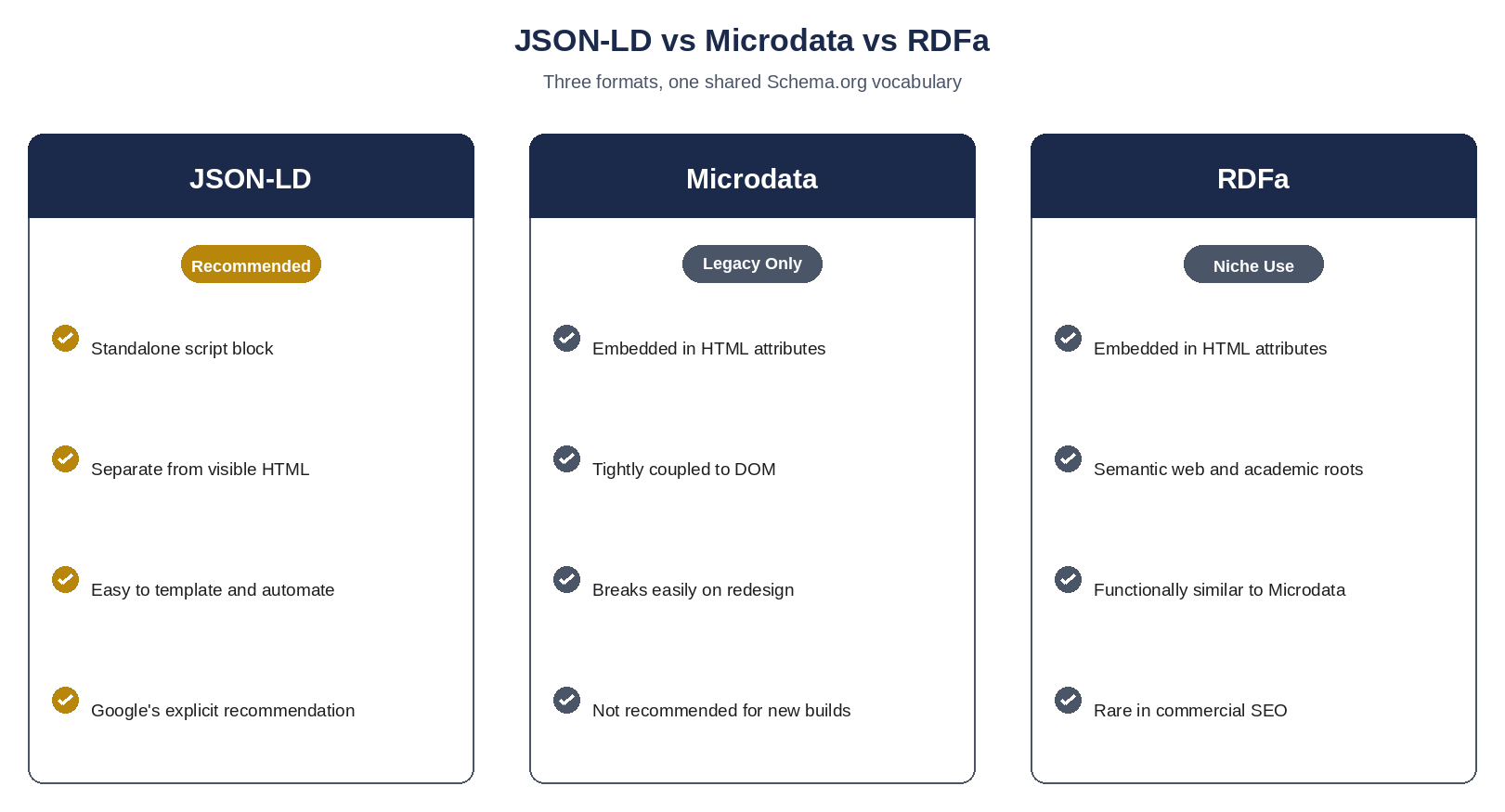
All three formats are functionally readable by search engines. The difference is entirely about implementation and maintenance. Microdata and RDFa tie your structured data directly to your DOM structure, meaning a template change can silently break your markup. JSON-LD lives in one clean block, which is far easier to generate dynamically from a database, template, or content management system, and far easier to update without touching the rest of your page.
Direct answer: JSON-LD is commonly recommended because Google explicitly prefers it, it separates structured data from visible HTML for easier maintenance, it is simpler to generate programmatically from a CMS or database, and it is the format most consistently supported across search engines and AI retrieval systems.
Four practical reasons this matters for a real website:
- Separation of concerns. Your developer or designer can redesign the entire visible page without touching the JSON-LD block, and vice versa.
- Easier automation. Because JSON-LD is just a structured script, it can be generated dynamically from whatever data already powers your site, your CMS fields, your product database, your CRM, rather than hand coded into every page.
- Fewer silent breaks. Microdata's dependence on specific HTML tags means a template redesign can quietly strip out structured data without anyone noticing. JSON-LD, sitting in its own block, is far less exposed to that risk.
- Broad compatibility. JSON-LD is what most modern validation tools, crawlers, and AI retrieval systems expect and parse most reliably.
Direct answer: Schema markup makes a page eligible for rich results, the enhanced search listings that show star ratings, prices, event dates, or breadcrumb trails directly in search results, though eligibility depends on the specific schema type, complete implementation, and current Google support, which has narrowed considerably by 2026.
This is the section where an accurate, current answer actually diverges from most existing guides, so it is worth being precise. Rich results are not automatic, and they are not permanent. Google has spent the last three years actively narrowing which schema types earn a visible SERP enhancement.
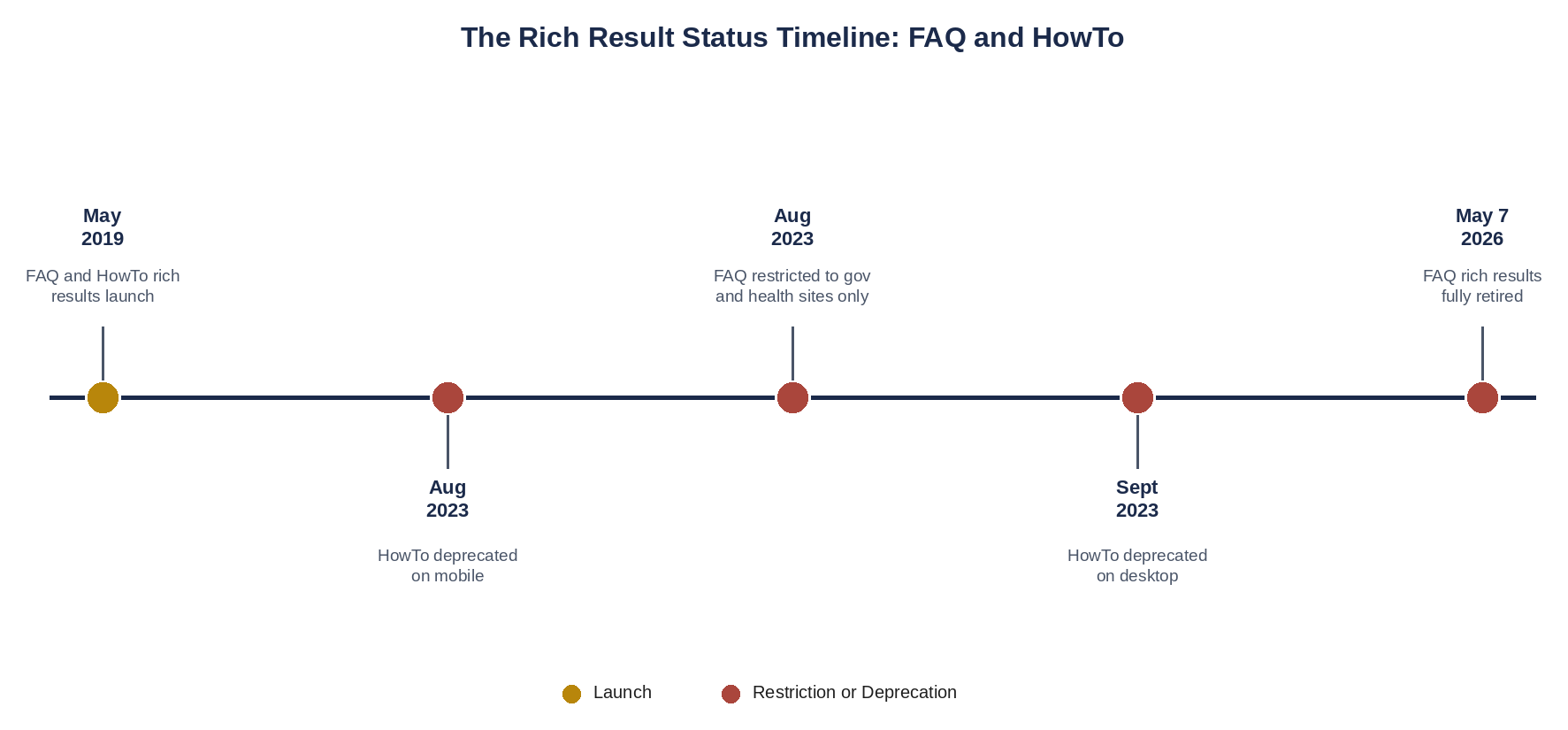
The FAQPage timeline deserves its own explanation because so much existing SEO advice online has not caught up. Google's own announcement on changes to HowTo and FAQ rich results, published in August 2023, confirmed that FAQ rich results would only appear for well known, authoritative government and health websites, effectively removing the feature for the vast majority of commercial sites at that point already. On May 7, 2026, Google went further and added a deprecation notice to its FAQ structured data documentation confirming FAQ rich results no longer appear in Google Search at all, for any site, including the government and health sites that had remained eligible. Google is removing the related Search Console reporting features in stages through August 2026.
None of this means FAQPage schema is broken or harmful to keep on your pages. Google has stated clearly that unused structured data does not cause problems for Search. What it means is that adding FAQPage schema purely to chase the old SERP dropdown is no longer a reason that holds up. If you still add it, the reason should be AI comprehension, covered in the next section, not the visual rich result.
Direct answer: Structured data helps AI systems ground their answers in verified facts rather than inferred text, which is why Google and Microsoft have confirmed their generative AI search features use schema markup, and why ChatGPT has confirmed it uses structured data to help decide which sources and products it surfaces.
This is the shift that makes schema markup worth more attention in 2026 than at almost any earlier point, even as several individual schema types lose their traditional SERP payoff. When an AI system retrieves a handful of sources to synthesize an answer, it faces the same problem a human researcher does: which of these sources can I actually trust, and what do they precisely say? Structured data answers that second question directly. A well marked up Organization entity, a correctly dated and attributed Article, a LocalBusiness with verified NAP data, all of these give an AI system verified facts to ground a response in, rather than facts it has to infer or risk hallucinating from unstructured prose. For a deeper look at how sameAs links and consistent entity data build that trust, see our Entity SEO guide.
This does not mean schema markup guarantees an AI citation, any more than it guarantees a Google ranking. What it does is remove one layer of uncertainty from a retrieval process that is already making dozens of trust judgments per query. A source that clearly, correctly identifies itself is simply easier to trust than one that does not. The retrieval mechanics behind that trust judgment are covered in more depth in our Generative Engine Optimization guide.
Expert tip: If you take one idea from this entire guide, take this one. Stop asking "will this schema type get me a rich result." Start asking "does this schema type make my identity, my content, and my facts unambiguous to a machine reading my page." The second question is the one that still pays off in 2026, regardless of what Google's SERP does with any individual feature.
Direct answer: The schema types that consistently earn implementation effort in 2026 are Organization, LocalBusiness, Article or BlogPosting, BreadcrumbList, Person, ImageObject, Service, Product where applicable, and VideoObject, with FAQPage and Speakable worth adding selectively for AI comprehension rather than SERP visibility, and HowTo generally not worth new implementation at all.
Organization Schema
Establishes your business as a defined entity, name, logo, description, and critically, sameAs links to your verified profiles elsewhere on the web. This is foundational. Nearly every other schema type on your site should connect back to it.
LocalBusiness Schema
An extension of Organization built for businesses with a physical presence or defined service area. Carries address, hours, phone number, and geographic data, and remains one of the more consistently reliable schema types for local pack and Knowledge Panel signals.
Article and BlogPosting Schema
Confirms authorship, publish and update dates, and headline structure for content pages. Directly supports both traditional Article rich results and the entity trust signals AI systems look for when evaluating a source's credibility.
BreadcrumbList Schema
A low effort, high reliability schema type that clarifies your site hierarchy and continues to produce a visible breadcrumb trail in Google results.
Person Schema
Establishes named individuals, founders, authors, senior team members, as their own connected, credible entities. Increasingly valuable as Knowledge Panels for individuals have expanded well beyond public figures.
ImageObject Schema
Provides structured metadata about images, including licensing, dimensions, and captions. Supports image rich results and gives AI systems clearer signals about visual content.
Service Schema
Defines what a business offers, useful for agencies and service based companies that want to describe specific offerings, such as SEO services or web development, as distinct, structured entities rather than paragraphs of unstructured marketing copy.
FAQPage Schema, with an honest caveat
Still a valid Schema.org type. No longer produces a Google rich result as of May 7, 2026. Worth adding selectively, on pages with genuine, substantive FAQ content, for the AI comprehension benefit rather than any expectation of a visual SERP feature. Never add it to marketing pages simply to expand SERP real estate. That practice is exactly what triggered the original 2023 restriction.
Speakable Schema
Marks specific sections of text as suited for voice assistant readback. Historically limited primarily to news publishers and voice contexts in specific regions. Worth understanding, worth testing if your content is a strong fit, but not a universal priority for most businesses.
Product Schema, when applicable
Essential for ecommerce. Supports pricing, availability, and review rich results, and remains one of the more durable, actively supported schema types heading into 2027.
VideoObject Schema
Structured metadata for video content, including thumbnail, upload date, and duration. Supports video rich results and helps AI systems understand and potentially surface video content correctly.
HowTo Schema, the type to generally skip
Deprecated from mobile rich results in August 2023 and from desktop shortly after. As of 2026, there is no HowTo rich result on any surface. Existing implementations are harmless to leave in place, but new implementations built purely for the old step by step rich result are not a good use of development time.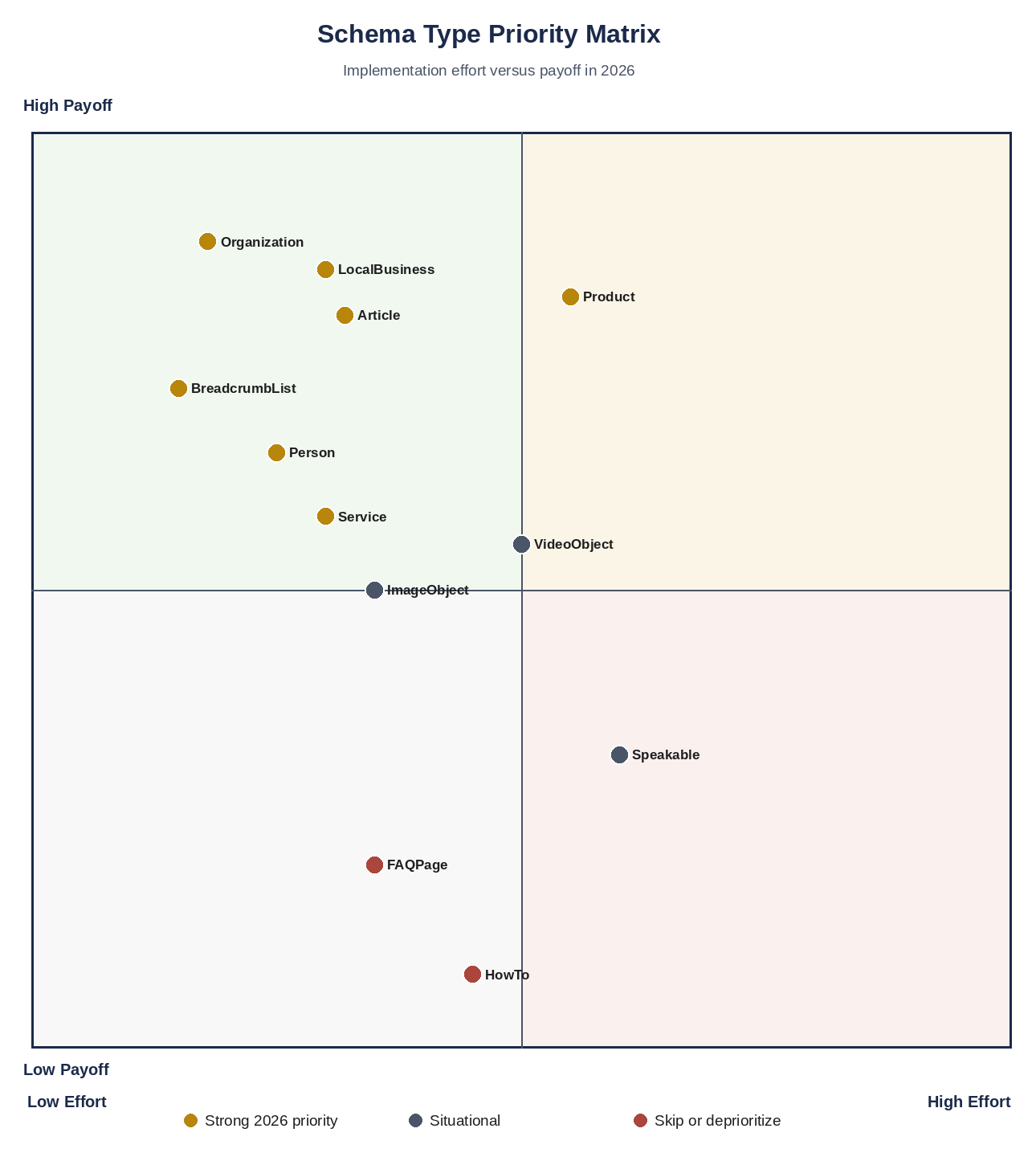
- Marking up content that is not visible on the page. Google explicitly treats this as spam and can issue a manual action. If the schema claims a rating, the rating needs to be visible to a human reader too.
- Incomplete implementation. A Product schema missing a required AggregateRating property will not generate star ratings. Partial implementation of a schema type frequently produces zero benefit at all, not a partial one.
- Nesting errors. A Review should nest inside a Product, not sit beside it as a standalone type. An Offer nests inside a Product. Getting these relationships wrong can mean individual types still validate while the connections between them silently fail.
- Schema drift. Visible content changes but the JSON-LD does not. A price updates in the CMS while a hardcoded JSON-LD block still shows last month's figure. This mismatch is a growing 2026 problem as more content gets updated dynamically or through AI assisted editing.
- Still chasing FAQPage rich results. As covered above, this specific SERP feature is gone as of May 2026. Implementing FAQPage schema for that reason alone is now a wasted effort, though the schema itself remains useful for other reasons.
- Using Microdata or RDFa for new builds. Not wrong, exactly, just unnecessarily fragile and harder to maintain than JSON-LD with no real upside.
- Duplicate or conflicting schema across pages. Multiple Organization blocks with slightly different details on different pages confuse rather than clarify entity signals.
- No validation before publishing. A single typo in a JSON-LD block can silently disable the entire structured data block without breaking the visible page at all.
- Never revisiting schema after launch. Structured data is treated as a one time project rather than something that needs the same ongoing maintenance as the content it describes.
- Copying schema templates without adjusting them. Generic boilerplate JSON-LD lifted from a tutorial, still containing placeholder text or unrelated business details, is more common than most site owners realize.
- Ignoring the sameAs property. Skipping this on Organization and Person schema means missing one of the more direct, low effort ways to help disambiguate your entity across the web.
- Treating schema as an AI citation guarantee. It is a trust and comprehension signal, not a switch that forces inclusion in an AI generated answer.
The following is a hypothetical, illustrative scenario built to show how the concepts in this guide apply in practice. It is not a real client engagement, and the figures are representative estimates for teaching purposes, not documented results.
Scenario: A regional professional services firm has a well designed, content rich website with zero structured data anywhere on it. A technical audit finds three specific problems: no Organization schema anywhere, meaning the business has no consistent, machine readable identity across its own site; an old FAQPage implementation still live on service pages, added years ago specifically to chase the now retired SERP dropdown; and an Article template that omits the author field entirely, despite every post being written by a named team member.
Applied fixes:
- Implemented Organization schema sitewide, including sameAs links to the firm's verified LinkedIn and industry directory profiles.
- Left the existing FAQPage markup in place, since removal offered no benefit and a small engineering risk, but stopped treating it as an SEO priority and stopped adding it to new pages built purely for that reason.
- Added Person schema for each team member alongside corrected Article authorship fields.
- Added BreadcrumbList schema across the site's service and resource pages.
- Ran every template through the Rich Results Test and Schema Markup Validator before deployment, and corrected two nesting errors the validator flagged in the Service schema.
Illustrative outcome pattern: consistent with the broader shift described throughout this guide, a firm making these changes should expect the visible SERP impact to come primarily from the Organization, Article, and BreadcrumbList work, not from the retained FAQ markup. The harder to measure benefit, improved entity clarity feeding AI retrieval and Knowledge Panel eligibility, typically compounds over a longer window and is worth tracking through the monitoring approach covered in the checklist below, rather than expected to show up immediately.
Direct answer: Two primary tools cover structured data validation in 2026. Google's Rich Results Test checks whether your markup qualifies for a specific Google rich result. The Schema Markup Validator, hosted at Schema.org, checks general Schema.org spec compliance across all types, independent of Google's own feature support.
A practical three step workflow: validate the raw JSON-LD code before it goes live, test the actual staged or live URL through the Rich Results Test to confirm the rich result renders as expected, then monitor Search Console's Enhancements reports on a recurring basis to catch errors that appear after launch, since a CMS update or template change can silently break markup that validated correctly on day one.
Direct answer: Structured data needs the same ongoing maintenance as the visible content it describes, since prices, hours, authorship, and other schema fields drift out of sync with reality as a site evolves, and stale schema actively misleads the systems it was built to help.
- Generate schema from live data where possible, pulling values from the same CMS fields, product database, or CRM that power your visible content, rather than hardcoding values that will inevitably go stale.
- Recheck validation after any template or CMS change. A redesign that alters your HTML structure can silently strip Microdata, and even a JSON-LD block can be accidentally dropped during a migration.
- Monitor Search Console's Enhancements reports on a recurring schedule, not just at launch, to catch schema drift and new errors as they appear.
- Review sameAs links periodically to confirm the external profiles they point to are still active and still accurately represent the business.
- Treat schema removal decisions carefully. Google has confirmed unused structured data does not cause problems for Search, so removing a deprecated type like FAQPage is optional, not urgent, and only worth doing if it meaningfully simplifies your codebase.
Direct answer: Structured data is shifting from a rich result visibility tactic toward an AI comprehension and entity trust layer, with Google continuing to prune underused or frequently abused schema features from the visible SERP while structured data's role in grounding AI generated answers continues to grow.
A few trends worth planning around:
- More SERP features will likely be pruned, not fewer. The FAQPage and HowTo pattern, restriction followed eventually by full deprecation, is Google's demonstrated approach to features that get widely gamed.
- AI grounding becomes the primary payoff. As more search volume shifts to AI generated answers, the comprehension value of clear, accurate structured data is likely to outlast any individual SERP feature's lifespan.
- Schema drift detection tools will mature. Several validation tools already flag mismatches between visible content and JSON-LD automatically, and this category is likely to become standard tooling rather than a specialty product.
- Entity level schema, not page level schema, becomes the priority. Organization, Person, and sameAs based entity signals are proving more durable than feature specific types like FAQPage, because they serve identity and trust rather than a single visual SERP treatment.
Businesses that want a head start on these shifts can lean on our AI Search Optimization services to build this foundation now rather than after the next round of SERP changes.
Schema markup is code, most commonly written in JSON-LD, added to a webpage to explicitly tell search engines and AI systems what the page represents, using the standardized vocabulary from Schema.org.
No, not directly. Google has been consistent on this point. Schema markup unlocks rich results, entity recognition, and AI comprehension benefits, but it is not itself a ranking factor.
JSON-LD, short for JavaScript Object Notation for Linked Data, is a structured data format that lives in a standalone script block, separate from a page's visible HTML, and is the format Google explicitly recommends.
For nearly all modern implementations, yes. JSON-LD is easier to maintain, easier to generate dynamically, and less likely to break silently during a template change.
Schema.org is the shared structured data vocabulary jointly maintained by Google, Microsoft, Yahoo, and Yandex since 2011, giving every website a common set of terms to describe its content.
Only selectively. Google fully retired FAQ rich results from Search on May 7, 2026, so the schema no longer produces a visible dropdown in results. The schema type remains valid and can still support AI comprehension on pages with genuine FAQ content, but it should not be added purely to chase a rich result that no longer exists.
HowTo rich results were deprecated on mobile in August 2023 and shortly after on desktop. As of 2026, there is no HowTo rich result on any surface, though the schema type itself remains valid.
Product, Review and AggregateRating, Article, Recipe, Video, Event, Organization, LocalBusiness, and BreadcrumbList all continue to produce rich results as of 2026.
No. Google has confirmed unused structured data does not cause problems for Search. Removal is optional and only worth doing if it simplifies your codebase.
Structured data gives AI systems verified, unambiguous facts to ground their answers in, rather than facts inferred from unstructured prose, which supports trust and retrieval confidence even though it does not guarantee a citation.
Yes. Reporting in 2025 confirmed ChatGPT uses structured data to help determine which products and sources appear in its results, alongside Google and Microsoft's confirmed use of schema in their own generative AI search features.
Structured data is the underlying code. Rich snippets, or rich results, are the enhanced search listings, such as star ratings or FAQ dropdowns, that Google may generate from that structured data when eligible.
Organization schema establishes your business as a defined entity, including name, logo, description, and sameAs links to verified external profiles, and is foundational for entity recognition.
LocalBusiness schema extends Organization schema for businesses with a physical location or defined service area, carrying address, hours, and contact information that supports local search and Knowledge Panel eligibility.
A property that links your Organization or Person schema to your verified profiles elsewhere on the web, such as LinkedIn, helping search engines and AI systems confirm that multiple profiles refer to the same entity.
Use Google's Rich Results Test to confirm eligibility for a specific Google rich result, and the Schema Markup Validator at Schema.org to confirm general spec compliance across all schema types.
Schema drift happens when a page's visible content changes but its structured data does not, such as a price updating in the CMS while a hardcoded JSON-LD block still shows the old figure.
Marking up content that is not visible to users, sometimes called spammy structured data, can result in a manual action from Google. Correctly implemented schema that matches visible content carries no such risk.
A schema type that clarifies your site's hierarchy and can produce a visible breadcrumb trail in Google search results, remaining one of the more reliable, low effort schema types to implement.
Yes. Organization, LocalBusiness, and BreadcrumbList schema are low effort, high reliability implementations that meaningfully support local search visibility and entity recognition regardless of business size.
A schema type that marks specific text sections as suited for voice assistant readback, historically most relevant to news publishers and specific voice search contexts.
Yes. Product schema remains one of the more actively supported and durable schema types, essential for ecommerce pricing, availability, and review rich results.
Person schema establishes named individuals, such as founders or authors, as their own connected, credible entities, increasingly valuable as individual Knowledge Panels have expanded.
Schema should be reviewed any time the underlying content changes, and revisited entirely after any major template, CMS, or redesign change, since these changes are the most common cause of silent schema breakage.
JSON-LD is typically placed in the page head or body as a standalone script tag. It does not need to sit near the visible content it describes, since it is not rendered.
Not in terms of the underlying code. Both rely on the same Schema.org vocabulary. The difference is in what each system does with it: Google primarily evaluates rich result eligibility, while AI platforms primarily evaluate trust and grounding for generated answers.
Schema markup will not rank your website higher, and it will not force an AI system to mention your business. What it does is remove the guesswork between your content and the systems trying to understand it, and in 2026, that comprehension layer matters more than the individual rich results that first made structured data popular. The businesses getting real value from schema markup right now are the ones treating it as an entity clarity project, correct, complete, consistently maintained, rather than a checklist item aimed at a single SERP feature that may not even exist by next year.
If you are weighing whether to build this properly in house or bring in outside expertise, Brand Multimedia is a full service, AI powered digital marketing and web development agency headquartered in Addis Ababa, Ethiopia, working with clients across Ethiopia and internationally on exactly this kind of technical foundation, structured data implementation, entity clarity, and the broader SEO, GEO, AEO, and AI optimization work covered throughout this guide and its companion articles. If your structured data has never been properly audited, or if you are not sure whether your existing schema is helping, hurting, or simply doing nothing, talk to us about a structured data audit, a straightforward, low risk conversation to start.
In the meantime, read our other digital marketing guides for more on building visibility across both traditional and AI powered search.
Ready to grow your
business? Reach out to our team today on
WhatsApp and let’s discuss how we can help.
Click here to chat with us