Executive Summary
A page can contain the exact words someone typed into a search box and still fail them completely. Someone searching "apple nutrition facts" is not looking for a page about Apple's quarterly earnings, and a page that only repeats the word "apple" fifteen times without ever clarifying which apple it means will satisfy neither Google nor the person reading it. This is the gap semantic SEO exists to close. It is not a replacement for keyword research, and it is not a secret Google ranking algorithm. It is a way of organizing content around what searchers actually mean, what topics and entities that meaning connects to, and how those pieces relate to each other across a website.
This guide explains what semantic SEO is in plain terms, how it differs from and connects to Entity SEO, Generative Engine Optimization, Answer Engine Optimization, and AI Optimization, and what Google's own documentation actually says about how Search interprets meaning, as opposed to what industry blogs assume it says. It covers search intent, topical authority, content clusters, internal linking, structured data, and a practical, step by step implementation framework, including guidance specific to local businesses, international businesses, ecommerce, and B2B and SaaS companies. Throughout, claims are labeled as fact, expert interpretation, practical recommendation, or industry hypothesis, because that distinction genuinely matters and most guides on this topic blur it.
A business can publish a page that contains the exact keyword a customer searches for, in the title, the headings, and the body copy, and still watch that page fail to rank, fail to satisfy the visitors it does get, and fail to appear anywhere in an AI generated answer. This happens constantly, and it is not a technical glitch. It is a mismatch between what the page says and what the searcher actually needs.
Consider someone searching "apple." Are they researching the fruit's nutritional content, comparing phone models, or checking a stock ticker. A keyword matching system has no way to know. A system that understands context, the surrounding words, the searcher's recent activity, the structure of the page itself, has a much better chance of getting it right. That shift, from matching words to understanding meaning, is what semantic SEO describes.
The practical path looks like this: keywords lead to context, context leads to search intent, intent connects to topics, topics connect to entities, entities connect to relationships between ideas, and all of that ultimately shapes the user experience a page delivers, which is increasingly also what AI assisted search systems are trying to evaluate when they decide what to retrieve, synthesize, and cite. None of these layers replace the one before it. Each one adds a dimension that pure keyword matching never had.
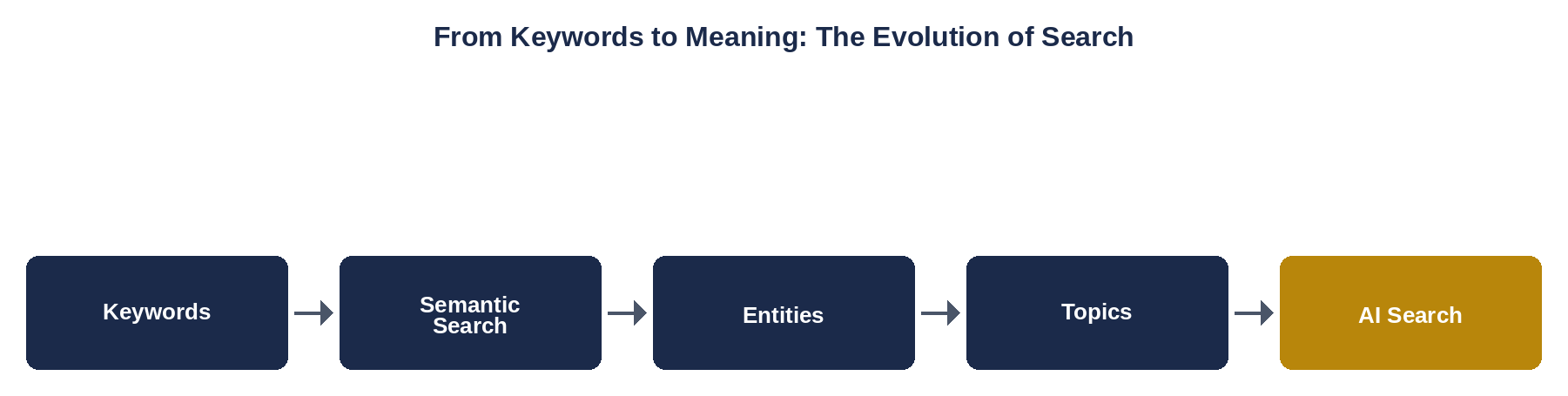
Direct answer: Semantic SEO is the practice of structuring content around meaning, topics, entities, and the relationships between them, so that search engines and AI systems can accurately interpret what a page is about and whether it satisfies a searcher's actual need, rather than relying on the literal presence of specific keywords.
Quick Answer: Semantic SEO means writing and structuring content the way a knowledgeable person would explain a topic, covering the concepts, related ideas, and questions a reader would actually have, instead of repeating one target phrase as many times as possible.
A simple example: a page titled "Why Is My TV Making a Buzzing Sound" that never uses the word "fix" can still satisfy a search for "TV buzzing fix," because the underlying meaning, a malfunction and a desire to resolve it, is the same. Google's own research into neural matching, the technique behind this kind of understanding, has described exactly this kind of conceptual connection between queries and content that share no literal words in common.
The technical explanation: modern search systems use natural language processing, developed and refined over successive systems like RankBrain and BERT, to interpret both the query and the content on a page in terms of concepts and relationships rather than isolated tokens. Google's own guidance in its Search Essentials documentation centers this idea directly, describing the core practice for ranking well as creating helpful, reliable, people first content, not content engineered around keyword frequency.
The business explanation: a website that clearly organizes its content around real topics, with clearly defined entities such as the business itself, its services, its people, and its location, and content that answers the actual questions its audience has, is easier for both algorithms and human readers to trust. That trust compounds. It shows up in traditional rankings, and it is increasingly relevant to whether AI systems consider a source worth retrieving in the first place.
Direct answer: Traditional keyword SEO optimizes for the presence and placement of specific search terms. Semantic SEO optimizes for topical completeness, contextual relevance, and the relationships between ideas, while still using keywords as an important, but no longer sufficient, signal.
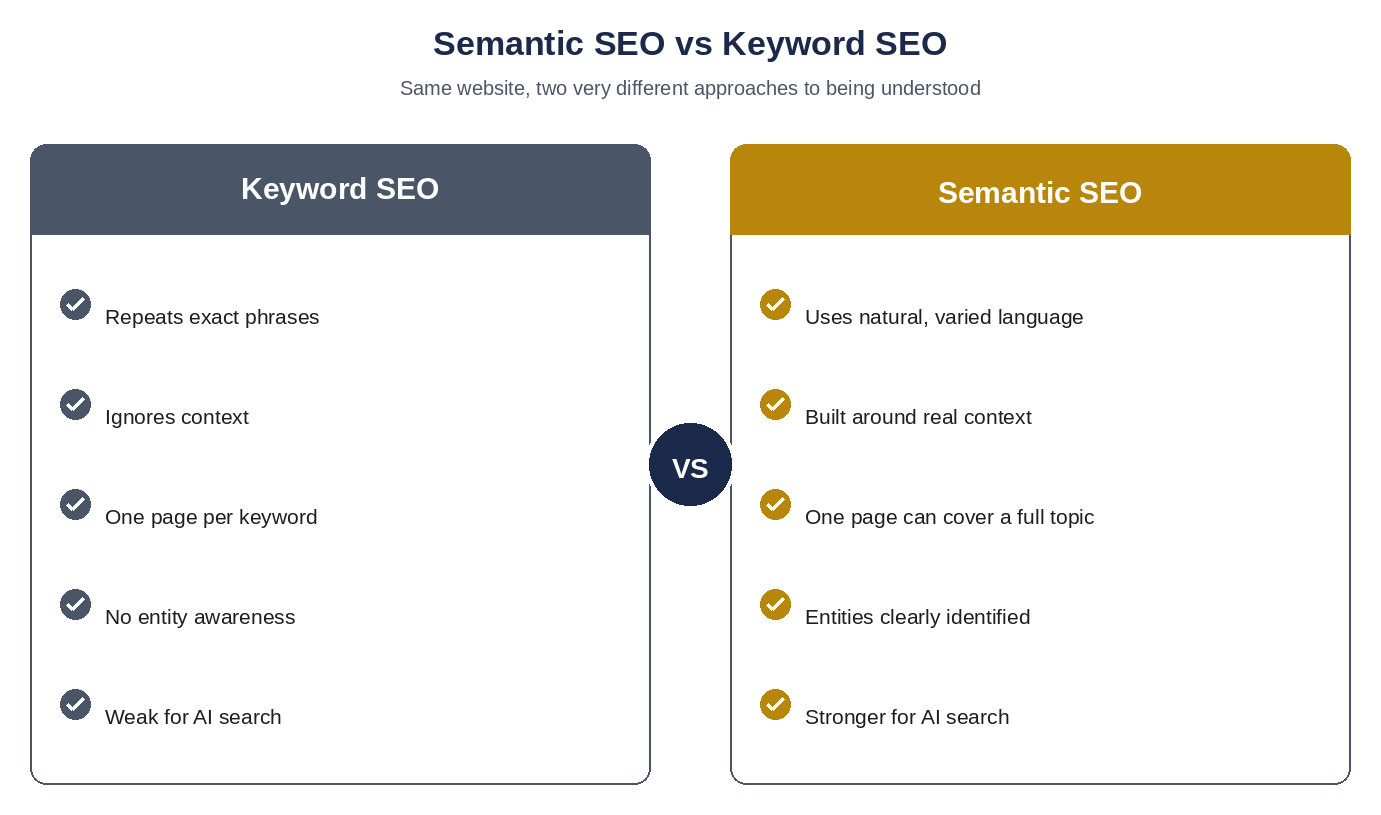
To be direct about a point many guides get wrong: semantic SEO does not mean abandoning keywords or keyword research. Keywords remain how real people phrase their questions, and they remain a legitimate, useful signal for understanding demand and structuring content. Semantic SEO changes what you do with that keyword once you have it. Instead of asking how many times to repeat it, you ask what the searcher actually needs, and what full topic that need belongs to.
Direct answer: Google interprets meaning through a combination of natural language processing systems, including RankBrain and BERT, that analyze the relationships between words in both queries and content, alongside entity recognition drawn from its Knowledge Graph. The precise internal mechanics of how these systems weigh and combine signals are not publicly disclosed, and any claim describing them in exact detail should be treated as inference, not documented fact.
What is publicly documented, as fact: Google introduced RankBrain in 2015 to help interpret new or ambiguous search queries. In 2019, Google announced the application of BERT, Bidirectional Encoder Representations from Transformers, to Search. According to Google's own announcement, BERT represented one of the biggest leaps forward in the history of Search for understanding the full context of a word by considering the words that come before and after it, which is particularly useful for longer, more conversational queries where small words like prepositions carry real meaning.
What is reasonable expert interpretation: industry analysis, including Google Cloud's own explanation of the underlying concept, describes semantic search as technology that considers the relationships between words, entities, and the intent behind a query rather than only literal keyword matches. This aligns with, but is a broader industry framing of, the specific systems Google has confirmed using.
What remains industry hypothesis: exactly how heavily any single factor, such as entity recognition versus phrase matching versus user behavior signals, is weighted in a specific ranking outcome is not something Google publishes, and any SEO resource claiming to know the precise formula is speculating, however confidently.
Key takeaway: Google has confirmed it uses NLP systems like BERT to understand context and RankBrain to interpret ambiguous queries. It has not confirmed a specific, named "semantic SEO score," and no legitimate primary source claims one exists.
Direct answer: Search intent is the underlying goal behind a search query, typically categorized as informational, navigational, commercial investigation, or transactional, and understanding it correctly is a prerequisite for creating content that actually satisfies the person searching.
- Informational intent: the searcher wants to learn something. Example: "what is semantic SEO."
- Navigational intent: the searcher wants to reach a specific website or page. Example: "Brand Multimedia PLC."
- Commercial investigation intent: the searcher is comparing options before a decision. Example: "best SEO agency Addis Ababa."
- Transactional intent: the searcher is ready to take an action. Example: "hire SEO consultant Ethiopia."
Beyond these four classic categories, real searches are often more nuanced than a single label suggests. A search for "SEO agency reviews" sits between commercial investigation and informational intent. A search for "how much does SEO cost" is informational in form but frequently transactional in underlying motivation. Content built for a single, oversimplified intent category will underperform against content that acknowledges this overlap and addresses it directly.
Direct answer: The same keyword can represent entirely different search intents depending on context, which is why optimizing purely for a keyword, without researching what searchers actually mean by it, routinely produces content that ranks for the wrong reasons or fails to convert the traffic it attracts.
Five examples:
- "SEO" alone could mean someone wants a definition, wants to learn how to do it themselves, or wants to hire an agency. The keyword is identical. The intent is not.
- "Best CRM" could mean best for enterprise, best for a five person startup, or best free option. Content built for one audience will disappoint the other two.
- "Apple" could mean the fruit, the technology company, or, in some markets, a person's name. Context resolves the ambiguity, the keyword alone cannot.
- "Semantic SEO" could be searched by a complete beginner wanting a definition or an experienced marketer wanting an advanced implementation framework. The same article rarely serves both well.
- "Digital marketing agency" could reflect someone browsing casually, someone actively comparing three specific agencies, or someone ready to sign a contract this week. Treating all three the same wastes the opportunity each one represents.
Direct answer: An entity is any uniquely identifiable thing, a person, organization, place, product, service, concept, or event, that can be recognized and distinguished from every other entity, and that search engines can connect to other entities through defined relationships.
Entities are the building blocks semantic search systems use to move beyond text matching. A business is an entity. Its founder is an entity. Its city is an entity. Its services are entities. Each of these connects to the others through relationships: a founder is connected to their organization, an organization is connected to its location, a service is connected to the organization that offers it. This guide covers the mechanics of building and strengthening these relationships in far more depth in our Entity SEO guide, which is worth reading alongside this one, since the two concepts overlap heavily but are not identical, covered next.
Direct answer: Semantic SEO is the broader discipline of optimizing for meaning, context, and topical relevance. Entity SEO is a more specific practice focused on helping search engines recognize, verify, and trust a particular entity, such as a business or a person, as a distinct, well defined thing. The two are complementary, not interchangeable.
Direct answer: Topical authority is an industry term, not an official Google ranking factor, describing the degree to which a website comprehensively and credibly covers a given subject area, typically built through interconnected content rather than isolated articles.
It is worth being precise here, since this term gets used loosely. Google has not published a specific "topical authority score" or confirmed a named ranking signal by this name. What Google has consistently emphasized, through its Search Essentials and helpful content guidance, is rewarding content that demonstrates real expertise and comprehensively serves a topic. The industry term "topical authority" is a reasonable, widely used shorthand for that broader, less precisely defined idea, and it is a useful practical framework, but it should be presented as expert interpretation, not as a documented Google feature.
In practice, this means publishing 100 unrelated articles across unrelated subjects is a weaker strategy than publishing 20 deeply interconnected articles covering one subject area from multiple angles, with clear internal links between them. The second approach gives both readers and algorithms a coherent picture of genuine expertise. The first looks, to both a human and a machine, like a content farm.
Direct answer: A content cluster is a practical architecture for building topical authority, organized around a central pillar page that broadly covers a topic, supporting articles that go deep on specific subtopics, and internal links that connect everything back to the pillar and to each other.
The model in practice:
Pillar Page (broad coverage of the core topic) ↓ Supporting Articles (deep coverage of specific subtopics) ↓ Subtopics (further granular breakdowns within each supporting article) ↓ Internal Links (connecting pillar, supporting articles, and subtopics) ↓ Entity Relationships (connecting the content to the business, its people, and its services) ↓ Conversion Pages (service or product pages the cluster ultimately supports)
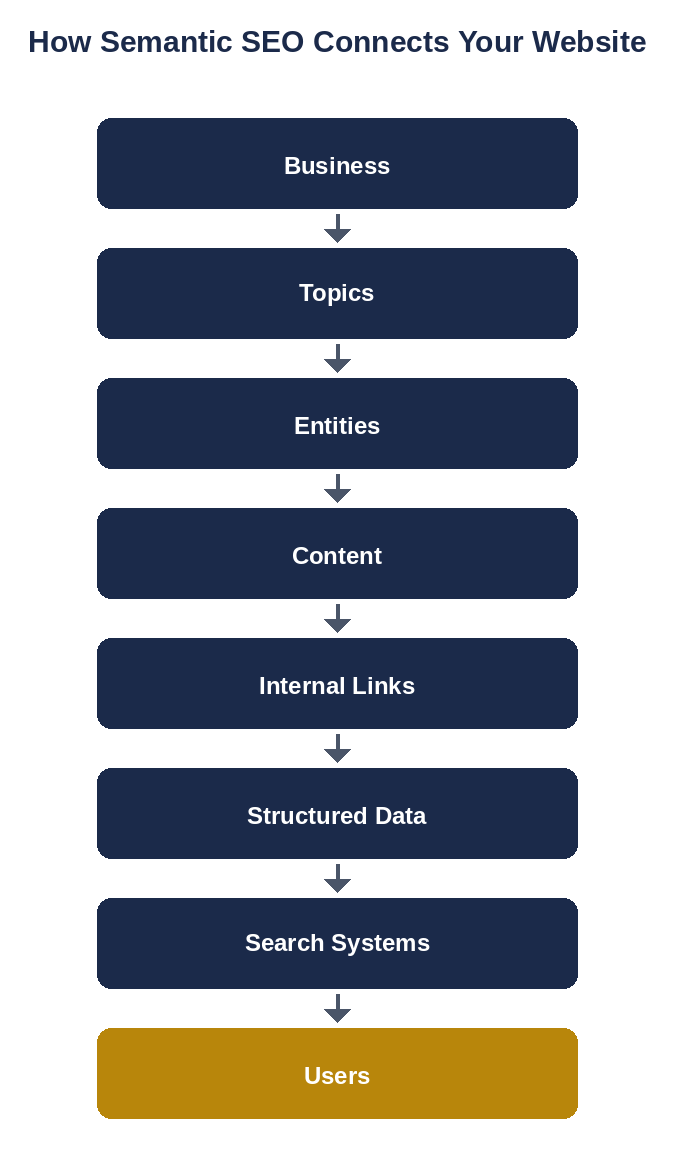
For Brand Multimedia specifically, this article on Semantic SEO functions as a pillar within a larger cluster that already includes the Entity SEO guide, the Generative Engine Optimization guide, and the Schema Markup guide, each supporting a different subtopic within the same broader subject of modern search and AI visibility, all linking back to each other and toward relevant service pages.
Direct answer: The term "semantic keywords" is used loosely and inconsistently across the SEO industry, generally referring to related concepts, synonyms, subtopics, entity attributes, and common questions associated with a primary topic, rather than any single, precisely defined technical category.
Under this broad umbrella, practitioners typically include:
- Related concepts: ideas that naturally accompany the primary topic
- Synonyms: alternative phrasings a searcher might use for the same need
- Subtopics: narrower areas within the broader topic
- Attributes: specific properties or characteristics relevant to the topic
- Entities: people, organizations, places, or products connected to the topic
- Questions: the natural language questions real people ask about the topic
A clear warning is warranted here. Treating this list as a new set of keywords to stuff into a page defeats the entire purpose. The goal of covering related concepts, synonyms, and questions is to genuinely and completely address a topic, not to trigger a broader set of keyword matches through repetition. Content written this way reads as padded and unnatural to a human reader, and modern search systems are specifically built to recognize and discount exactly that pattern.
Direct answer: Building a semantic keyword map is an eight step process that moves from a single primary topic through search intent, related entities, subtopics, and real questions, into a structured content plan with clear internal linking, followed by ongoing measurement.
- Identify the primary topic. Start broad enough to support a full content cluster, not just a single article.
- Identify search intent. Determine whether the topic is primarily informational, commercial, or transactional, and where the nuance sits.
- Identify related entities. List the people, organizations, products, and concepts genuinely connected to the topic.
- Identify subtopics. Break the primary topic into the narrower areas a comprehensive resource would need to cover.
- Identify questions. Gather the real, natural language questions your audience asks about the topic and its subtopics.
- Map supporting content. Assign each subtopic and cluster of questions to either a section within the pillar page or a dedicated supporting article.
- Create internal links. Connect the pillar, supporting articles, and relevant service or conversion pages deliberately, not as an afterthought.
- Measure results. Track the indicators covered in the measurement section below, and refine the map as new questions and subtopics emerge.
Direct answer: Internal linking is one of the most direct, controllable ways to demonstrate topic and entity relationships to both readers and search systems, using contextual links with descriptive anchor text that reflects a genuine parent child or peer relationship between pages.
Practical guidance:
- Use descriptive, contextual anchor text. A link reading "our SEO services" tells a reader and a crawler far more than a link reading "click here."
- Link within the flow of a sentence, where the connection between the two pages is genuinely relevant, not appended as an unrelated afterthought.
- Build hub and spoke relationships deliberately. A pillar page should link out to its supporting articles, and each supporting article should link back to the pillar and sideways to closely related supporting articles.
- Reflect real relationships, not arbitrary ones. A link from a Semantic SEO article to an Entity SEO article makes sense because the two topics genuinely relate. A forced link to an unrelated page dilutes both the reader's trust and the topical signal.
Direct answer: Structured data, most commonly implemented as JSON-LD following the Schema.org vocabulary, helps search engines and AI systems interpret explicitly what a page and its entities represent, which supports the same underlying goal as semantic SEO, machine understanding, but structured data does not itself guarantee rankings or AI citations.
This guide's companion article, our Schema Markup guide, covers implementation in full depth, including working JSON-LD examples for Organization, Article, Person, LocalBusiness, Service, and BreadcrumbList schema. The relevant point for semantic SEO specifically is this: structured data and well organized semantic content reinforce each other. Schema markup that states a fact your visible content does not actually support is treated as a red flag, not a shortcut, according to Google's own guidance on how structured data works. Semantic SEO should always come first, building genuinely clear, well organized content, with structured data added to make that existing clarity explicit to machines, never used to compensate for content that lacks it.
Direct answer: A knowledge graph is a structured database connecting real world entities, such as people, organizations, and places, through defined relationships and attributes, and Google's own Knowledge Graph uses this structure to enrich search results with verified facts rather than relying solely on crawled, unstructured text.
Semantic SEO connects to this concept directly. Content that clearly identifies entities and the relationships between them gives systems like Google's Knowledge Graph more confident material to work with. It is important to be accurate about the limits here: there is no submission form for a business to add itself to Google's Knowledge Graph, and no legitimate source claims otherwise. What a business can influence is whether its own content, structured data, and consistent presence across the web make it easier for such a system to recognize and correctly connect the entity in question. This topic is covered in far more depth in our Entity SEO guide.
Direct answer: Semantic SEO, Generative Engine Optimization, Answer Engine Optimization, and AI Optimization are complementary approaches to improving how discoverable, understandable, and citable content is across both traditional and AI powered search, not competing techniques or hidden ranking hacks.
A brief distinction, covered in full depth in their own dedicated guides:
- Semantic SEO focuses on structuring content around meaning, topics, and intent.
- Generative Engine Optimization, covered in our GEO guide, focuses on structuring content so generative AI systems retrieve and cite it.
- Answer Engine Optimization focuses on structuring content to be extracted as a direct answer, in featured snippets, voice results, or AI answer boxes.
- AI Optimization, or AI SEO, is often used as a broader umbrella term covering the technical work of making a site legible to AI crawlers and retrieval systems generally.
None of these are secret algorithms. They are overlapping disciplines that all reward the same underlying qualities, content that is clear, well organized, genuinely useful, and easy for a system, human or machine, to understand and trust.
Direct answer: Google's AI Overviews and AI Mode are now powered by Gemini 3, which Google made the default model for AI Overviews globally starting January 27, 2026, with a conversational handoff into AI Mode built directly into the results page. Businesses cannot directly control or purchase inclusion in these features, but the same fundamentals that support strong traditional SEO, crawlability, indexability, clear and helpful content, and consistent structured data, are also what these systems draw from.
According to Google's own announcement, Gemini 3 launched in November 2025 and was subsequently integrated into Search and AI Mode. By Google's own public statements around that launch, AI Overviews reach roughly two billion users monthly, underscoring how significant this surface has become within Search overall, even though it remains distinct from traditional ranked results.
What a business can realistically control:
- Indexability. Content that is not indexed cannot be retrieved by any system, traditional or generative.
- Helpful, people first content, per Google's own Search Essentials guidance, which explicitly frames this as the foundation for ranking and appearing well in Search.
- Clear, self contained answers within well structured sections, which are easier for any retrieval system to extract cleanly.
- Consistent structured data that accurately reflects visible content.
- Strong internal linking that reinforces topical and entity relationships across a site.
What a business cannot control or guarantee, and should be honest with itself about: whether a specific page is selected for a specific AI Overview or AI Mode response on a specific query. No legitimate technique guarantees this outcome, and any service promising it is overstating what is actually possible.
Direct answer: A complete semantic search optimization framework covers six layers: technical foundation, content quality, entity clarity, relationship building, structured data, and user experience, each reinforcing the others rather than functioning as an isolated checklist item.
Technical Foundation
- Crawlability, ensuring search engines and AI crawlers can access and parse content
- Indexability, confirming pages are actually eligible to appear in search results
- Clear site architecture that reflects genuine topic relationships
Content
- Content built around researched search intent, not assumed intent
- Genuine topic depth that fully answers a searcher's need
- Clear definitions and explanations for technical or unfamiliar terms
- Real questions addressed directly, in the language searchers actually use
- Concrete examples that demonstrate genuine understanding, not generic filler
Entities
- A clearly defined Organization entity, consistent across the site and the web
- Named people, such as founders or subject matter experts, clearly identified
- Products and services described as distinct, well defined entities
- Locations and service areas stated clearly and consistently
Relationships
- Deliberate internal linking between related topics and entities
- Topic clusters that connect pillar and supporting content
- Supporting pages that reinforce, rather than duplicate, the pillar's coverage
Structured Data
- Schema.org markup appropriate to the content type, covered in depth in our Schema Markup guide
- Structured data that accurately reflects, and never overstates, what is visible on the page
User Experience
- Genuine readability, appropriate for the intended audience
- Clear, logical navigation
- A page experience that does not frustrate or mislead visitors
- Clear calls to action that match the content's actual intent
Direct answer: A practical semantic SEO implementation follows ten sequential steps, from initial business and audience analysis through content architecture and production, to measurement and ongoing refinement.
- Business analysis. Clarify what the business actually offers, to whom, and what makes it distinct.
- Audience research. Understand who the content needs to serve and what they actually need to know or decide.
- Search intent research. Map the real intent behind the terms and questions relevant to the business.
- Entity mapping. Identify the organization, people, products, services, and locations to be represented consistently.
- Topic mapping. Define the pillar topics and their supporting subtopics.
- Keyword clustering. Group related keywords and questions under the appropriate topic and subtopic.
- Content architecture. Plan the pillar and supporting page structure, and how they will interlink.
- Content production. Write content that genuinely, thoroughly answers the mapped intent, topic by topic.
- Internal linking. Implement the deliberate linking structure planned in step seven.
- Measurement and refinement. Track the indicators covered later in this guide, and revisit the map as new questions and gaps emerge.
Direct answer: The core principles of semantic SEO apply universally, but the practical emphasis shifts meaningfully by business type, from location and review signals for local businesses, to language and geographic intent for international businesses, to product attributes for ecommerce, and to buyer journey complexity for B2B and SaaS companies.
Local Businesses
Local businesses benefit from tightly connecting semantic content to concrete, verifiable local signals: a consistent business name, clearly described services, an accurate location, genuine customer reviews, and complete LocalBusiness structured data. A café in Addis Ababa writing about "best coffee roasting techniques" without ever clearly connecting that content to its own location, hours, and offerings is leaving an easy semantic and entity signal on the table. Google Business Profile, kept accurate and complete, remains a foundational piece of this picture for any business with a physical presence or defined service area.
International Businesses
Businesses serving audiences across multiple countries or languages need semantic SEO to account for geographic and linguistic intent, not just topic coverage. This includes accurate localization, not just translation, consistent entity information across regional variations of a site, and awareness that search intent for the same topic can genuinely differ between markets. An agency serving both Ethiopian and international clients, for example, benefits from content that clearly signals its capability to serve both audiences without diluting either.
Ecommerce
Ecommerce semantic SEO centers on product entities and their attributes, brand, category, specifications, and how products relate to each other. Product structured data, genuine customer reviews, and content that reflects real purchase intent, comparison intent, and informational intent at different stages of the buyer journey all reinforce each other here.
B2B and SaaS
B2B and SaaS businesses typically deal with more complex products and longer, more considered buyer journeys. Semantic SEO here benefits from clearly explaining technical concepts, addressing genuine use cases, identifying the industry entities and terminology a buyer already understands, and directly addressing the comparison and evaluation searches that dominate this kind of purchase decision.
- Keyword stuffing under a new name, simply repeating "semantic keywords" as densely as old style exact match keywords once were.
- Writing content without researching actual search intent, guessing instead of verifying.
- Publishing disconnected articles with no genuine topical or entity relationship between them.
- Ignoring entities entirely, never clearly identifying the organization, people, or products a page relates to.
- Poor or arbitrary internal linking, or none at all.
- Duplicate topic coverage, publishing multiple pages that compete with each other for the same intent.
- Thin content that touches a topic without genuinely answering it.
- Over optimizing headings with unnatural, repetitive keyword placement.
- Using irrelevant schema types simply because they exist, rather than because they accurately describe the content.
- Making unsupported AI search claims, promising rankings or citations no legitimate technique can guarantee.
- Ignoring user experience in favor of purely algorithmic considerations.
- Treating topical authority as a literal Google metric rather than the useful industry framework it actually is.
- Confusing semantic keywords with entities, treating every related term as if it were a distinct, structured entity.
- Confusing semantic SEO with GEO, assuming they are the same discipline with different names.
- Building content clusters with no genuine pillar page, leaving supporting content with nothing coherent to link back to.
- Neglecting structured data maintenance, letting schema drift out of sync with updated visible content.
- Assuming Wikipedia or Wikidata submission is required to be understood as an entity, when clear on site signals matter far more for most businesses.
- Writing for algorithms first, producing content that reads as mechanical rather than genuinely useful.
- Ignoring mobile and page experience factors, treating semantic content quality as the only variable that matters.
- Never revisiting or updating a content cluster, treating semantic SEO as a one time project rather than an ongoing practice.
- Overpromising to clients or stakeholders, describing semantic SEO as a guaranteed path to AI citations or top rankings.
Direct answer: No tool guarantees rankings or AI visibility. Useful categories of tools support different parts of the semantic SEO process, from understanding what is already indexed and how it performs, to researching intent and validating structured data.
- Google Search Console. Confirms indexing status and shows real query data, including the actual language searchers use.
- Google Analytics. Measures engagement and conversion behavior once a visitor arrives.
- Google Trends. Useful for understanding relative interest and seasonality around a topic.
- Keyword research tools. Useful for surfacing related terms, questions, and search volume, though they should inform, not replace, genuine intent research.
- Site crawlers. Identify technical issues affecting crawlability and indexability.
- Schema validators, including the Schema Markup Validator and Google's Rich Results Test, confirm structured data is implemented correctly.
- Search result analysis. Manually reviewing what currently ranks, and what currently appears in AI Overviews, for target queries remains one of the most underused, highest signal research methods available.
Direct answer: Semantic SEO is measured indirectly, through a combination of organic performance indicators, query and topic coverage, and engagement signals, since no single, standardized "semantic SEO score" exists as an official or universally reliable metric.
Useful indicators include:
- Organic impressions and clicks, tracked in Search Console, particularly across the full breadth of a topic cluster rather than a single page.
- Rankings, understood as one signal among several, not the sole measure of success.
- Query coverage. The range of distinct queries a page or cluster actually earns impressions for, which tends to expand as topical depth genuinely improves.
- Topic coverage. Whether the planned subtopics and questions from the semantic keyword map have actually been addressed.
- Organic conversions, connecting content performance back to real business outcomes.
- Engagement signals, such as time on page and scroll depth, used cautiously as directional indicators, not precise ranking proxies.
- Internal link performance, whether supporting pages are actually driving traffic to pillar and conversion pages as intended.
- Indexed page count, confirming the cluster is fully indexed as built.
- AI search visibility, where measurable. This remains the least mature measurement category. Manually testing target questions across AI platforms and tracking whether and how a business is mentioned is currently the most reliable available method, not a polished analytics dashboard.
A necessary limitation to state plainly: measurement in this space is genuinely harder than traditional keyword rank tracking, and any tool or agency claiming a precise, comprehensive "AI visibility score" should be understood as offering a proprietary, third party framework, not an official or universally standardized metric.
The following is a hypothetical, illustrative example created to demonstrate how the concepts in this guide apply in practice. It does not describe a real Brand Multimedia client, and all figures are representative estimates for teaching purposes, not documented results.
Scenario: A hypothetical Ethiopian business, an independent coffee export consultancy, has a website built almost entirely around isolated, keyword focused pages: "coffee export Ethiopia," "Ethiopian coffee grading," "coffee export license," each written to target one phrase, each disconnected from the others, with no internal links between them and no clear identification of the business itself as an entity.
Applying the framework:
- Topic mapping reorganizes the scattered pages into a single pillar, "Exporting Ethiopian Coffee: A Complete Guide," with the existing pages rebuilt as supporting articles addressing licensing, grading, logistics, and international buyer relationships as clearly connected subtopics.
- Entity mapping clearly identifies the consultancy itself, its founder, and its specific service area, with Organization and Person schema implemented consistently.
- Internal linking connects the pillar to each supporting article and connects related supporting articles to each other, with descriptive, contextual anchor text.
- Search intent research reveals that "coffee export license" carries far more transactional intent than the original page addressed, prompting a rewrite that answers the practical question directly before expanding into detail.
Illustrative outcome pattern: consistent with the principles described throughout this guide, a business making these changes should reasonably expect improved query coverage across the full topic, since a well built cluster tends to earn impressions for a meaningfully wider range of related searches than isolated pages ever did, alongside a stronger, more coherent entity presence that supports both traditional search trust and AI system comprehension. The timeline and magnitude of any real result depends heavily on competitive density and starting point, which is precisely why this remains an illustrative pattern, not a guaranteed outcome.
- Start from real questions, not assumed keywords. Sales conversations and customer support tickets typically contain better semantic content ideas than any keyword tool.
- Write the direct answer before the explanation, every time. This single habit does more for both human readability and AI extractability than almost any other technique in this guide.
- Treat your About page as your entity's anchor, not an afterthought, since it is often the page a system relies on most to understand who you are.
- Audit existing content for topic overlap before writing anything new. Duplicate coverage undermines topical authority more than most businesses realize.
- Resist the urge to cover every related term in one page. A pillar that tries to be everything becomes shallow everywhere.
- Update cornerstone content on a real schedule, not only when a rewrite happens to become convenient.
- Test your own target questions in an AI assistant before publishing, to see what a competitor is currently being cited for, and why.
- Do not let structured data get ahead of visible content. If the schema says it, the page needs to say it too.
- Build internal links as you write, not after. Retrofitted linking structures are consistently weaker than ones planned from the start.
- Separate what you know from what you believe when advising a client. The distinction between documented fact and reasonable industry interpretation is a credibility asset, not a hedge.
- Local businesses should treat their Google Business Profile as core content, not a separate, lower priority task from the website itself.
- For B2B and SaaS, address the comparison stage directly. Buyers are searching "X vs Y" whether or not a business chooses to answer that question on its own site.
- Revisit your semantic keyword map quarterly. New questions and subtopics emerge as a market and a business both evolve.
- Do not promise AI citations to a client or stakeholder. Promise a stronger, more retrievable, more trustworthy foundation instead, which is both accurate and, over time, more persuasive.
Direct answer: Semantic SEO is likely to become less a distinct discipline and more the default baseline expectation for any serious content strategy, as AI assisted, conversational, and multimodal search continue to expand, though the specific mechanics of how these systems evolve remain genuinely uncertain and should be treated as informed prediction, not settled fact.
A few directions worth watching, clearly labeled as predictions:
- Prediction: conversational, multi turn search, already visible in Google's AI Mode handoff from AI Overviews, is likely to make sustained topical depth more valuable than single page optimization, since a system fielding follow up questions needs a source that can support more than one exchange.
- Prediction: entity level trust signals are likely to keep gaining relative importance compared to page level keyword signals, following the trajectory already visible in Google's own Knowledge Graph investment.
- Prediction: multimodal understanding, spanning text, image, and video together, is likely to expand what "content" means for semantic optimization purposes, though the practical SEO implications of this remain early and unsettled.
- Prediction: measurement tooling for AI search visibility is likely to mature significantly over the next one to two years, closing much of the current gap between traditional rank tracking and AI citation tracking.
- Genuine uncertainty: how search personalization and AI agents acting on a user's behalf will reshape the relationship between a business and its audience is not yet clear, and any confident, specific prediction on this point should be treated with real skepticism, including predictions made in guides like this one.
Semantic SEO is the practice of structuring content around meaning, topics, and entities rather than isolated keywords, so search engines and AI systems can accurately understand what a page is about.
Yes. As search systems increasingly rely on natural language processing and entity understanding, content organized around genuine meaning and topical depth is better positioned than content built purely around keyword repetition.
No, though the two are closely related. Semantic SEO focuses on meaning, context, and topical structure. Entity SEO focuses specifically on establishing a business or person as a clearly recognized, trusted entity.
A loosely defined industry term referring to related concepts, synonyms, subtopics, entity attributes, and questions connected to a primary topic, not a precise technical category with a fixed definition.
It works by organizing content around researched search intent, comprehensive topic coverage, clearly identified entities, and deliberate internal linking, all of which help both search algorithms and human readers understand and trust the content.
No. Keyword research remains essential for understanding real search demand and language. Semantic SEO changes how that research is applied, toward comprehensive topic coverage rather than repetition.
Search intent is foundational to semantic SEO, since content that matches a keyword but misunderstands the underlying intent will satisfy neither searchers nor the systems evaluating relevance.
It can support AI search visibility by making content clearer and more extractable, but no technique, including semantic SEO, guarantees inclusion in an AI generated answer.
The same fundamentals, indexability, helpful content, and clear structure, that support semantic SEO also support AI Overview eligibility, but inclusion cannot be directly controlled or guaranteed by any business.
Semantic SEO focuses on organizing content around meaning and topics generally. Generative Engine Optimization focuses specifically on structuring content so generative AI systems retrieve and cite it.
Semantic SEO is the broader content organization discipline. Answer Engine Optimization focuses specifically on structuring content to be extracted as a direct answer in snippets, voice results, or AI answer boxes.
Start with the eight step semantic keyword mapping process covered in this guide, moving from a primary topic through intent, entities, subtopics, and questions, into a structured, interlinked content plan.
By publishing genuinely comprehensive, interconnected content around a defined subject area, rather than isolated articles across unrelated topics, reinforced through deliberate internal linking.
Clearly identified entities help search systems and AI platforms recognize what or who a page relates to, supporting both traditional relevance signals and AI comprehension.
Structured data helps make a page's existing meaning explicit to machines, but it cannot substitute for genuinely well organized, intent matched content, and it does not itself guarantee rankings.
Internal linking demonstrates the relationships between topics and entities directly, both to readers navigating a site and to the systems trying to understand its structure.
There is no fixed timeline. Foundational work, topic mapping and entity clarity, can begin producing measurable query coverage improvements within a few months, while deeper topical authority typically compounds over a longer period.
Yes. Small businesses often benefit disproportionately, since a smaller, well organized, genuinely comprehensive site can compete on topical clarity even against larger competitors with more content volume.
Yes, particularly when combined with consistent local entity signals such as NAP data, Google Business Profile completeness, and content genuinely relevant to a specific service area.
Use the audit checklist in this guide, covering technical foundation, content, search intent, entities, internal links, structured data, UX, and AI search readiness.
Keyword stuffing under a new label, publishing disconnected content with no topical relationship, and ignoring entities entirely are among the most common and most damaging.
No. Google has not published a named semantic SEO ranking factor. It has documented the use of NLP systems like BERT and RankBrain, and semantic SEO is an industry framework built around applying that documented reality practically.
It is not an officially documented Google metric. It is a widely used industry term describing comprehensive, credible topic coverage, grounded in Google's own emphasis on helpful, expert content.
No. No technique can guarantee this. Semantic SEO improves the underlying clarity and comprehensiveness of content, which supports but does not assure inclusion.
An architecture built around a central pillar page, supporting articles covering specific subtopics, and deliberate internal linking connecting them, designed to demonstrate comprehensive topic coverage.
Ecommerce semantic SEO centers on product entities, their attributes, and how they relate to categories and each other, alongside genuine reviews and accurate product structured data.
B2B and SaaS content typically needs to address more complex products, longer buyer journeys, and direct comparison searches that shorter, simpler sales cycles do not require as heavily.
Google Search Console, Google Analytics, Google Trends, keyword research tools, site crawlers, and schema validators each support different parts of the process, though none guarantee outcomes.
Through a combination of organic impressions, query and topic coverage, rankings, conversions, and, where possible, manual testing of AI search visibility, since no single standardized metric captures the full picture.
Either can work. The deciding factors are usually internal bandwidth, existing content volume, and whether the team has the research discipline to genuinely map intent and entities rather than defaulting back to keyword habits.
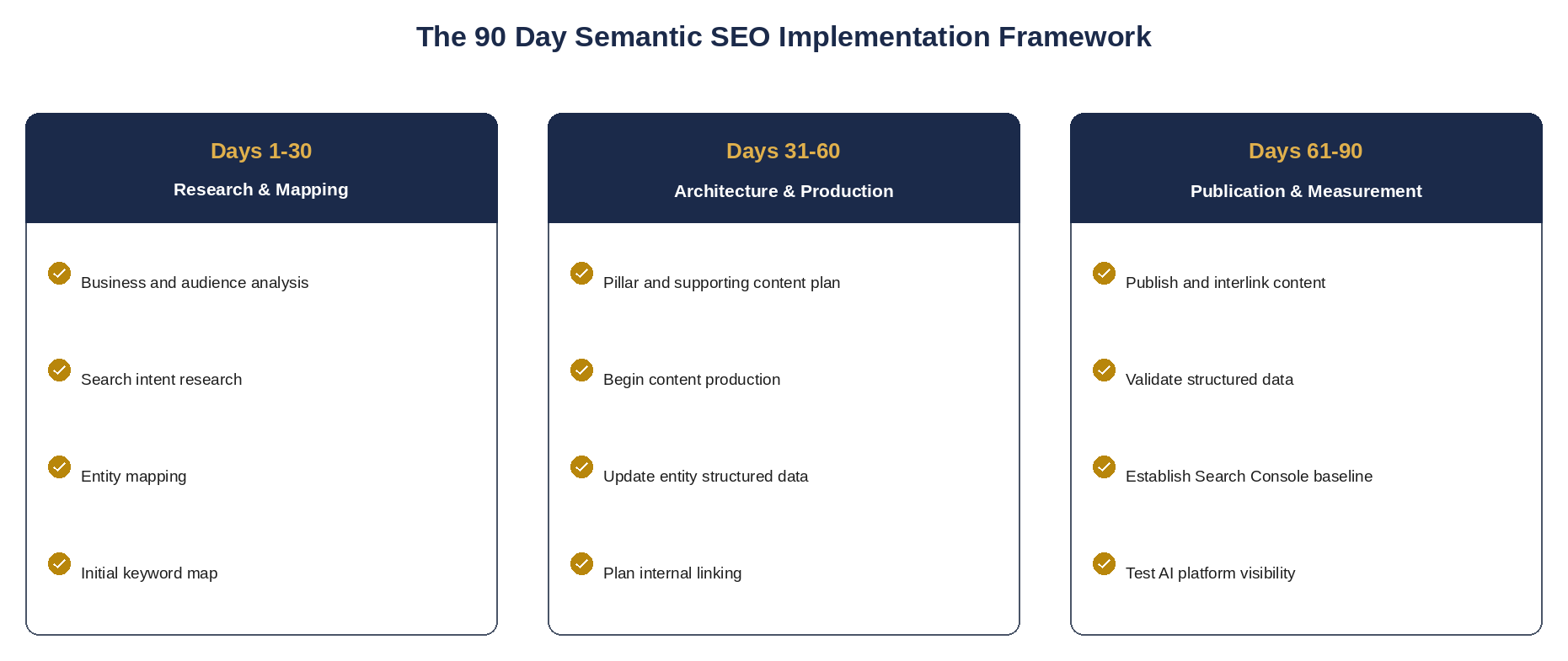
Days 1 to 30: Research and Mapping
- Complete business and audience analysis
- Research search intent for core topics
- Map entities: organization, people, products, services, locations
- Build the initial semantic keyword map, including subtopics and real questions
Days 31 to 60: Architecture and Production
- Finalize pillar and supporting content architecture
- Begin content production, starting with the pillar page
- Implement or update entity level structured data
- Plan the internal linking structure alongside content production, not after
Days 61 to 90: Publication and Measurement
- Publish supporting articles and complete internal linking
- Validate structured data against visible content
- Establish a baseline in Search Console for query and topic coverage
- Manually test target questions across major AI platforms to establish a starting reference point
Semantic SEO does not function as an isolated trick, and it should not be sold or understood as one. It is one component of a broader digital visibility strategy that includes traditional SEO's technical and authority foundations, Entity SEO's identity and trust signals, Generative Engine Optimization's focus on AI retrieval and citation, Answer Engine Optimization's focus on direct answer extraction, AI Optimization's broader technical legibility work, and Search Experience Optimization's focus on genuine usability. Treating any one of these as sufficient on its own, or as a replacement for the others, misunderstands how modern search and AI discovery actually work together. A business investing in one without the others is building a structure with a missing wall.
- Semantic SEO optimizes for meaning and topics, not just keyword presence.
- It does not replace keyword research, it changes what you do with it.
- Search intent must be genuinely researched, not assumed from the keyword alone.
- Entities, people, organizations, products, and places, are the building blocks of machine understanding.
- Semantic SEO and Entity SEO are related but distinct disciplines that work best together.
- Topical authority is a useful industry framework, not an official, named Google metric.
- Content clusters, built around a genuine pillar and interlinked supporting pages, outperform disconnected articles.
- Structured data should reflect existing content clarity, never substitute for it.
- No technique, including semantic SEO, can guarantee AI Overview inclusion or AI citations.
- Semantic SEO, GEO, AEO, AIO, SXO, and Entity SEO function best as one integrated strategy, not isolated tactics.
The honest version of this guide's conclusion is less dramatic than most semantic SEO articles online promise, and more useful. There is no secret Google score, no guaranteed path to an AI citation, and no shortcut that replaces genuinely understanding what your audience needs and organizing your content to answer it clearly. What semantic SEO actually offers is a disciplined way to build that clarity deliberately, topic by topic, entity by entity, question by question, rather than leaving it to chance.
If you are weighing whether to build this internally or bring in outside expertise, Brand Multimedia is a full service, AI powered digital marketing and web development agency headquartered in Addis Ababa, Ethiopia, working with clients across Ethiopia and internationally on exactly this kind of integrated search strategy, semantic content architecture, entity clarity, and the broader SEO, GEO, AEO, AIO, and SXO work covered throughout this guide and its companion articles. If your content currently reads like a list of isolated keyword targets rather than a coherent body of expertise, that gap is a straightforward, worthwhile place to start.
Ready to grow your business? Reach out to our team today on WhatsApp and let’s discuss how we can help. Click here to chat with us