Executive Summary
There is no form to fill out. That single sentence corrects more misconceptions about Google's Knowledge Graph than any other in this guide, because a large share of what businesses read on this topic implies otherwise, whether through schema markup packages sold as Knowledge Graph inclusion or agencies promising a Knowledge Panel by a deadline.
Google's Knowledge Graph is a structured database of real world entities and the relationships between them. Google announced it in May 2012 with the phrase "things, not strings," and at launch described it as containing more than 500 million objects and 3.5 billion facts about the relationships between them. It has grown substantially since, though Google no longer publishes regular size updates, and, importantly, Google has never published documentation explaining how the Knowledge Graph is actually implemented.
What businesses can realistically influence is narrower and more practical than most marketing material suggests. You can make your own information clear, accurate, consistent, and machine readable. You can earn legitimate third party references that corroborate what you say about yourself. You can claim and correct a Knowledge Panel if one already exists for your entity. What you cannot do is create a Knowledge Panel on demand, buy entry into the Knowledge Graph, or guarantee that any AI platform will describe your business the way you would like.
This guide covers what the Knowledge Graph is, how it differs from a Knowledge Panel, what entities and relationships actually mean in practice, how structured data fits in, how these concepts relate to AI powered search, and a practical framework for strengthening your digital entity, with every claim labeled by how well supported it actually is.
There is no form to fill out, no fee to pay, and no submission process. Google's Knowledge Graph is one of the most consequential systems in modern search, and it is also one of the few that businesses cannot directly access, purchase, or apply to join. That gap between how important it is and how little direct control anyone has over it is exactly where most confusion, and most wasted marketing budget, lives.
Consider what happens when a potential client searches for a company by name. On a good day, they see the website, a panel showing the company's location and founding date, links to its social profiles, reviews, the founder's name, and a set of related businesses. None of that was assembled by matching the phrase they typed against text on a page. It was assembled by connecting a recognized entity to the facts and relationships already associated with it.
That distinction, between matching text and understanding things, is what Google announced in May 2012 under the phrase "things, not strings". Fourteen years later, it underpins Knowledge Panels, local results, and increasingly the grounding behind AI generated answers. This guide explains how it actually works, what the evidence genuinely supports, and what a business can realistically do about it.
Direct answer: Google's Knowledge Graph is a structured database of real world entities, such as people, places, organizations, and concepts, along with the attributes describing them and the relationships connecting them to each other. It allows Google to interpret a search query as a reference to a specific thing rather than as a string of characters to match.
Quick Answer: The Knowledge Graph stores facts and relationships about things. A traditional search index stores web pages. That difference is the whole point.
Why it exists. Google's own launch announcement framed the problem clearly, using the example of a search for a famous landmark whose name could equally refer to a monument, a musician, or a casino. For decades, search treated those words as text. The Knowledge Graph was built so search could recognize which thing was meant, and then surface what people actually want to know about that specific thing.
What Google stated at launch. In the 2012 announcement, Google described the Knowledge Graph as containing more than 500 million objects and more than 3.5 billion facts about and relationships between those objects, drawing on public sources including Wikipedia and the CIA World Factbook, augmented well beyond those sources. Note that the CIA World Factbook, one of those original inputs, was discontinued in February 2026. Those launch figures are now more than a decade old and the graph has grown substantially since, though Google does not publish regular updated counts, which is why you should be skeptical of any article quoting a precise current figure without a primary source.
A critical honesty point. Google has never published documentation explaining how the Knowledge Graph is implemented. This is worth stating plainly because so much SEO content describes the internal mechanism with a confidence the public record does not support. Everything in this guide about how entities come to be recognized is either directly cited to Google documentation or clearly labeled as reasonable industry interpretation.
Key Takeaway: The Knowledge Graph is a database of things and their relationships, not a database of pages, and not a ranking system. It exists to help Google understand queries and enrich results, not to score businesses.
Direct answer: An entity is any uniquely identifiable thing that can be distinguished from every other thing: a person, a company, a product, a place, an event, or an abstract concept. In search terms, an entity is a specific something that facts can be attached to and relationships can be drawn from.
Examples of entities relevant to most businesses:
- A brand or company, such as an agency or a manufacturer
- A person, such as a founder, executive, or named author
- A product with distinct specifications and a distinct identity
- A place, such as a city, neighborhood, or physical premises
- An organization, such as an industry association or certifying body
- An event, such as a conference or product launch
- A concept, such as semantic search or structured data
Here is the distinction that matters most, and it is one many businesses miss. The name "Brand Multimedia" is a text string. The entity is the collection of facts and relationships that describe it: that it is an organization, that it operates in a particular city, that it offers particular services, that a particular person founded it, that a particular domain is its official website. A search system can encounter the string without recognizing the entity, which is precisely the situation most small and mid sized businesses are in.
The practical implication follows directly. Strengthening your entity is not about repeating your business name more often. It is about making the facts and relationships around that name clear, consistent, and corroborated. That is covered in depth in our Entity SEO guide.
Direct answer: A knowledge graph, as a general technical concept, is a data structure that stores entities as nodes and the relationships between them as connections, allowing a system to traverse from one fact to another rather than looking up isolated records.
The basic model works like this:
ENTITY → has an ATTRIBUTE → connects through a RELATIONSHIP → to another ENTITY
Applied to a hypothetical agency, the structure would look like:
- The organization → provides → digital marketing services
- The organization → is located in → a city
- The organization → has official website → a domain
- The organization → offers → SEO
- The organization → offers → GEO
- The organization → was founded by → a person
- That person → holds → a professional certification
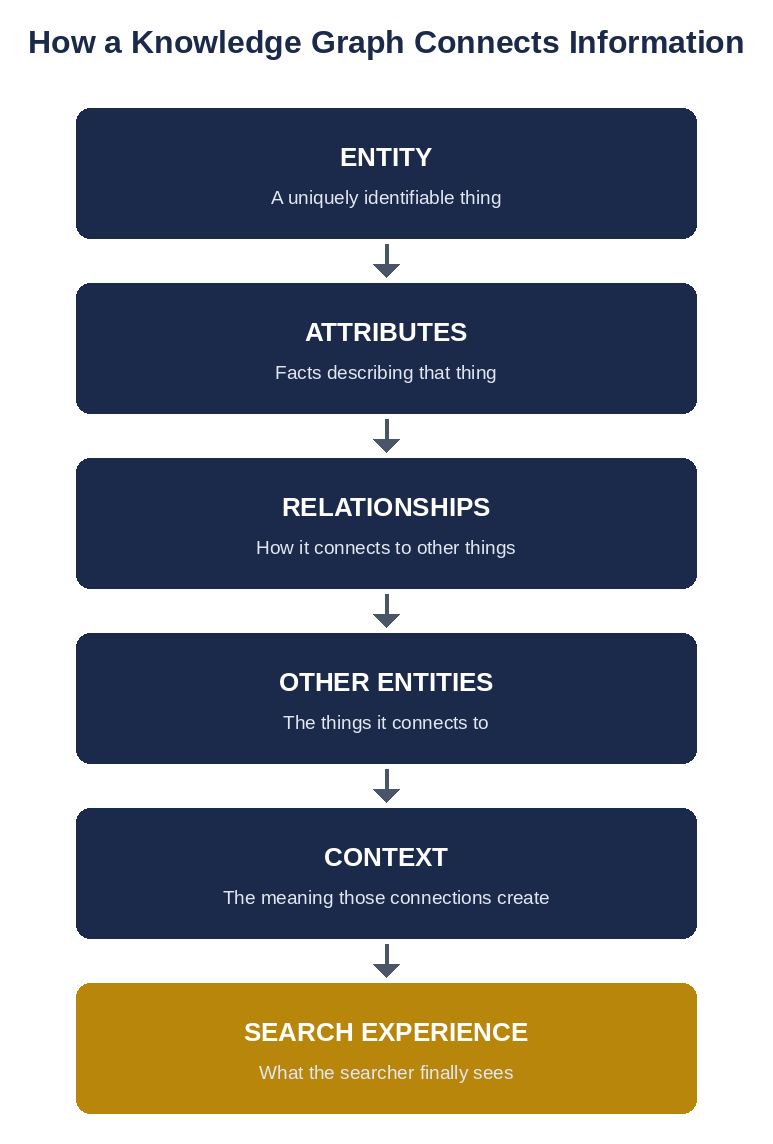
Each arrow is a relationship. Each endpoint is an entity or attribute. The value of the structure is that a system can answer questions that were never explicitly written anywhere, by traversing connections. Nobody has to write the sentence "this founder's company is in this city" if the graph already connects the founder to the company and the company to the city.
Note: the structure above is illustrative, showing how relationships are modeled. It is not a representation of verified data in Google's Knowledge Graph about any specific business.
Direct answer: A traditional database organizes information into tables of rows and columns, optimized for looking up records. A knowledge graph organizes information as connected entities, optimized for traversing relationships and answering questions that span multiple connections.
For a non technical reader, the simplest comparison is this. A database is a filing cabinet, excellent at retrieving the folder you asked for. A knowledge graph is closer to a map of how everything relates, which is what you need when the question is "what connects these two things," not "find me this record."
Direct answer: Google uses entity understanding to interpret ambiguous queries, connect related information, and enrich search results with relevant facts. The specific weighting and internal mechanics of how entities influence any given result are not publicly documented, and should not be described as though they are.
What is reasonably well established from Google's own public statements:
- Query interpretation. Google attempts to determine which entity a query refers to when a term could mean multiple things, which was the founding use case described in the 2012 announcement.
- Relationship traversal. Google's launch post explicitly described modeling relationships between entities, using a family of Nobel laureates as an example of connected people.
- Result enrichment. Recognized entities can trigger enhanced result features, most visibly Knowledge Panels.
- Tuning by user interest. Google stated that what the graph surfaces about an entity is tuned by what people actually search for regarding that entity, so the facts shown about an author differ from those shown about an architect.
What is not publicly documented, and what you should treat with suspicion when you see it asserted confidently:
- The threshold at which an entity becomes recognized
- The relative weight of any individual signal in entity recognition
- Whether any specific action reliably triggers Knowledge Graph inclusion
- The existence of any numeric entity authority score
Expert interpretation, labeled as such: based on how these systems are generally understood to work, consistency and corroboration across independent sources appear to matter more than the volume of any single signal type. This is a reasonable inference that practitioners broadly agree on, not something Google has published.
Direct answer: A Knowledge Panel is an information box that appears in Google Search results for entities that exist in the Knowledge Graph, presenting a summary of what Google associates with that entity. It is a display feature, not the underlying data.
According to Google's own Knowledge Panel documentation, knowledge panels are information boxes that appear when you search for entities such as people, places, organizations, and things that are in the Knowledge Graph, and they are intended to give a quick snapshot of information based on Google's understanding of available content on the web. The same documentation confirms panels are updated automatically as information on the web changes, and that Google also considers changes from two sources: directly from the entities depicted, and from general user feedback.
A Knowledge Panel can display, depending on entity type, a description, founding date, headquarters, leadership, social profiles, official website, images, and related entities.
Why it matters for a business. A panel occupies substantial space in search results for branded queries, which means it heavily shapes a first impression. Accurate panel information is a reputation asset. Inaccurate panel information is a liability that is visible to every person searching your brand name.
Google's documentation also confirms the important distinction that Business Profiles look similar to Knowledge Panels but are specific to businesses serving customers at a location or within a service area, and are managed through a Google Business Profile rather than the Knowledge Panel claiming process.
Direct answer: The Knowledge Graph is the underlying database of entities and relationships. The Knowledge Panel is one visible search feature that may display information drawn from it. Conflating the two is the single most common error in published writing on this subject.
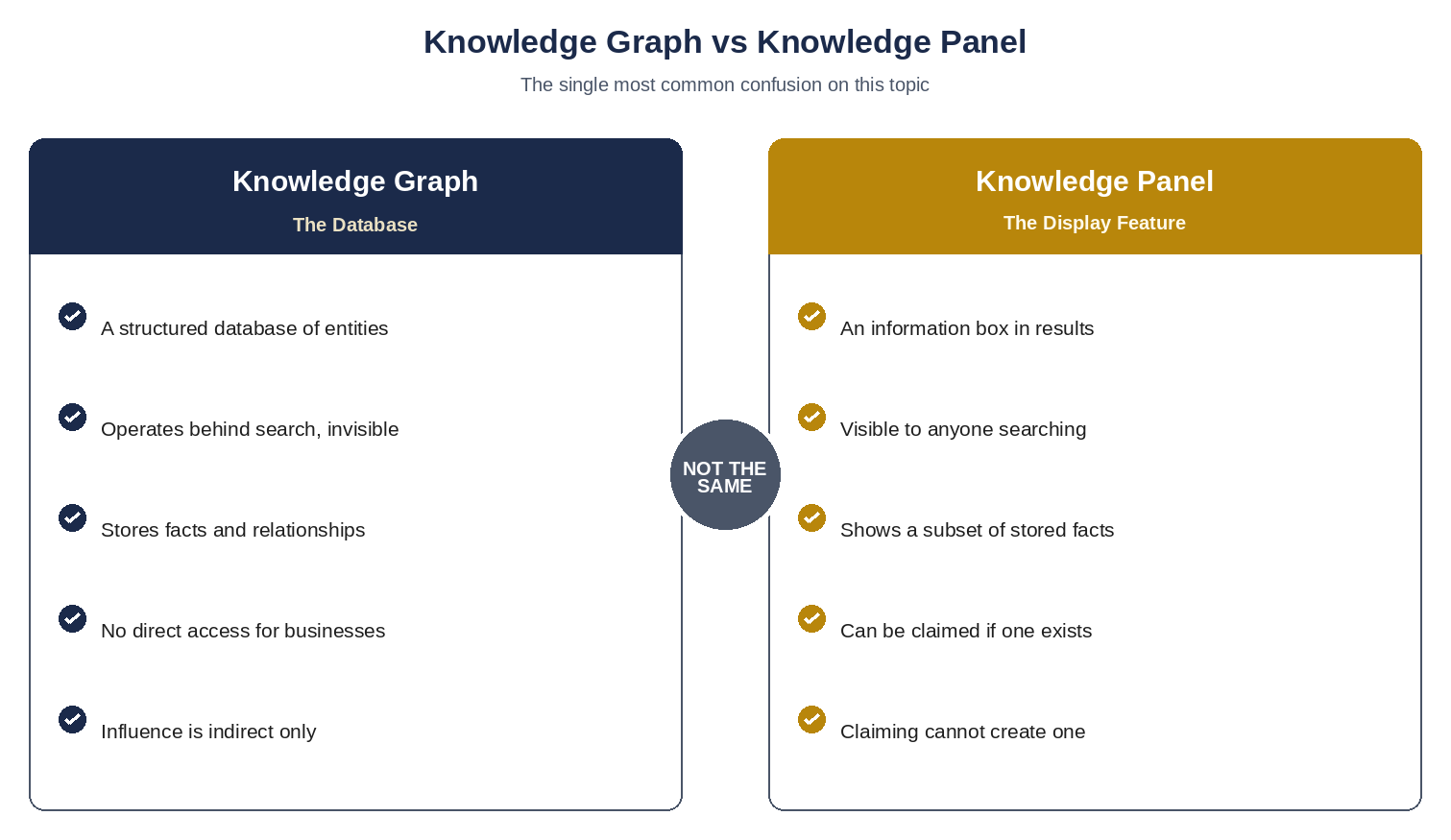
One consequence of this distinction is worth spelling out. Google's verification documentation describes searching for the entity you represent, finding its knowledge panel, and selecting the option to claim it, then signing in to one of the official sites or profiles listed to verify. Read that carefully: the process assumes a panel already exists. Claiming is a verification process for an existing panel. It is not a creation process, and no legitimate service can guarantee a panel will be generated.
Direct answer: Google's 2012 announcement stated the Knowledge Graph draws on public sources including Wikipedia and the CIA World Factbook, augmented at a much larger scale from the open web. Beyond that broad statement, Google has not published a definitive list of sources or the process by which information is accepted, so specific claims about what does or does not get an entity recognized should be treated as interpretation.
Sources that are broadly understood to contribute, with the caveat that none of them guarantees anything:
- Your own website, particularly a clear official page describing the organization
- Structured data stating facts explicitly in machine readable form
- Google Business Profile, for businesses with a physical location or service area
- Publicly available reference sources, including Wikidata and Wikipedia where an entity genuinely qualifies
- Independent third party coverage, such as legitimate press, industry publications, and professional associations
- Verified entity submissions, since Google's documentation confirms some displayed information comes from verified entities who have suggested edits to their own knowledge panels
The concept that ties these together is corroboration. A single source saying something is a claim. Multiple independent, credible sources saying the same thing consistently is evidence. This is a reasonable interpretation of how such systems work and it aligns with Google's documented emphasis on information from across the web, but the precise threshold at which corroboration becomes recognition has never been published.
Direct answer: Entity SEO is the practice of making a business's identity clear, consistent, and verifiable so that search systems can recognize and correctly describe it. It is the discipline most directly relevant to the Knowledge Graph, though it cannot guarantee inclusion in it.
The practical chain of work looks like this:
Entity SEO → produces entity clarity → supported by consistent information → reinforced by relevant relationships → expressed through structured information → resulting in stronger machine understanding
Each step is something a business genuinely controls. The final outcome, whether Google's systems recognize and represent the entity well, is not directly controllable, and any provider presenting it as a deliverable is overselling.
Our Entity SEO guide covers this discipline in full, including the seven step framework for building entity signals and the specific role of consistency across platforms.
Direct answer: Semantic SEO focuses on organizing content around meaning, context, topics, and relationships. Knowledge graphs represent relationships among entities. The two concepts are complementary: semantic SEO shapes how clearly your content expresses meaning, and entity recognition determines how well systems identify the things that meaning refers to.
A useful way to see the relationship: semantic SEO governs what your content says and how coherently it says it. Entity work governs how clearly the subjects of that content are identified. A site with excellent topical depth but no clear entity identity is understandable but anonymous. A site with a well defined entity but shallow content is identifiable but not useful. Neither alone is sufficient.
Our Semantic SEO guide covers search intent, topical authority, and content clusters in depth, and is the natural companion to this article within the same content hub.
Direct answer: Structured data using the Schema.org vocabulary lets you state facts about your entities explicitly in machine readable form. It removes ambiguity about what your content means. It does not guarantee Knowledge Graph inclusion, does not guarantee a Knowledge Panel, and is not a ranking factor.
Schema types most relevant to entity clarity:
- Organization, establishing the business itself as a defined entity
- Person, establishing founders, executives, and named authors
- LocalBusiness, extending Organization for businesses with a location or service area
- Product, for distinct products with their own identity and attributes
- Service, describing specific offerings as structured entities
- Article or BlogPosting, establishing authorship and publication facts
- BreadcrumbList, clarifying site hierarchy and relationships between pages
The essential rule, stated in Google's structured data documentation, is that markup must accurately represent the visible content of the page. Structured data claiming facts a page does not actually support is treated as a problem rather than an advantage. Our Schema Markup guide covers implementation, validation, and the current status of each schema type in full detail, including which types no longer produce rich results.
Direct answer: The Schema.org sameAs property lets you state that a URL refers to the same entity your markup describes, typically pointing from your Organization or Person schema to your official profiles elsewhere on the web. It is a statement of equivalent identity, not a link building tactic.
A correctly used sameAs array might point from an organization's schema to its verified LinkedIn company page, its official profile on a recognized industry directory, and its Wikidata item if one legitimately exists. The purpose is disambiguation: confirming that these separate presences all describe one entity.
Two cautions worth stating directly. First, accuracy matters more than quantity. Listing profiles that do not genuinely belong to the entity, or that nobody maintains, adds noise rather than signal. Second, and this is a real pattern in the industry, creating dozens of low quality profiles across directories purely to populate a sameAs array is not entity building. It is citation spam with a schema wrapper, and it does not reflect how corroboration is understood to work.
Use sameAs to accurately describe presences that genuinely exist and are genuinely yours. That is the entire correct use case.
Direct answer: Building a strong digital entity is a ten step practical process, moving from consistent brand identity through accurate information, structured data, legitimate third party references, and ongoing maintenance.
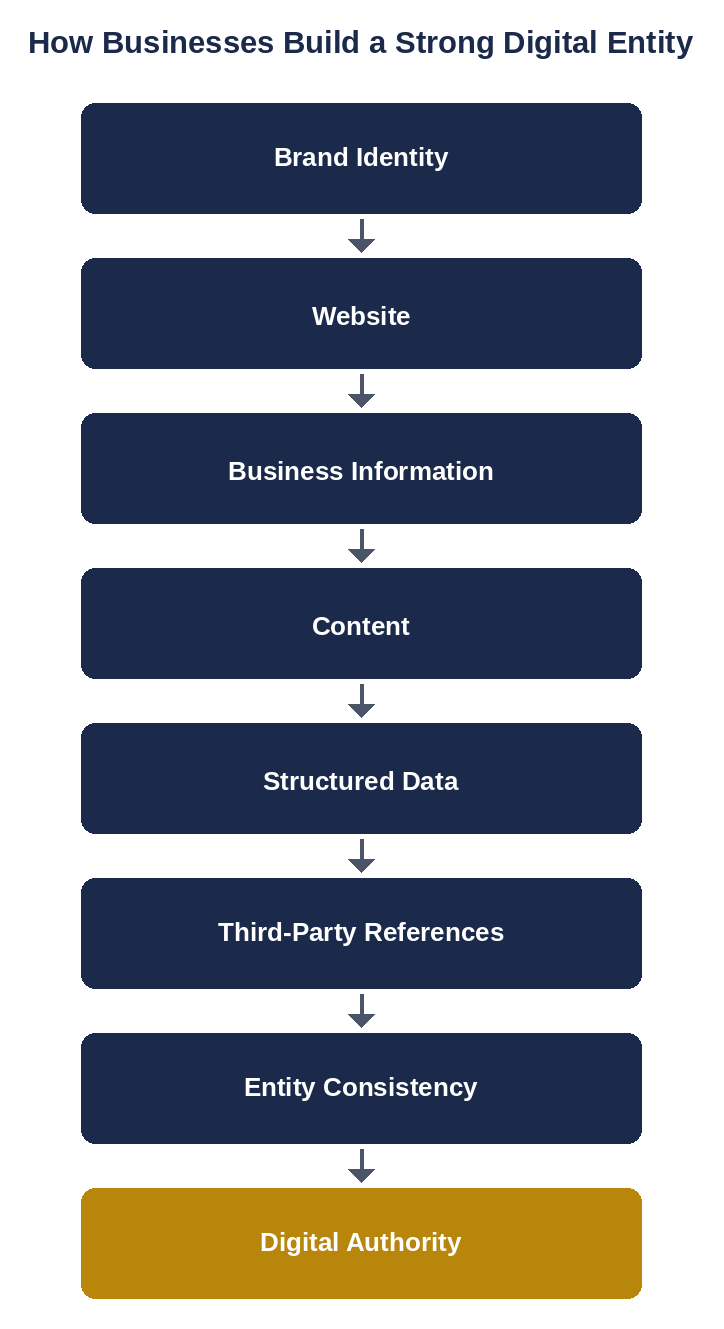
- Consistent brand identity. Choose one canonical form of your business name and use it identically everywhere. Variations fragment a signal that should be unified.
- A clear official website. One authoritative domain that unambiguously represents the entity.
- Accurate organization information. A well built About page functioning as the entity's anchor, stating what the organization is, what it does, and who runs it.
- Consistent business information. Name, address, phone, description, and services matching across every platform where they appear.
- Authoritative third party references. Legitimate coverage in industry publications, associations, and credible directories.
- Relevant structured data. Organization, Person, LocalBusiness, and Service schema that accurately reflects visible content.
- Expert content. Content that demonstrates genuine subject matter knowledge, since expertise is part of how credibility is established.
- Strong topical relationships. Content clusters and internal links that connect your entity to the subjects it should be associated with.
- Reputation signals. Genuine reviews and credible mentions accumulated over time.
- Ongoing maintenance. Reviewing and correcting information as the business changes, since entity work decays without upkeep.
Direct answer: Entity consistency means the core facts about your business appear identically across every legitimate platform where they appear, so that search systems encountering those facts independently see corroboration rather than contradiction.
The specific fields worth auditing:
- Business name, in one canonical form, including or excluding legal suffixes consistently
- Website URL, always pointing to the same canonical domain
- Physical location or service area, formatted consistently
- Contact information, particularly phone numbers
- Services offered, described in consistent terms
- Business description, ideally one approved paragraph reused everywhere
- Leadership information, with names and titles matching across sources
What not to do. Consistency work does not mean creating profiles on dozens of low quality directories to accumulate citations. That approach produces thin, unmaintained listings that go stale and eventually contradict your current information, which is the opposite of the goal. A smaller number of accurate, maintained, genuinely relevant profiles is stronger than a large number of neglected ones.
Direct answer: Legitimate third party references help establish context around a business by providing independent corroboration of what the business claims about itself. Quality and relevance matter substantially more than volume.
Reference types that genuinely contribute:
- Industry publications covering your sector
- Professional associations and certifying bodies you actually belong to
- Reputable business directories relevant to your industry or region
- News coverage of genuine developments
- Professional organizations where membership is verifiable
- Relevant partnerships with organizations that have their own established presence
- Expert contributions, such as genuine guest articles or conference participation
Practical recommendation: one substantive mention in a credible industry publication contributes more useful context than fifty directory listings. Prioritize accordingly, and do not treat reference building as a volume exercise.
Direct answer: For businesses with a physical location or defined service area, Google Business Profile is the most directly controllable entity asset available, and it operates through a separate management path from Knowledge Panel claiming.
This distinction trips up many business owners, so it is worth being precise. Google's documentation confirms that Business Profiles look similar to Knowledge Panels but are specific to businesses serving customers at a location or within a service area, and are claimed or created through Google Business Profile rather than the Knowledge Panel claiming flow described earlier.
Practical priorities for a local business:
- A complete, accurate, actively maintained Google Business Profile, since this is the one entity surface you can directly manage
- LocalBusiness structured data on the website matching the profile exactly
- Consistent NAP information across the website, the profile, and any directories
- Genuine reviews, accumulated legitimately over time
- Clear service and location descriptions on the website itself
- Content genuinely relevant to the service area, not generic content with a city name inserted
For an Ethiopian SME, a restaurant in Addis Ababa, a hotel, a professional services firm, or a retailer, the practical reality is that most competitors have incomplete or inconsistent information across these surfaces. Doing this carefully is achievable, and it is an area where diligence produces genuine separation.
Direct answer: Different AI platforms use different data sources, retrieval methods, and models. Google's Knowledge Graph does not control what ChatGPT, Claude, or Perplexity says about a business. The connection between entity work and AI visibility is conceptual rather than mechanical: clear, consistent, corroborated information is easier for any system to interpret correctly.
This is the section where most published content on this topic goes wrong, so let me be precise about what can and cannot be claimed.
What is accurate: Google's own AI features, including AI Overviews and AI Mode, operate within Google's broader Search systems, which include Knowledge Graph derived entity understanding. Non Google platforms, including ChatGPT, Claude, and Perplexity, use their own combinations of training data, retrieval infrastructure, and search index partnerships. They are separate systems with separate data pipelines.
What is not accurate: claims that appearing in Google's Knowledge Graph causes any particular AI assistant to recommend a business. Claims that a Knowledge Panel guarantees AI citation. Claims that one entity optimization service influences all AI platforms uniformly.
The defensible principle is more modest and more useful. A business whose information is clear, internally consistent, corroborated by independent sources, and stated in machine readable form is easier for any information system to interpret correctly, whether that system is Google Search, a generative AI assistant, or a tool that has not been built yet. That is a genuine benefit. It is not a guarantee of any specific outcome on any specific platform.
Our Generative Engine Optimization guide covers how AI retrieval and citation actually work in far more depth.
Direct answer: There is no Knowledge Graph optimization trick for AI Overviews. Google's guidance for AI features points back to the same fundamentals that govern Search generally: content must be crawlable, indexable, helpful, and accurately represented, including through structured data.
What a business can genuinely influence:
- Crawlability and indexability, since content that cannot be accessed and indexed cannot be surfaced by any Google system
- Helpful, people first content, which Google Search Essentials frames as the foundation for appearing well in Search
- Clear, self contained answers, which are easier for any system to extract cleanly
- Accurate structured data consistent with visible content
- Internal linking that establishes real topical and entity relationships
What no business can control: whether a specific page appears in a specific AI Overview for a specific query. Anyone promising that outcome is describing something that is not within their power to deliver.
Direct answer: An entity first website architecture organizes pages so that each major entity associated with the business, the organization itself, its people, its services, its locations, and its work, has a clear home page of its own, with relationships expressed through navigation and internal links.
A practical structure:
Homepage (the organization's primary surface) ↓ About (the entity anchor, stating what the organization is and who runs it) ↓ Services (each significant service as its own page, not a single combined list) ↓ Industries (the sectors served, connecting the organization to industry entities) ↓ Locations (physical or service areas, connecting to place entities) ↓ People (founders and key team members as named, credible entities) ↓ Resources (content demonstrating genuine expertise) ↓ Case Studies (evidence connecting the organization to real outcomes and clients, where permitted)
The relationships matter as much as the pages. A service page should connect to the industries where that service applies, to the people who deliver it, and to resources demonstrating expertise in it. That web of connections is the site level expression of exactly the entity and relationship structure this guide has been describing.
Direct answer: Entity first internal linking uses contextual links with descriptive anchor text to express genuine relationships between the entities and topics on your site, rather than linking arbitrarily or purely for navigation.
Examples of relationship expressing links:
- A service page linking to the person who leads that service, connecting a service entity to a person entity
- An article about a technique linking to the service page that delivers it, connecting a concept to an offering
- A case study linking to both the service used and the industry served, connecting three entities in one page
- A location page linking to the services available in that area, connecting a place to offerings
Compare that to a footer full of links to every page on the site, which expresses no relationship at all. The difference is not the number of links, it is whether each link communicates something true about how two things relate.
Direct answer: The underlying entity principles are constant, but the entities that matter most shift by business model: products and attributes for ecommerce, company and software entities for B2B and SaaS, and location and service entities for local businesses.
Ecommerce
The central entities are products, brands, and categories. Each product is a distinct entity with attributes such as specifications, price, and availability, related to a brand entity and a category entity. Product structured data, genuine reviews, and accurate availability information are the primary expressions. The common failure is treating a product page as marketing copy rather than as a structured description of a distinct thing.
B2B and SaaS
The central entities are the company, the software product, its features, the industries it serves, its integrations, and its founders. Use cases connect the software to problems, and integrations connect it to other recognized software entities, which is one of the more underused entity opportunities in this category. Comparison content connects the product to competitor entities, which buyers are searching for whether or not you address it.
Local Businesses
The central entities are the business, its location, its services, and the people delivering them. Google Business Profile is the primary controllable surface, supported by LocalBusiness structured data and consistent information everywhere else. For an Ethiopian SME competing locally, the practical advantage usually comes from completeness and consistency, since these are frequently neglected by competitors.
- "My business can submit itself to the Knowledge Graph." There is no submission process. Influence is indirect, through clear, consistent, corroborated information.
- "Schema markup guarantees Knowledge Graph inclusion." It does not. Structured data states facts explicitly, which removes ambiguity, but it guarantees no outcome.
- "Getting a Knowledge Panel means Google trusts my business." A panel means Google's systems recognized an entity and generated a display feature. It is not an endorsement or a trust score.
- "A Knowledge Panel improves my rankings." There is no documented ranking benefit from having a panel. It affects presentation on branded searches, which is valuable for different reasons.
- "More citations automatically create entity authority." Volume is not the mechanism. Relevance, credibility, and consistency are what corroboration depends on.
- "Any backlink improves entity recognition." Links and entity corroboration are different things. An unlinked mention in a credible publication can be more useful than a link from an irrelevant site.
- "Creating hundreds of profiles strengthens my entity." Unmaintained profiles go stale and eventually contradict your current information, which actively undermines consistency.
- "All AI platforms use Google's Knowledge Graph." They do not. Different platforms use different data sources, retrieval methods, and models.
- "Claiming a Knowledge Panel creates one." Claiming is a verification process for a panel that already exists. It cannot generate one.
- "I need a Wikipedia page." Wikipedia is one influential input among several, and it has notability requirements that most businesses genuinely do not meet. Pursuing one inappropriately is a waste of effort.
- "There is a Knowledge Graph score I can track." No such public metric exists. Any tool presenting one is offering a proprietary estimate, not a Google figure.
- "Google has published how the Knowledge Graph works." It has not published its implementation. Detailed mechanical explanations circulating online are interpretation.
- "Entity optimization produces results in weeks." Corroboration accumulates over time. Fast results are not what this discipline offers.
- "Knowledge Graph inclusion guarantees AI recommendations." It guarantees nothing on platforms Google does not operate, and nothing specific on the ones it does.
- "Entity work is a one time project." Information decays as businesses change. Without maintenance, today's accurate entity becomes tomorrow's contradiction.
- "An agency can guarantee me a Knowledge Panel." No legitimate provider can guarantee this, because the outcome is not within any provider's control.
- Using inconsistent business name variations across the website, profiles, and directories.
- Having no clear entity anchor page, leaving no authoritative statement of what the organization is.
- Omitting Organization schema entirely, forcing systems to infer identity from prose alone.
- Implementing sameAs with irrelevant or unmaintained profiles, adding noise instead of clarity.
- Letting structured data drift out of sync with updated visible content.
- Never searching their own brand name to see what Google currently displays and believes.
- Ignoring an inaccurate Knowledge Panel rather than claiming it and correcting the errors.
- Confusing Google Business Profile with Knowledge Panel management and pursuing the wrong process.
- Building citations in volume rather than pursuing a smaller number of credible, relevant references.
- Treating founders and key people as invisible, never establishing them as named entities.
- Publishing thin service pages that do not describe offerings substantively enough to be understood as distinct.
- Neglecting internal linking, leaving relationships between entities unexpressed.
- Pursuing Wikipedia inappropriately when the business does not meet notability requirements.
- Changing business details without updating them everywhere, creating contradictions across sources.
- Buying services that promise Knowledge Graph inclusion, which no provider can deliver.
- Expecting rapid results and abandoning the work before corroboration has had time to accumulate.
- Measuring the wrong things, chasing a nonexistent entity score instead of tracking branded search and panel accuracy.
Direct answer: A digital entity audit is a nine step process that starts with searching your own brand name and ends with ongoing monitoring, designed to surface contradictions between what you say about yourself and what the web currently says.
- Search your brand. Search your exact business name in Google and note everything that appears: the panel if one exists, the profiles, the directory listings, and anything inaccurate or outdated.
- Check consistency. Compare the business name, address, phone, description, and services across every result from step one. Document every discrepancy.
- Review website entity information. Confirm your About page clearly states what the organization is, where it operates, and who leads it, and that your Organization schema matches.
- Check business profiles. Verify Google Business Profile completeness and accuracy, along with LinkedIn and any industry directories that genuinely matter.
- Review structured data. Validate your Organization, Person, and where applicable LocalBusiness schema, confirming every stated fact appears in visible content.
- Review third party references. Identify which independent sources mention your business and whether what they say is accurate and current.
- Identify contradictions. Consolidate everything into a list of specific conflicts, such as an old address, a former business name, or an outdated leadership description.
- Correct authoritative sources. Fix contradictions starting with the sources you control, then request corrections where you do not. If a Knowledge Panel exists and is inaccurate, claim it and suggest edits through Google's process.
- Monitor changes. Recheck on a recurring schedule, quarterly at minimum, since information drifts as the business and the web both change.
Direct answer: No tool provides a Knowledge Graph score or guarantees inclusion. Useful tools support auditing, validation, and monitoring, which is the work that actually matters.
- Google Search itself. Searching your brand name and related queries remains the single most informative audit method available, and it costs nothing.
- Google Search Console. Shows what queries actually surface your site, including branded query performance over time.
- Google Business Profile. For businesses with a location or service area, the primary directly manageable entity surface.
- Schema.org. The vocabulary reference for every structured data type discussed here.
- Schema Markup Validator. Confirms structured data complies with the Schema.org specification.
- Google Rich Results Test. Confirms eligibility for specific Google rich results.
- Google Knowledge Graph Search API. Worth understanding with important caveats: Google's documentation describes it as a read only API, explicitly warns it is not suitable for use as a production critical service, and states Google is migrating it to Cloud Enterprise Knowledge Graph, recommending new users adopt that product instead. It returns individual matching entities rather than graphs of interconnected entities, so it is useful for checking whether an entity is recognized, not for mapping relationships.
- Wikidata and Wikipedia. Relevant where an entity genuinely qualifies. A caution worth stating plainly: creating entries purely for marketing purposes, for entities that do not independently meet the relevant notability or inclusion standards, is inappropriate and can be counterproductive.
Direct answer: There is no publicly available Google Knowledge Graph score. Entity visibility is measured indirectly through branded search performance, panel presence and accuracy, local visibility, and manual checks of how systems currently describe your business.
Indicators worth tracking:
- Branded search growth, measured in Search Console as impressions and clicks on queries containing your business name
- Search impressions across entity related queries, such as your business name combined with a service or location
- Knowledge Panel presence, simply whether one exists, and whether its information is accurate
- Search result features appearing for branded queries, such as sitelinks
- Local visibility, including Google Business Profile insights where applicable
- Organic and referral traffic from sources connected to entity building work
- Brand mentions across the web, tracked through alerts or monitoring tools
- AI search descriptions, checked manually by asking major AI platforms about your business and evaluating accuracy
A limitation worth stating directly. Every indicator above is a proxy. None of them measures Knowledge Graph status, because that status is not exposed to businesses. Any tool or agency presenting a definitive entity authority number is offering a proprietary estimate, which may still be useful as a directional tracking tool, but should never be mistaken for a Google metric.
The following is a hypothetical scenario created to demonstrate how the concepts in this guide apply in practice. It does not describe a real Brand Multimedia client. No traffic figures, rankings, or outcomes are claimed, because inventing them would undermine the accuracy standard this article is built on.
Before. A hypothetical Addis Ababa based logistics company has operated for nine years. Searching its name returns its website, two outdated directory listings, a LinkedIn page, and no Knowledge Panel.
Entity confusion. The company name appears in four variations across those sources: with a legal suffix, without it, with a different transliteration, and with an old trading name the business stopped using in 2021.
Inconsistent information. The website footer lists a phone number changed two years ago. One directory shows a previous office address. LinkedIn describes the company as a freight forwarder while the website describes it as a full service logistics provider.
Weak website architecture. Services are listed as bullet points on a single page. The founder is never named. There is no About page stating what the organization is. No structured data exists anywhere on the site.
Implementation. The company selects one canonical name and applies it everywhere. It builds a genuine About page naming the founder and stating what the business does. Each service becomes its own substantive page. Organization, Person, and LocalBusiness schema are implemented and validated. The outdated directory listings are corrected or removed. The Google Business Profile is completed accurately. Internal links connect services to industries served and to the people delivering them.
Improved entity clarity. Independent sources now describe the business consistently. Its name, location, leadership, and services match wherever they appear. Its structured data states these facts explicitly.
What can honestly be said about the outcome. The company has removed contradictions and made its identity unambiguous, which is the entire controllable portion of this work. Whether Google generates a Knowledge Panel, and when, remains outside the company's control. Any article claiming a specific traffic or ranking result from this sequence would be inventing it.
- Search your own brand name before doing anything else. Most businesses have never done this deliberately, and the contradictions it surfaces usually reorder the entire priority list.
- Treat your About page as infrastructure, not marketing. It is the most likely page a system uses to understand what your organization is, and most About pages say almost nothing factual.
- Pick one canonical business name and enforce it. Businesses commonly get this wrong by treating the legal suffix as optional, creating two entities where they intended one.
- Name your people. Anonymous organizations are harder to corroborate, and most businesses never establish their founder or senior staff as identifiable entities.
- Use sameAs accurately and sparingly. The common error is padding it with profiles nobody maintains, which creates stale contradictions later.
- Prioritize one credible reference over fifty listings. Businesses consistently overestimate the value of directory volume and underestimate industry publications.
- Give each service its own substantive page. A bulleted list of twelve services describes no entity clearly. Twelve real pages describe twelve.
- Check your structured data against your visible content, not against a template. Drift between the two is common and actively harmful.
- Claim a Knowledge Panel if one exists, and monitor it if it does not. Businesses often discover an inaccurate panel months after it appeared.
- Do not pursue Wikipedia unless you genuinely meet notability standards. This is one of the most common wasted efforts in entity work.
- Know which surface you are managing. Business Profile and Knowledge Panel use different processes, and businesses regularly pursue the wrong one.
- Express relationships through internal links deliberately. Most sites link for navigation, not to communicate how entities relate, which wastes a free and fully controllable signal.
- Update entity information the same week the business changes. Contradictions form during the gap between a change and its propagation.
- Be skeptical of any entity metric presented as a Google number. No such public metric exists, and knowing that protects you from buying against a fabricated baseline.
- Separate what is documented from what is inferred when advising anyone. On this topic especially, that discipline is a credibility asset, since so much competing material does not observe it.
Direct answer: Entity based understanding is likely to become more consequential as AI powered search expands, though specific predictions about how should be treated as informed speculation rather than established fact.
Established fact: Google's Knowledge Graph has operated since 2012 and continues to underpin entity recognition in Search. Structured data remains officially supported and documented. Google's AI features operate within its broader Search systems.
Reasonable prediction: entity clarity is likely to grow in relative importance compared to page level optimization signals, since systems that generate answers rather than lists of links depend more heavily on knowing what things are.
Reasonable prediction: agentic search, where AI systems act on a user's behalf rather than simply answering, would raise the stakes of being correctly recognized, since being acted upon requires being identified unambiguously.
Reasonable prediction: multimodal understanding spanning text, images, and video is likely to expand what contributes to entity understanding, though the practical implications remain early.
Genuine uncertainty: how digital identity and search personalization evolve, and whether entity recognition becomes more transparent to businesses or remains opaque, is not predictable from the current public record. Anyone stating confidently how this resolves, including in guides like this one, is speculating.
A structured database of real world entities and the relationships between them, launched in 2012, that lets Google understand queries as things rather than text strings.
It stores entities, their attributes, and the relationships connecting them, allowing Google to match a query to a known entity and draw on connected facts. Google has never published its full implementation.
Any uniquely identifiable thing that facts can be attached to: a person, company, product, place, event, or concept, distinct from the text string used to name it.
An information box appearing in search results for entities in the Knowledge Graph, summarizing what Google associates with that entity.
The Knowledge Graph is the underlying database. The Knowledge Panel is one visible feature that may display information from it. They are not interchangeable terms.
Through information drawn from across the web, including websites, structured data, and public reference sources, with consistency and corroboration widely understood to matter. The precise mechanism is not published.
Possibly, over time, through clear and corroborated information. But it cannot be requested, purchased, or guaranteed.
No. There is no submission process. Anyone offering one is misrepresenting how the system works.
It helps by stating facts explicitly in machine readable form, which reduces ambiguity. It does not guarantee inclusion.
The practice of making a business's identity clear, consistent, and verifiable so search systems can recognize and accurately describe it.
The practice of organizing content around meaning, context, topics, and relationships rather than isolated keyword matching.
Semantic SEO shapes how clearly content expresses meaning. Entity SEO clarifies who or what that meaning refers to. They are complementary disciplines.
A Schema.org property stating that a URL refers to the same entity your markup describes, used to connect an organization or person to its official profiles elsewhere.
Start with a brand name audit, build a clear About page, implement accurate Organization schema, and correct contradictions across every platform where your business appears.
For businesses with a location or service area it is the most directly manageable entity surface available, and Google's documentation treats Business Profiles as a distinct feature from Knowledge Panels.
Wikipedia was named in Google's 2012 announcement as one public source among several, and remains influential. It is neither required nor sufficient, and it has notability requirements most businesses do not meet.
Wikidata is widely understood in the industry to be a relevant structured source. Google has not published a definitive statement quantifying its influence, so treat strong claims either way as interpretation.
Yes. Consistency and clarity are achievable at any size, and many competitors neglect them, which makes diligence a genuine differentiator.
There is no documented ranking benefit from Knowledge Graph presence. The benefits are about recognition, accurate representation, and presentation on branded searches.
Clear, consistent, corroborated information is easier for any system to interpret correctly. That is a real benefit, but not a guarantee of any specific AI outcome.
No. It uses its own combination of training data and retrieval infrastructure. Google's Knowledge Graph does not control what it says about a business.
Gemini is a Google product operating within Google's broader systems, which include Knowledge Graph derived entity understanding. Google has not published a detailed breakdown of exactly how that information is used in generated responses.
No. Perplexity operates its own retrieval infrastructure. Like other non Google platforms, it is a separate system with separate data pipelines.
Through whatever combination of training data, retrieval, and indexing each platform uses. The common thread is that clear, consistent, corroborated information is easier for all of them to interpret.
Core facts about a business appearing identically across every legitimate platform, so independent encounters with those facts produce corroboration rather than contradiction.
Follow the nine step process in this guide, beginning with searching your own brand name and ending with recurring monitoring.
There is no fixed timeline. Foundational work takes weeks. Corroboration accumulates over months. Anyone promising a specific date for a specific outcome is guessing.
No. Structured data states facts explicitly, which is useful, but no markup guarantees a panel will be generated.
Usually contradictions between sources, often from outdated directory listings, previous business names, changed addresses, or stale profiles nobody maintains.
No. Google's claiming process is a verification step for a panel that already exists. Claiming cannot create one.
Yes, though with limitations. Google's documentation describes it as read only, warns it is not suitable for production critical use, and notes it is being migrated to Cloud Enterprise Knowledge Graph.
Through structured data implementation, entity consistency auditing, website architecture, and the broader search and AI visibility work described throughout this content hub, with realistic expectations rather than guarantees no provider can honor.
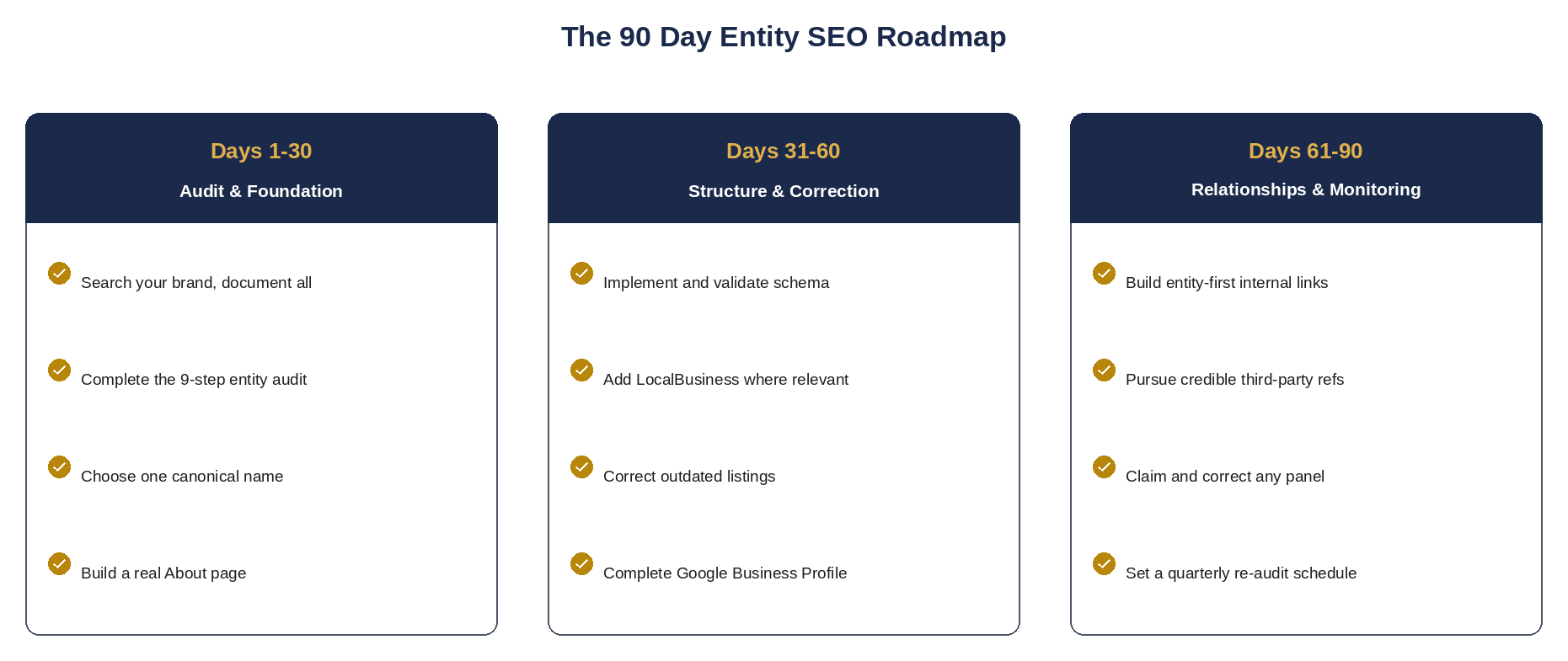
Days 1 to 30: Audit and Foundation
- Search your brand name and document everything that appears
- Complete the full nine step entity audit
- Choose one canonical business name and description
- Build or rewrite the About page as a genuine entity anchor
Days 31 to 60: Structure and Correction
- Implement Organization and Person schema, validated against visible content
- Add LocalBusiness and Service schema where applicable
- Correct or remove outdated directory listings and stale profiles
- Complete and verify the Google Business Profile
Days 61 to 90: Relationships and Monitoring
- Build out substantive service pages and entity first internal linking
- Pursue two or three credible third party references
- Claim and correct a Knowledge Panel if one exists
- Establish a baseline for branded search performance and set a quarterly re-audit schedule
This is Brand Multimedia's practical working framework for approaching entity work. It is not a Google ranking formula, and Google has published nothing resembling it. It is a way of sequencing work so that each stage supports the next.
Identity → the business decides precisely what it is and what it is called ↓ Consistency → that identity is expressed identically everywhere it appears ↓ Context → content establishes what subjects the entity is genuinely associated with ↓ Relationships → connections to people, places, services, and industries are made explicit ↓ Evidence → independent, credible sources corroborate the claims ↓ Authority → accumulated corroboration establishes the entity as well understood ↓ Machine Understanding → systems can interpret and represent the entity accurately
The sequence matters. Businesses commonly attempt evidence gathering before establishing identity and consistency, which produces references that corroborate contradictory information. Establishing identity first is what makes everything downstream worth doing.
SEO, Entity SEO, Semantic SEO, structured data, GEO, AEO, AI Optimization, and SXO are not eight separate ranking hacks, and treating them that way is how businesses end up paying for eight overlapping services with no coherent strategy.
They are components of one objective: being findable, understandable, credible, and useful to both people and machines. Traditional SEO handles the technical foundation and discoverability. Entity SEO establishes who you are. Semantic SEO establishes what you know. Structured data states both explicitly in machine readable form. GEO and AEO address how generative and answer focused systems retrieve and present information. AI Optimization covers broader technical legibility to AI systems. SXO ensures the experience actually serves the person who arrives.
Removing any one of them leaves a gap the others cannot fully cover.
The most useful thing this guide can leave you with is a correction rather than a tactic. Google's Knowledge Graph is not a directory you join, a score you optimize, or a switch an agency can flip. It is a system that recognizes things the web describes clearly, consistently, and credibly. The businesses that get represented well are, overwhelmingly, the businesses whose information does not contradict itself.
That is genuinely achievable work, and most of it is within your control: one canonical name, an About page that states real facts, structured data that matches visible content, corrected listings, credible references, and the discipline to keep all of it current as the business changes. What is not within your control is the outcome, and any provider promising a Knowledge Panel by a deadline is selling something they cannot deliver.
If you would like a clear picture of how your business currently appears across search and AI platforms, and where the contradictions are, Brand Multimedia is a professional digital marketing agency in Addis Ababa working with businesses across Ethiopia and internationally on exactly this: entity clarity, structured data, website architecture, and the broader SEO, GEO, AEO, AI Optimization, and SXO work covered throughout this content hub. Talk to us about a digital entity audit, or read our other digital marketing guides to continue with the companion articles referenced throughout this one.
Ready to grow your business? Reach out to our team today on WhatsApp and let’s discuss how we can help. Click here to chat with us