Executive Summary
Here is the sentence most AEO guides avoid writing: Google's own documentation says that, from Google Search's perspective, optimizing for generative AI search is optimizing for the search experience, and therefore still SEO. Google's July 2026 guide names "AEO" and "GEO" directly, acknowledges people use those terms, and then points readers to its guidance on evaluating third-party advice before paying for it.
That does not make AEO meaningless. It makes it more useful to understand honestly. Answer Engine Optimization is an emerging industry term for the work of structuring and presenting information so that answer-oriented systems can understand, retrieve, summarize, and surface it. Those systems now include Featured Snippets and People Also Ask, Google's AI Overviews and AI Mode, Microsoft Copilot and Bing's AI summaries, ChatGPT search, voice assistants, and other conversational interfaces. They work differently from each other, and their inner workings are mostly not public.
What is public is more than most people realize. Google explains how its generative AI features retrieve and ground responses, tells site owners no special optimization is required, and, as of August 31, 2026, gives every website worldwide a Generative AI performance report and a control over inclusion in Search Console. Microsoft has published an AI Performance report in Bing Webmaster Tools that shows how often content is cited in Copilot and Bing's AI answers. OpenAI documents how to keep its search crawler from being blocked. This guide is built on those primary sources, and it labels every claim as documented, publicly stated, observed, inferred, or speculative.
Practically, businesses should do less than the AEO industry implies and do it more carefully: answer real questions directly, build genuinely useful non-commodity content, keep technical access clean, keep entity and business information consistent, add accurate structured data where it fits, and measure with the tools that now exist.
What AEO does not do is guarantee anything. No legitimate professional can promise a Featured Snippet, an AI Overview appearance, or a citation from a specific AI system.
Key Takeaway: AEO is not about trying to "hack" AI systems. It is about making valuable information clear, structured, authoritative, accessible, and easy to understand and retrieve.
If a potential customer asks an AI assistant a question your business is well qualified to answer, what decides whether your knowledge shows up in the response?
It is not one lever, and anyone who tells you it is one lever is selling something. Somewhere between the question and the answer, a system interprets what was asked, retrieves candidate sources, judges which ones to trust, and writes or selects a response. Sometimes that response links to the pages it drew from. Sometimes it does not. Sometimes it sits above a familiar list of blue links, and sometimes it replaces the list entirely.
For businesses, that raises a practical question: is there anything you can do differently so that your accurate, useful information is easier for those systems to understand and use? The honest answer has two parts. Much of it is careful SEO that you may already know. And a smaller part is genuinely new, mostly in how you structure answers, how you check your technical access, and how you measure what is happening.
This guide covers both parts. It explains what Answer Engine Optimization is, where the term came from, what Google, Microsoft, and OpenAI have actually published about answer-oriented search, and how to implement it on a real website without making claims nobody can support.
Direct answer: Answer Engine Optimization (AEO) is an emerging optimization discipline focused on structuring and presenting information so that answer-oriented search systems, search engines, assistants, and AI experiences can more easily understand, retrieve, summarize, and surface useful answers from that information.
Definition box: An answer engine is any system that responds to a question with a direct answer instead of, or in addition to, a list of links. Examples include Featured Snippets, People Also Ask boxes, Google's AI Overviews and AI Mode, Microsoft Copilot, ChatGPT search, and voice assistants. Answer-oriented search describes the experiences these systems produce. AEO is the industry term for optimizing content for them.
Why the term emerged. Direct answers arrived in stages. Featured Snippets and voice assistants came first, rewarding pages that stated an answer clearly. Generative AI then added systems that synthesize an answer from several sources. Practitioners needed a label for the work of preparing content for all of it, and "answer engine optimization" stuck.
The difference in flow. Traditional search and answer-oriented search work differently, though real products often blend the two:
- Traditional search: query → search results → click → answer
- Answer-oriented search: question → retrieval and interpretation → synthesized answer → supporting sources
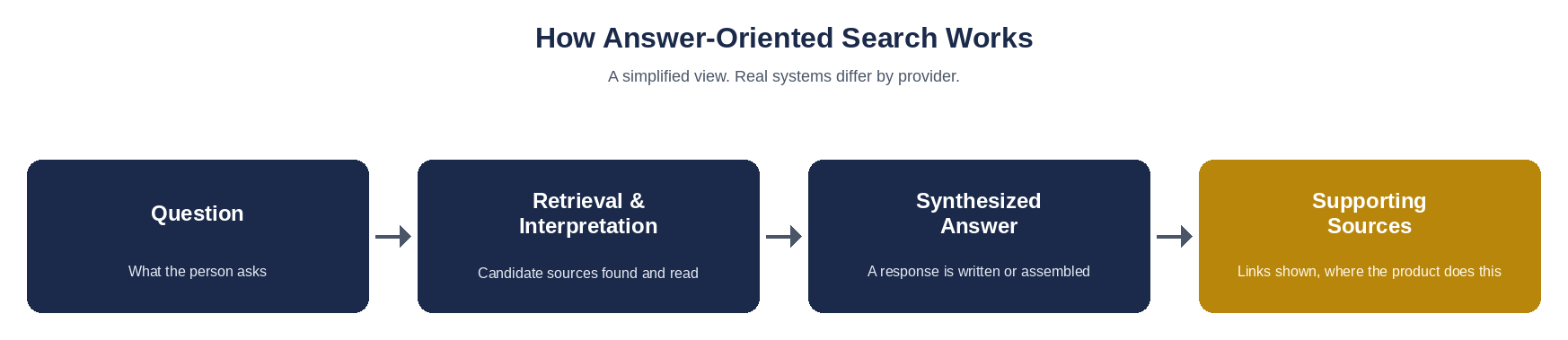
Do not treat that as a precise diagram of any single product. Google's AI Overviews appear on a results page. AI Mode is conversational. Copilot and ChatGPT behave differently again. Actual systems vary, and their internal workings are largely undisclosed.
A note on terminology. AEO is an industry term, not an official ranking system from Google, Microsoft, or anyone else. Google's July 2026 documentation, which its site owners can read in the official guide to optimizing for generative AI features on Google Search, acknowledges "AEO" and "GEO" as terms in circulation and treats the underlying work as SEO. That framing runs through this whole guide.
Simple example. A hypothetical Addis Ababa web design company gets asked constantly, "How long does it take to build a business website?" A page that opens with a plain two sentence answer, followed by what affects the timeline, a worked example, and links to related pages is easier for a reader, a Featured Snippet system, and an AI retrieval system to use than a page that buries the answer under a company history. Same content, clearer structure.
Key Takeaways
- AEO is a label for preparing information for answer-oriented systems, not a separate search engine or an official ranking factor.
- It overlaps heavily with SEO, content quality, semantic SEO, entity clarity, and structured data.
- Different systems retrieve, rank, and cite differently, so no single tactic works everywhere.
- It guarantees no rankings, snippets, citations, or traffic.
Direct answer: AEO matters because search now includes several answer experiences alongside traditional results, and each depends on content that systems can understand, retrieve, and trust. Traditional search is not dead. It coexists with these newer experiences.
The experiences worth knowing about:
- Blue link search. Still a core part of Google and Bing, and still the foundation the rest builds on.
- Featured Snippets and People Also Ask. Google describes featured snippets as special boxes that show the descriptive snippet first, and notes they can also appear within a related questions group, better known as People Also Ask.
- AI Overviews and AI Mode. Google's documentation for site owners describes both as features that surface relevant links, and says both may use a "query fan-out" technique, issuing multiple related searches across subtopics and data sources to build a response. Google's help pages also describe moving from an AI Overview into a deeper conversation in AI Mode. Google states AI Overviews are available in over 120 countries and territories.
- Bing and Copilot. Microsoft's AI Performance report in Bing Webmaster Tools covers citations across Microsoft Copilot, AI-generated summaries in Bing, and select partner integrations.
- ChatGPT search. OpenAI says any public website can appear in ChatGPT search, provided its search crawler is not blocked.
- Voice assistants and multimodal search. Google's own Search Console reporting now distinguishes text-based searches from multimodal ones where an image is part of the query.
What this does not mean. It does not mean people have stopped clicking links or that SEO is obsolete. It means a business's information can now reach a person in more than one form, sometimes without a visit to the site. That changes what you should measure and how you write, but it does not change the need to be crawlable, useful, and trustworthy.
What has changed most recently is measurement. Until 2026, publishers had little first-party visibility into AI answer performance. Microsoft launched an AI Performance report in February 2026. Google rolled out its Generative AI performance report and an inclusion control to all websites worldwide on August 31, 2026. Both are covered in the measurement section.
Direct answer: SEO is the broad discipline of making a website discoverable and useful in search. AEO applies much of the same practice toward answer-oriented experiences. SEO provides the foundation. AEO extends that foundation toward answers.
The most important thing this table cannot show is dependency. Answer-oriented systems retrieve from an index, and an index depends on crawling, quality, and relevance. AEO without a sound SEO foundation is built on nothing. Everything above rests on the technical and content groundwork that our SEO services exist to build.
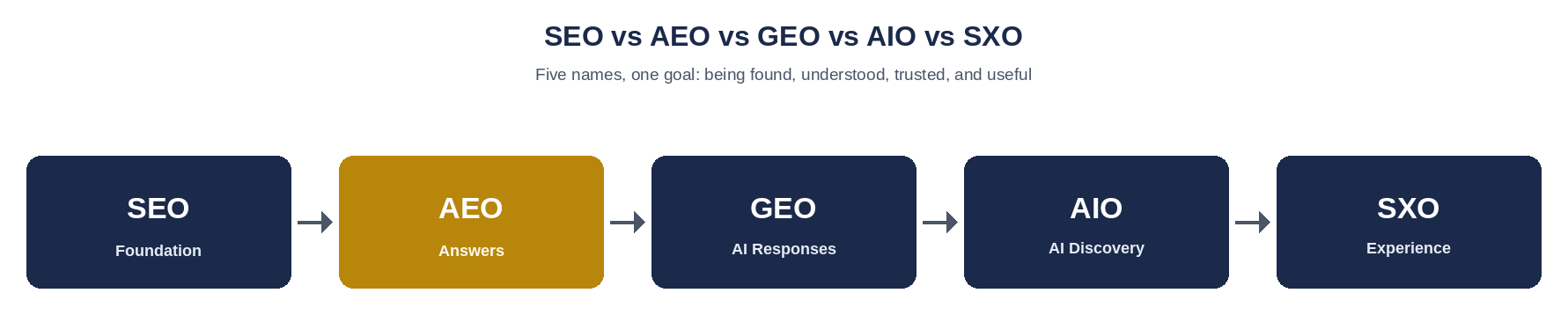
Direct answer: SEO, AEO, GEO, AIO (also called AI SEO), and SXO are overlapping disciplines that address different layers of the same goal: being found, understood, trusted, and useful. They are not isolated silos, and the boundaries between them are fuzzy and inconsistently used across the industry.
Where GEO came from. The term Generative Engine Optimization was formalized in a 2023 research paper, GEO: Generative Engine Optimization, by Aggarwal and colleagues, accepted to the KDD 2024 conference. It was an academic experiment on generative engines, not a statement from any search provider. Microsoft later used the term when it described its AI Performance report as an early step toward GEO tooling in Bing Webmaster Tools. Google, as noted earlier, folds the work into SEO. Three organizations, three framings, one underlying territory.
Brand Multimedia covers the generative side of this in our Generative Engine Optimization guide, and in practice through our GEO services.
A conceptual framework for how they connect. Brand Multimedia uses a simple sequence to explain how the disciplines relate:
SEO (be findable and useful) → AEO (be answerable) → GEO / AIO (be retrievable and citable in AI experiences) → SXO (be useful once someone arrives)
This is a conceptual framework, not an official industry standard. Real work moves back and forth across it, and a weak stage limits the ones after it. A site with excellent answers but a poor experience wastes the visibility it earns. The experience layer is where our SXO services apply, and the answer layer is where our AEO services apply the process described in this guide.
On evaluating advice. Google's guidance recommends reviewing any third-party AEO or GEO advice against its guidance on third-party SEO advice and tools. That applies to this article too. Verify what matters against the primary sources listed at the end.
Direct answer: Answer-oriented systems generally move through crawling, indexing, retrieval, interpretation, selection, and presentation, but each provider's exact process is proprietary and differs. What is publicly documented is narrower than what the industry often asserts, so each step below is labeled by how well supported it is.
Evidence labels used in this guide: Documented means a provider states it in official documentation. Guidance means a provider publicly recommends it. Observed means an industry pattern with no official confirmation. Inference means a reasonable conclusion. Speculation means uncertain.
- Crawling. Documented. Google's documentation says generative AI features depend on publicly accessible, crawlable content. OpenAI says its search crawler, OAI-SearchBot, must not be blocked for content to appear in ChatGPT search.
- Indexing. Documented. Google states a page must be indexed and eligible to be shown in Search with a snippet to be eligible for generative AI features.
- Retrieval. Documented for Google. Google describes retrieval-augmented generation, also called grounding, in which its systems use core Search ranking to retrieve relevant, current pages from the Search index and then review specific information from them to produce a response with supporting links.
- Understanding. Guidance. Google says its systems can understand synonyms and general meaning, connecting people to content that does not use the same precise words.
- Entity recognition. Established concept, opaque in detail. Covered in our Google Knowledge Graph guide.
- Semantic relationships. Established concept. Meaning is inferred from how ideas relate, not only from keywords.
- Query interpretation. Documented for Google. Google describes query fan-out: concurrent, related queries generated to gather more information. Its example is a question about fixing a weedy lawn that fans out into searches on herbicides, chemical-free removal, and prevention.
- Passage or content selection. Inference. Systems appear to draw on specific parts of pages, but the selection logic is not published.
- Ranking and relevance. Documented at a high level for Google. Generative AI features rely on core Search ranking and quality systems.
- Answer generation or presentation. Documented in outline. A model writes or assembles the response from retrieved material.
- Citation and source attribution. Varies by product. Google shows links that support the response. Microsoft's report counts sources displayed in AI answers. OpenAI's documentation focuses on crawler access, and its public site owner guidance does not explain how citations are chosen.
Seven concepts that recur.
- Retrieval: finding candidate information to use. If you are not retrievable, you cannot be used.
- Relevance: how well candidate information matches what was asked, including the underlying need.
- Authority: how trustworthy a source appears. Google frames this through helpful, reliable, people-first content.
- Freshness: how current the information is. Google says grounding improves the freshness of AI responses.
- Context: the surrounding information that clarifies meaning, such as the page topic, business, or location.
- Entity relationships: how people, organizations, places, and concepts connect.
- Grounding: anchoring a generated answer in retrieved, real sources rather than relying only on a model's training.
Why clearly written information can be easier to use. Inference. A system that must decide quickly which passage answers a question benefits from passages that state the answer plainly, define their terms, and keep related facts near each other. That is a reasonable expectation, not a documented guarantee, and Google explicitly says you do not need to break content into tiny pieces for its systems.
Direct answer: Answer-ready content states the answer clearly, supports it with context and evidence, and is organized so both people and systems can find the relevant part quickly. It is written for readers first.
- Direct answers. State the answer in the first one or two sentences. "Most small business websites take four to eight weeks to build, depending on scope" beats a paragraph of preamble.
- Clear definitions. Define technical terms where they first appear, in plain language.
- Question-based headings. Use headings that match how people ask, such as "How long does a website redesign take?"
- Strong information hierarchy. One H1, logically nested H2 and H3 headings, no skipped levels.
- Concise answer blocks. A short answer paragraph that stands on its own if read in isolation.
- Supporting context. After the answer, explain why, when it changes, and what it depends on.
- Evidence. Cite primary sources, show your data, and be specific instead of vague.
- Clear terminology. Use one name per concept. Calling the same service three different things confuses readers and systems.
- Entity consistency. Keep names, locations, and descriptions identical wherever they appear.
- Structured information. Use lists, tables, and steps where the content is genuinely a list, table, or process.
- Internal links. Connect related questions and pages with descriptive anchor text.
- Authoritative external references. Link to the sources that support important claims.
- Freshness. Update pages whose facts, prices, or policies change, and show a visible update date.
- Original expertise. Add what only you can add: experience, data, process, judgment. Google's guide calls this non-commodity content and says it likely matters more than any other suggestion in its guide.
- Strong user experience. Readable typography, fast loading, mobile friendly layouts, and a clear next step.
This is Brand Multimedia's strategic framework for planning answer-oriented content. It is not an official framework from Google, Microsoft, OpenAI, or any search provider, and it is not a ranking formula.
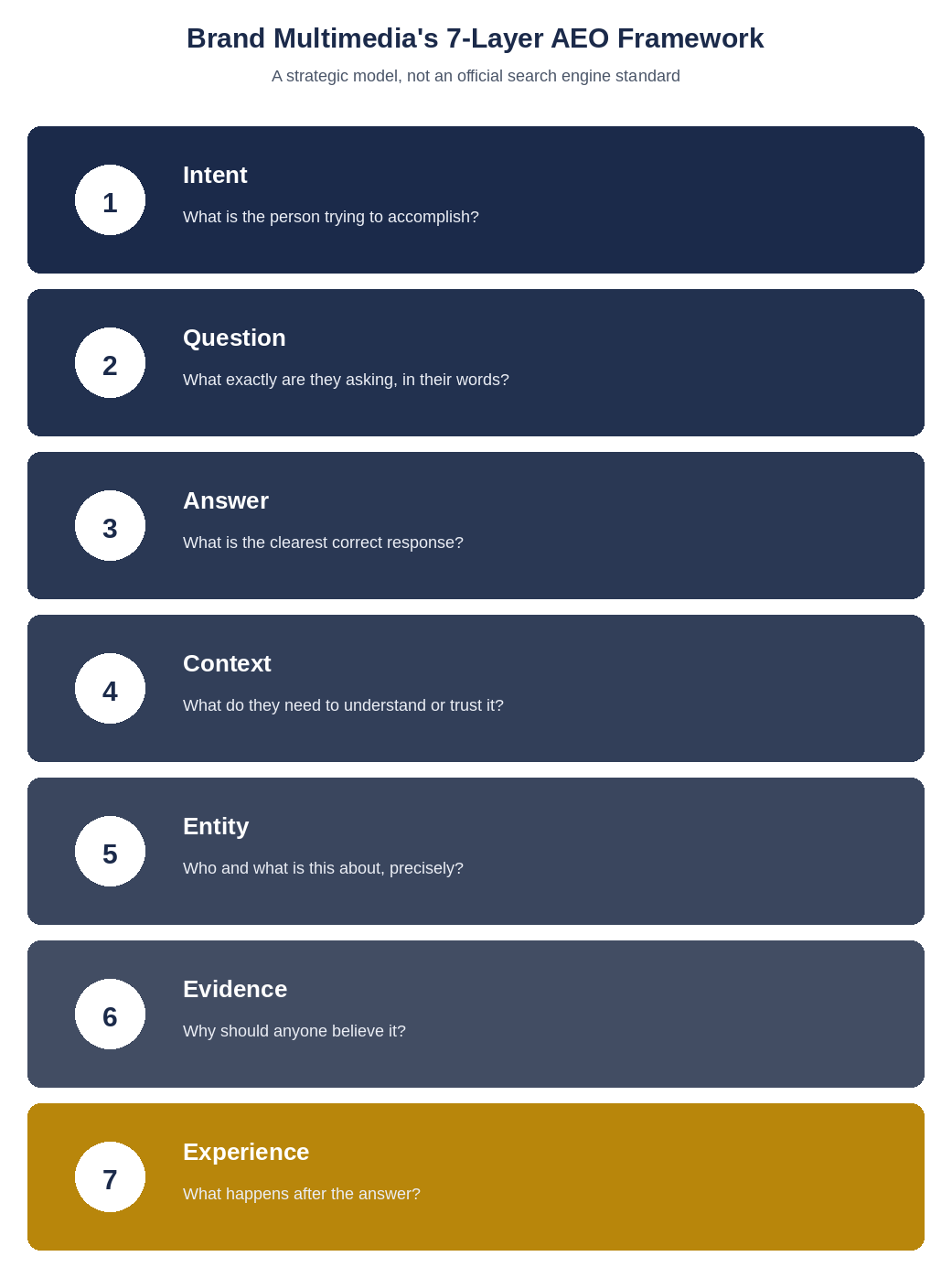
Layer 1: Intent. What is the person actually trying to accomplish? Decide whether the need is to learn, compare, decide, or act before writing a word. Output: an intent label for each target question.
Layer 2: Question. What exactly are they asking, in their words? Collect real phrasing from customers, not only from keyword tools. Output: a prioritized question list.
Layer 3: Answer. What is the clearest correct response? Lead with it. Output: a direct answer block of a sentence or short paragraph.
Layer 4: Context. What does the reader need to understand or trust that answer? Explain conditions, exceptions, and trade-offs. Output: an explanation that shows when the answer changes.
Layer 5: Entity. Who and what is this about, precisely? Name the organization, people, services, and places consistently, and connect them to the rest of your site. Output: consistent entity naming and, where fitting, accurate structured data.
Layer 6: Evidence. Why should anyone believe it? Cite sources, show data, use examples, and disclose limits. Output: linked primary sources and specific proof.
Layer 7: Experience. What happens after the answer? Make the page readable, fast, and clear about the next step, and add first-hand expertise no summary can copy. Output: a page that serves the reader beyond the answer.
Weakness in any layer limits the rest. A well-researched answer on a page nobody can read on a phone wastes Layers 3 through 6. A beautifully designed page that answers the wrong question wastes Layer 7.
Direct answer: A reliable structure for a question-led section is: the question as a heading, a direct answer, an explanation, an example, key takeaways, and related questions. This improves readability for people and can make content easier for search systems to understand, but it does not guarantee Featured Snippets or AI citations.
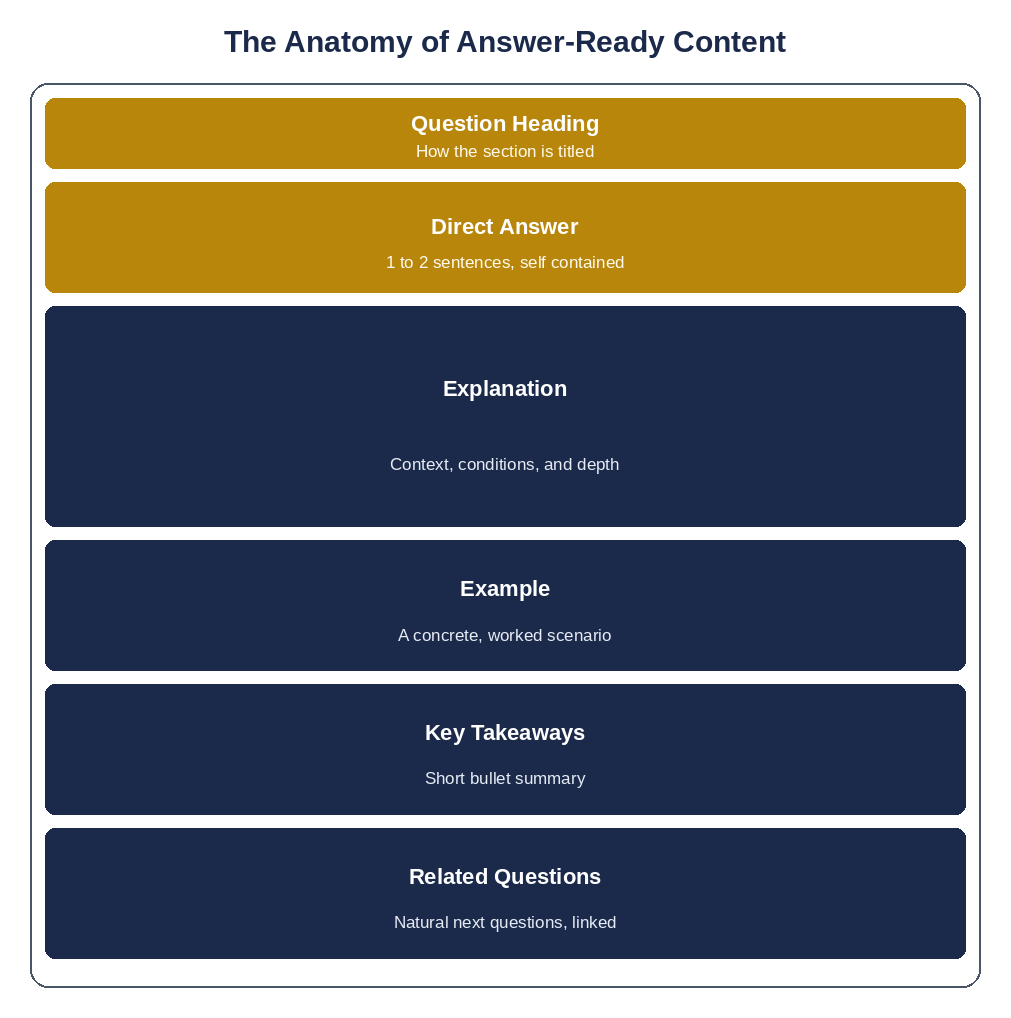
Question (heading): What is Answer Engine Optimization?
Direct Answer (40 to 60 words): A short, self contained answer that makes sense if read on its own.
Explanation: Detailed context: why it works this way, what it depends on, when it does not apply.
Example: A real-world scenario that shows the answer in use.
Key Takeaways: Two to four bullets that summarize the section.
Related Questions: Links or short answers to the natural next questions.
What this structure is for. It is for the person reading. Answer-first writing respects a reader's time and is easier to scan. It also tends to make each section coherent when read alone, which may help any system that retrieves individual passages.
What it is not. Google's July 2026 guide states there is no requirement to chunk content into tiny pieces for AI, that there is no ideal page length, and that you should write pages for your audience, not just for generative AI search. Treat the template as an editorial habit, not a technical trick. Do not fragment a good page into many thin ones to imitate it.
Direct answer: Effective AEO question research collects the real questions your audience asks, classifies them by type and intent, and maps each to a page that answers it well. Real customer language usually beats tool generated lists.
Where to find questions.
- Google autocomplete, People Also Ask, and related searches: show how people phrase questions publicly.
- Google Search Console: shows real queries that already surface your site, including longer questions.
- Keyword tools: useful for volume and variation, but verify against real data.
- Customer questions, sales calls, and support conversations: often the richest source, because they reflect real buying concerns.
- Reddit, forums, and community discussions: where appropriate and relevant, they show unfiltered language and confusion.
- Your existing FAQs and internal site search: show what visitors already fail to find.
- Competitor content: shows which questions others answer, and where their answers are thin.
- Google Trends: helps judge seasonality and relative interest.
- AI-assisted question discovery: a fast way to brainstorm, but treat output as hypotheses to verify, since it can invent plausible questions nobody asks.
The Question Research Framework
A boundary worth respecting. Google's guide warns that creating separate content for every possible variation of how people search, including fan-out queries, primarily to manipulate rankings or AI responses, violates its scaled content abuse spam policy. Build one strong page per real need, not fifty near duplicates per keyword variation.
Direct answer: Featured Snippets are the oldest answer feature in Google Search, and they overlap closely with AEO. Google states you cannot mark a page as a featured snippet. Its systems decide whether a page makes a good one. Clear, direct content can make a page easier to understand and may improve its suitability, but nothing guarantees the result.
According to Google's featured snippets documentation, these are special boxes that show the descriptive snippet first, they can appear within People Also Ask, clicking one can take a reader directly to the relevant section of the page, and Google does not publish an exact minimum length needed to qualify.
Formats commonly observed (industry observation, not Google guidance):
- Paragraph: a concise definition or explanation. Aim for a self-contained answer of roughly 40 to 60 words.
- List: numbered steps or bulleted items, typically for processes and rankings.
- Table: comparisons and specifications.
- Definition: a "what is" answer in a sentence or two.
- Step by step: an ordered process where sequence matters.
How to structure content well. Match the format to the question. A "how to" deserves numbered steps. A "compare" deserves a table. A "what is" deserves a crisp definition. Then support the answer with depth below it, so the page serves readers who click through.
Say it accurately. This structure can make content easier for search systems to understand and may improve eligibility or suitability for certain search features. Google decides.
A technical point that matters. Google's documentation describes controls that limit snippets, including the nosnippet rule and max-snippet limits. Google's generative AI guidance also states a page must be eligible to appear in Search with a snippet to be eligible for AI features. If a template or plugin applies snippet restrictions site wide by accident, it can quietly limit both. Audit this.
Direct answer: Google, Microsoft, and OpenAI each publish a different slice of guidance for site owners. Google says AI Overviews and AI Mode rely on core Search systems and need no special optimization. Microsoft reports citations in its own AI experiences. OpenAI documents crawler access. There is no single universal AI ranking algorithm.
Google AI Overviews and AI Mode.
- Documented. Google's AI features and your website documentation states that SEO best practices remain relevant, and that there are no additional requirements to appear in AI Overviews or AI Mode and no other special optimizations necessary. It describes query fan-out and notes these features can show a wider and more diverse set of supporting links than a classic search.
- Documented. The July 2026 guide explains that these features use retrieval-augmented generation, also called grounding, relying on Search ranking systems to retrieve current pages, then generating a response with clickable supporting links.
- Documented. Inclusion is managed through Search Console. As of August 31, 2026, Google's Search generative AI control is available to all websites worldwide. By default, sites are included. A site can choose to exclude itself, which prevents its links and content from appearing in and grounding those features, and Google states this control is not used as a ranking signal in other parts of Search.
- What you cannot do. You can opt out. You cannot force inclusion or a citation.
Bing generative search and Microsoft Copilot. Microsoft's Bing Webmaster Blog introduced AI Performance in Bing Webmaster Tools in February 2026, a report showing where and how often content is cited across Copilot, Bing's AI summaries, and select partner integrations. It reports citations as sources displayed in AI answers, without indicating placement within an answer.
ChatGPT search. OpenAI's publishers and developers FAQ says any public website can appear in ChatGPT search, and that to be included in its summaries and snippets you should make sure you are not blocking OAI-SearchBot. OpenAI's crawler overview describes its crawlers as independent settings, so a site can allow the search crawler without agreeing to training use. Public documentation on how ChatGPT search selects and cites sources is limited, so avoid confident claims about it.
Other assistants. Anthropic, Perplexity, and other providers operate their own crawlers, indexes, and citation behavior. Check each provider's current documentation, and be skeptical of confident claims that are not tied to one.
Retrieval, grounding, citations, and synthesis in plain terms. A system retrieves candidate material, grounds its answer in it, synthesizes a response, and may cite the sources it used. Which sources, how many, and how they are shown differ by product.
What you can realistically control: crawlability, indexability, snippet eligibility, content quality, entity clarity, accurate structured data, and technical access for the crawlers you choose to allow. For the broader technical work of making a site legible to AI systems, see our AI Optimization services.
What you cannot control: whether any specific system cites you for any specific question.
Direct answer: Entities, semantic relationships, and knowledge graphs give search systems the context they need to interpret information. AEO builds on that foundation by making the information easy to use as an answer.
- Entity SEO clarifies who or what a page is about. See our Entity SEO guide.
- Semantic SEO focuses on meaning, topics, and relationships beyond individual keywords. See our Semantic SEO guide.
- Knowledge graphs store entities and the relationships between them. See our Google Knowledge Graph guide.
- AEO applies that understanding to answer-oriented retrieval and presentation.
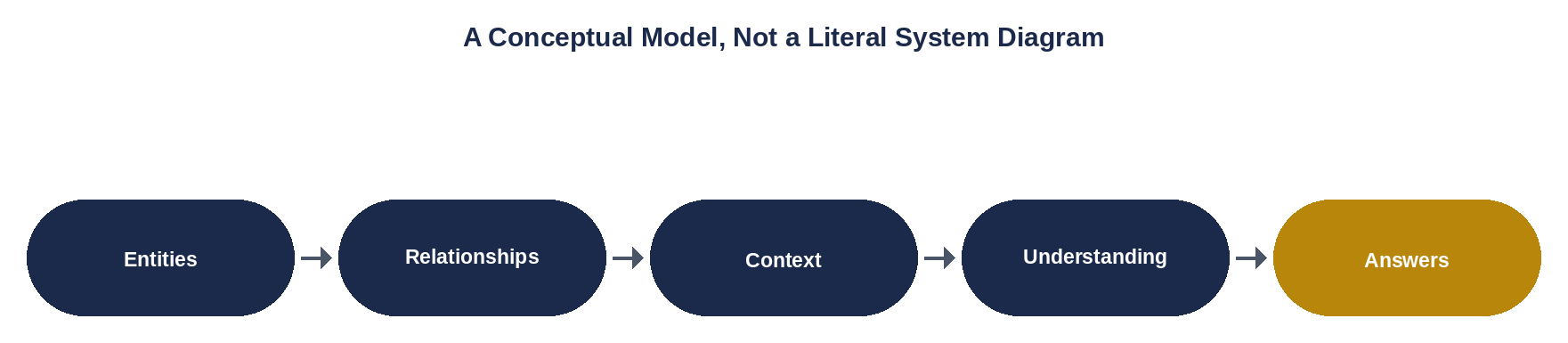
A conceptual model of how these connect:
Entities → Relationships → Context → Understanding → Answers
This is a conceptual model, not a literal description of how any search engine or AI system is built. Real systems differ in what they use and how. The practical implication is stable, though: a page that makes clear who is speaking, what it is about, and how that connects to related ideas is easier to interpret than one that leaves those things implicit.
Direct answer: Structured data provides standardized, machine-readable information that can help search engines understand page content and entities. It is not required for generative AI search, no special schema is needed, and it does not make any AI system cite you.
The vocabulary comes from Schema.org, usually written as JSON-LD, and Google's structured data documentation explains how it works and why markup must match visible content.
Types that make sense for most sites:
- Organization: the business as a defined entity
- Person: authors and named experts
- WebPage, Article, or BlogPosting: page and content level facts
- BreadcrumbList: site hierarchy
- LocalBusiness: physical location or service area
- Service and Product: what you offer, where they genuinely apply
- FAQPage: only where a page has genuine visible FAQs, with the caution below
The FAQPage caution. Google restricted FAQ rich results in 2023, as its own announcement on HowTo and FAQ changes explains, and then retired them from Search in 2026, as covered in our Schema Markup guide. Eligibility and display are decided by each search engine's systems and policies, and adding FAQ markup does not automatically produce any rich result or improve AI visibility. Write FAQs because readers need them.
Human-readable content vs machine-readable data. The visible page is what people read, and structured data is a parallel description for machines. They must agree. Markup that states facts the visible page does not support, or that describes content users cannot see, violates platform guidelines. Validate with the Schema Markup Validator and Google's Rich Results Test.
Where Google stands. Its generative AI guide lists overfocusing on structured data among the things you can ignore for AI search, while still advising you to keep using it as part of overall SEO, since it supports rich result eligibility elsewhere.
Direct answer: E-E-A-T, meaning Experience, Expertise, Authoritativeness, and Trust, is a quality framework, not a single measurable ranking factor. It matters for AEO because answer-oriented systems benefit from retrieving information people can reasonably trust.
Google's guidance on helpful, reliable, people-first content is the primary source. Practical signals worth making visible:
- Authorship: named authors with real credentials and short bios
- First-hand experience: what you actually did, measured, or saw
- Citations and sources: links to primary evidence for important claims
- Transparency: clear business identity, contact information, and About page
- Editorial standards: review dates and correction practices
- Original research and case studies: real data or clearly labeled hypothetical examples
Do not fabricate credentials, invent client results, or manufacture quotes. In answer-oriented systems, a wrong answer with your name on it costs more than a missing one.
Direct answer: One article rarely demonstrates comprehensive expertise. Topic clusters, meaning a pillar plus connected supporting content, show depth and give systems and readers a coherent picture. "Topical authority" is an industry term, not an official Google metric.
An example cluster for this subject:
AI Search Optimization → AEO → GEO → AI Overviews → Entity SEO → Semantic SEO → Knowledge Graph → Schema Markup → SXO → AI visibility measurement
Each item is its own page, and internal links express the relationships between them. Brand Multimedia's own content hub follows this pattern, which is why this article connects to its guides on entities, semantics, schema, and generative optimization.
A caution. Depth is not volume. A cluster of thoughtful pages that each serve a real need beats hundreds of thin pages, and the latter risks the scaled content problems discussed earlier.
Direct answer: For local questions, accurate and consistent business information gives search systems reliable data to work with. It supports discoverability. Nothing guarantees placement in a local AI answer.
Questions worth answering for a business such as a digital marketing agency:
- Best digital marketing agency in Addis Ababa
- Digital marketing agency near me
- SEO agency in Addis Ababa
- Where can I get SEO services in Ethiopia?
- Web design agency in Addis Ababa
What to do.
- Google Business Profile: complete, accurate, and current. Google's guide notes Business Profiles can help products and services appear in AI responses and other results, and its documentation on adding and managing business details covers the basics.
- Bing Places: claim and maintain your listing where relevant, since Microsoft experiences use their own data.
- NAP consistency: identical name, address, and phone across the site and listings.
- Categories, services, hours, and location: specific and accurate, not stuffed.
- Reviews: genuine, gathered ethically, answered thoughtfully.
- Website content: service pages that name real services and real places, not generic text with a city name inserted.
- Local landing pages: create one only where you genuinely serve a distinct location, with unique useful content, to avoid thin near duplicates.
- LocalBusiness structured data: accurate and matching the profile.
- Location specific FAQs: answers to questions people actually ask about serving that area.
Regional reality. Availability of AI features and the depth of business data vary by country and language. Search your own target questions in your own market and see what appears rather than assuming.
Direct answer: B2B buyers ask practical questions long before they contact anyone. Turning sales conversations into clear, honest answers is one of the highest value AEO activities.
Questions to answer publicly:
- What does this company do, and who is it for?
- How much does this service cost, and what drives the price?
- Which solution is right for my situation?
- What are the alternatives, and how do they compare?
- What industries does this company serve?
- How long does implementation take?
How sales questions become content. Log the ten questions your sales team hears most, answer each on a dedicated page or well structured section, and link them from relevant service pages. Answer honestly, including when you are not the right fit. That honesty is what makes an answer worth retrieving and worth trusting.
Direct answer: Ecommerce AEO centers on making product information clear, consistent, and current across your site and product feeds.
- Product questions: answer size, compatibility, materials, and use directly on the page.
- Comparisons and buying guides: help shoppers decide, not just sell.
- Specifications and attributes: consistent structure across products.
- FAQs: real pre-purchase questions, not filler.
- Structured data and feeds: Google notes Merchant Center feeds and Business Profiles can help products be visible in AI responses and other results.
- Reviews, pricing, availability, and shipping: accurate, visible, and up to date.
The failure mode is inconsistency: a price in the feed that differs from the page, or a spec described three ways across three pages.
Direct answer: Service businesses should structure their sites so that each service, its price logic, its process, and its proof are clearly answerable.
- Service pages: one substantive page per service, with a direct opening description.
- Pricing information: honest ranges and what changes them.
- Process pages: what happens after someone enquires, step by step.
- FAQs: the objections and practical questions prospects really raise.
- Comparison pages: how your approach differs from common alternatives.
- Case studies: real evidence, or clearly labeled hypothetical examples.
- Industry and location pages: only where you have genuine relevant experience.
Example. An accounting practice that explains "what a bookkeeping engagement includes, how long onboarding takes, and what we need from you" answers three high intent questions on one page, and gives a prospect a reason to make contact.
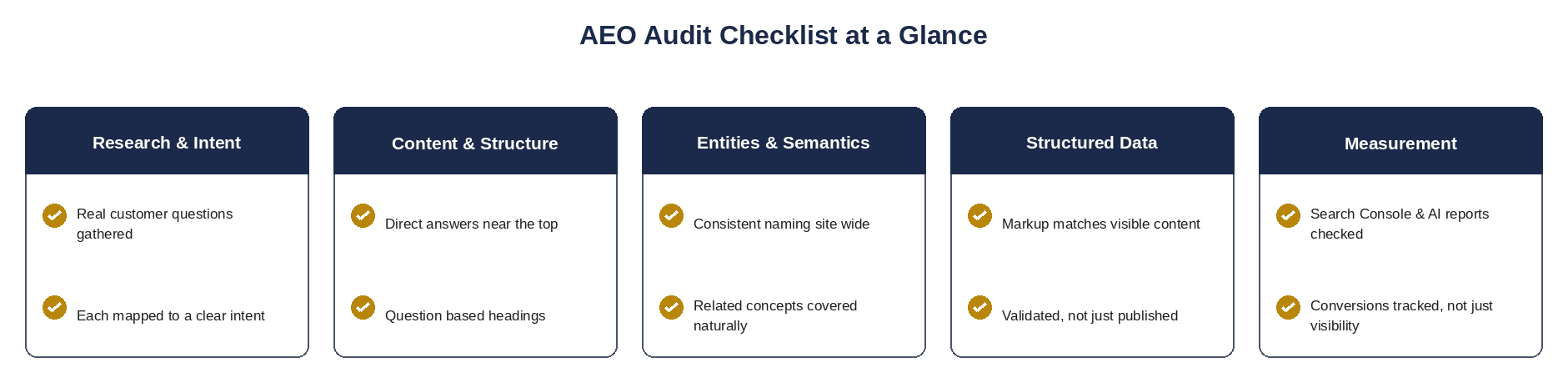
Direct answer: Optimizing an existing site is a fourteen step process that starts with real questions and ends with monitoring and updating.
- Identify high value questions. Example: list the fifteen questions prospects ask before hiring you.
- Map questions to search intent. Example: label each as learn, compare, decide, or act.
- Audit existing content. Example: find which questions your site already answers, poorly answers, or ignores.
- Create direct answer sections. Example: add a two sentence answer at the top of each key page.
- Improve headings. Example: rewrite "Our Approach" as "How does our SEO process work?"
- Strengthen semantic context. Example: add the definitions, exceptions, and related ideas a newcomer would need.
- Improve entity clarity. Example: unify business name, description, and leadership details site wide.
- Add relevant structured data. Example: Organization, Article, BreadcrumbList, LocalBusiness, validated against visible content.
- Improve internal linking. Example: link each service page to its supporting guides with descriptive anchors.
- Add authoritative references. Example: cite Google and Microsoft documentation for technical claims.
- Strengthen E-E-A-T. Example: add named authors, credentials, and review dates.
- Improve UX. Example: fix mobile readability, page speed, and unclear calls to action.
- Monitor performance. Example: review Search Console, the Generative AI performance report, and Bing AI Performance monthly.
- Update content. Example: revisit pages when facts change, and keep visible update dates honest.
Technical audit alongside. Confirm pages are crawlable and indexable, check for accidental nosnippet or noindex, review robots.txt for the search crawlers you want to allow, and check that CDN or security settings are not blocking legitimate crawlers before robots.txt is even consulted.
Direct answer: Use this template to plan any answer-led page. Copy it, fill it in, and adapt it. It is a planning aid, not a guarantee of any outcome.
Direct answer: AEO is measured through a combination of platform reports, standard search data, analytics, and manual testing. No universal AEO score exists, and capabilities differ significantly by platform.
What the platforms now offer.
- Google Search Console. The Generative AI performance report, rolled out to all websites worldwide on August 31, 2026, shows organic impressions from AI Overviews and AI Mode over time, which pages get the most and least impressions, and where they come from by device and country. It can be filtered by text based or multimodal search. Its documentation describes impressions, so check the current report for what else it shows. Some properties may not see it yet, or may lack enough impressions, or may have excluded themselves through the generative AI control.
- Bing Webmaster Tools. The AI Performance report, introduced in February 2026, shows total citations, average cited pages, page level citation activity, grounding queries, and trends over time across Copilot, Bing AI summaries, and select partner integrations. Microsoft notes it does not indicate placement within an answer, and it measures citations, not clicks or rankings. It does not cover ChatGPT, Perplexity, or Google AI Overviews. It launched as a public preview, so check current status.
Limitations to state plainly. Measurement is uneven: Google and Microsoft give first-party reports for their own surfaces, while ChatGPT and most others give none. Google's guide also warns to be wary of third-party tools that promise ranking success or claim to use internal Google metrics, since no third-party tool has access to Google's internal systems. Third-party monitoring can still be useful for directional tracking, but treat any proprietary "AEO score" as that vendor's own metric, not an industry standard. Measuring citations alone is insufficient too. A citation that brings no qualified visitors is not a business result.
What is already documented.
- Google offers a generative AI performance report and an inclusion control, both worldwide as of August 31, 2026.
- Microsoft offers AI citation reporting in Bing Webmaster Tools.
- Google's July 2026 guide already covers agentic experiences, noting browser agents can read a site through visual renderings, the page structure, and the accessibility tree, and that emerging protocols may let Search agents do more.
What is emerging.
- Agentic search, where AI systems complete tasks such as booking or comparing on someone's behalf, which raises the value of clear, accurate, machine-usable information.
- More first-party measurement from other providers, following Google and Microsoft.
- Continued blending of conversational, multimodal, and voice interfaces.
What remains uncertain.
- Whether other AI providers will publish citation or performance reporting.
- How answer experiences will affect click behavior and business models over time.
- How much detail providers will disclose about retrieval and citation selection.
- Whether the AEO and GEO labels persist or fold into SEO as Google's framing suggests.
Any confident, specific prediction beyond this should be treated with skepticism, including predictions in guides like this one.
- Put the answer before the explanation. Readers scan, and any system lifting a passage benefits from a self-contained answer. The common error is opening with background.
- Entity consistency beats clever markup. If your business name, description, and leadership differ across your site and listings, no schema fixes that. Fix the source of truth first.
- Context beats keyword repetition. Google states its systems understand synonyms and meaning. Repeating a phrase adds nothing. Explaining conditions and exceptions does.
- Write FAQs that answer real questions. A shallow FAQ block on every page reads as filler and helps no one.
- Thin AI-generated content is a liability. Google's guide calls out commodity content and scaled content abuse. If a language model could write your page without your input, so could everyone else's.
- Internal links carry semantic meaning. They tell readers and systems which ideas connect. Plan them while writing, not after.
- Structured data should complement visible content, never replace it. If the schema says it, the page must say it.
- AEO belongs with technical SEO. A perfectly written answer on a page that is blocked, unindexed, or snippet restricted is invisible.
- Citations alone are an incomplete metric. Track whether the visibility produces qualified visits and enquiries.
- Conversion intent still matters. Even informational answers should lead somewhere useful. Give a next step that fits the question.
- Check crawler access deliberately. Decide which AI crawlers you welcome, distinguish search crawlers from training crawlers, and verify with server logs rather than assuming.
- Do not chase every fan-out variation. Build one strong page per real need. Near duplicates invite spam problems.
- Separate documented fact from industry lore in client conversations. That discipline builds credibility and protects you from promises you cannot keep.
- Test your own target questions monthly. Ask the assistants and search engines your prospects use, record what they say, and note accuracy problems you can correct at the source.
Hypothetical Example. This is an illustrative scenario. It does not describe a real Brand Multimedia client, and no traffic figures or results are claimed.
The company. A fictional Addis Ababa commercial cleaning and facility management firm serves offices, hotels, and clinics.
Before
- Twenty-five service pages, most a few generic sentences long
- Almost identical wording across pages, differing only in the service name
- An FAQ page of six vague questions
- Three variations of the company name across the site and listings
- An outdated phone number in two directories
- Almost no internal links, and no page explaining pricing or process
Strategy
Prioritize the questions prospects actually ask, consolidate overlapping pages, fix entity information first, then build answer-led content around the services that produce the most enquiries.
Implementation
- Interview the sales lead and collect the twenty most common prospect questions
- Merge twenty-five thin pages into eight substantive service pages, each opening with a direct description
- Add a pricing explanation page describing what drives cost, without inventing figures
- Rewrite the FAQ with real questions and honest answers, and remove the vague ones
- Standardize the company name and details site wide and correct the directory listings
- Complete the Google Business Profile and add accurate LocalBusiness structured data
- Add named authors, a clear About page, and internal links between related services
- Check robots.txt, snippet directives, and indexing, and review the Search generative AI control in Search Console
- Begin monthly review of Search Console, the Generative AI performance report, and manual question testing
Expected types of improvement
Cleaner crawling and consolidation of duplicated pages. More consistent business information across sources. Clearer answers for readers, which may improve engagement and enquiry quality. Better visibility into how the site appears in AI features through platform reports. Whether any specific answer feature or AI system cites the firm remains outside its control, and this example claims no result.
- Treating AEO as a replacement for SEO. It depends on SEO. It does not replace it.
- Writing for machines instead of people. Google says to make pages for your audience, not just for generative AI search.
- Keyword stuffing. Google states you do not need to worry about capturing every long-tail variation.
- Creating shallow FAQs. Thin questions with vague answers add nothing.
- Publishing generic AI-generated content. Commodity content offers no reason to be chosen.
- Making unsupported claims. Unsourced statistics and invented benefits erode trust.
- Hiding answers deep inside pages. Lead with the answer.
- Ignoring search intent. A correct answer to the wrong question still fails.
- Ignoring entities. Unclear or inconsistent identity makes information harder to trust.
- Using incorrect structured data. Errors and mismatches can undermine the markup.
- Marking up content that is not visible. This violates guidelines.
- Publishing outdated information. Freshness matters, and old facts mislead.
- Ignoring internal links. Relationships between pages go unexpressed.
- Ignoring authority and trust. Anonymous, unsourced content is easy to discount.
- Creating hundreds of low-value pages. Quantity is not quality, and it risks spam policy problems.
- Focusing only on AI citations. Visibility that does not produce value is a vanity metric.
- Ignoring traditional search. It remains a major channel and the foundation for the rest.
- Measuring only rankings. Rankings miss answer features and AI visibility.
- Ignoring conversions. Attention without action is not a result.
- Assuming every AI system works the same way. Indexes, retrieval, and citation behavior differ.
- Blocking the wrong crawlers by accident. Confusing search crawlers with training crawlers can remove you from features you wanted.
- Buying "special AI files" or markup as a fix. Google states its Search does not use llms.txt files, and that unnecessary AI text files and special markup are not needed for its generative AI features. They are harmless to keep for other systems that use them, but they are not a Google Search lever.
Answer Engine Optimization (AEO) is an emerging discipline focused on structuring and presenting information so that search engines, assistants, and AI systems can more easily understand, retrieve, summarize, and surface useful answers from it. It overlaps heavily with established SEO and does not guarantee rankings, Featured Snippets, or AI citations.
AEO stands for Answer Engine Optimization. The term describes work aimed at answer-oriented experiences such as Featured Snippets, voice assistants, and AI-generated answers. It is an industry term, not an official Google or Microsoft ranking system.
No, but they overlap heavily. SEO is the broader discipline of making a site discoverable and useful in search. AEO applies much of the same practice, such as search intent, clear content, structured data, and entity clarity, toward answer-oriented experiences. Google's own guidance treats optimizing for AI search as part of SEO, so AEO works best as an extension of SEO, not a replacement.
They are closely related but not identical. AEO focuses on making information easy to extract and present as a direct answer, including Featured Snippets and voice results. GEO focuses on visibility inside generative AI responses. In practice the two share most of their tactics, and the boundary between them is blurry.
AI SEO, sometimes called AIO, is a broader umbrella term for optimizing for AI driven discovery, including technical access for AI crawlers. AEO is narrower and centers on answers. Both terms are used inconsistently across the industry, so check what a provider means before comparing them.
It can help indirectly, but nothing guarantees inclusion. Google says AI Overviews and AI Mode rely on its core Search systems, that no special optimizations are required, and that the same SEO fundamentals apply. Clear, helpful, indexable content is what AEO and Google's guidance both emphasize.
Clear, direct answers can make content easier for search systems to understand and may improve suitability for a Featured Snippet. But Google states you cannot mark a page as a featured snippet, and its systems make that decision.
Start with real questions, answer each one directly near the top of its section, then add context, evidence, and examples. Make sure pages are crawlable and indexable, keep business and entity information consistent, and support content with accurate structured data where it fits. Then measure and update.
Use Google autocomplete, People Also Ask, related searches, Search Console queries, sales calls, support tickets, internal site search, and community discussions. Real customer language is usually more valuable than a keyword tool export.
It can help machines interpret what a page and its entities represent, but Google states structured data is not required for generative AI search and that no special schema is needed. Use it because it accurately describes visible content and supports other search features, not as an AI shortcut.
There is no special AEO schema. Sensible defaults are Organization, WebPage or Article or BlogPosting, BreadcrumbList, Person for authors, and LocalBusiness, Service, or Product where they apply. FAQPage is valid when a page has genuine visible FAQs, but it no longer produces a Google rich result.
There is no documented evidence that FAQ schema improves AI visibility. Google retired FAQ rich results from Search in 2026, and Google says special markup is not needed for its generative AI features. Visible, well written FAQ content helps readers, and accurate markup does no harm, but treat it as optional.
Answer-ready content states the direct answer clearly, defines its terms, supports the answer with context and evidence, and is organized under headings that reflect real questions. It is written for people first and happens to be easy for systems to interpret.
Entities matter because systems need to know what or who a page is about before they can use it confidently. Clear, consistent information about your organization, people, services, and locations supports understanding, though no specific entity signal guarantees inclusion anywhere.
It matters as a quality framework, not as a single measurable ranking factor. Trustworthy, expert, transparent content is what Google's helpful content guidance asks for and what answer-oriented systems benefit from retrieving.
Yes. Accurate, consistent business information, a complete Google Business Profile, clear service and location pages, and genuine reviews support discoverability for local questions, though placement in any local AI answer cannot be promised.
Combine Google Search Console's Generative AI performance report, the Bing Webmaster Tools AI Performance report, standard performance data, analytics, and manual testing of your target questions. No universal AEO score exists, and each platform measures different things.
No. Answer-oriented systems depend on the same crawling, indexing, quality, and relevance foundations as traditional search, so AEO without SEO is built on nothing.
No. Add an FAQ only where readers genuinely have follow-up questions that the page does not already answer. Thin FAQs added to every page are a common mistake.
There is no reliable timeline. Technical and content fixes can be crawled within days or weeks, but changes in visibility depend on indexing, competition, and the platform. Plan in months and measure trends rather than expecting fixed dates.
Google states AI-assisted content is acceptable if it meets Search Essentials and spam policies, and it warns against commodity content and scaled content abuse. Content that adds no original insight is unlikely to be useful to readers or to stand out.
Treating AEO as a replacement for SEO, writing for machines instead of people, publishing shallow FAQs, making unsupported claims, and measuring only citations or rankings. The full list appears earlier in this guide.
Not necessarily. Much of AEO is careful SEO and content work an in-house team can do. An agency helps when you lack capacity or technical depth. Google's guidance suggests evaluating third-party AEO or GEO advice against its official documentation, and any provider promising guaranteed citations should be treated with caution.
AEO makes information easy to extract and present as an answer. GEO focuses on visibility inside generative responses. Both rest on the same foundation of clear, authoritative, accessible content, so most businesses can pursue them together as one strategy.
AEO sits alongside SEO, content, entity and structured data work, and user experience. It captures the questions people ask at the top and middle of their journey, and it should connect to pages that help a visitor act. Conversions still depend on the experience after the answer.
AEO is not about manipulating answer engines. It is about creating information that is useful, clear, authoritative, structured, context-rich, accessible, trustworthy, and easy to understand, and useful to humans first. Every system this guide has covered, from a Featured Snippet to an AI Overview to a Copilot answer, is trying to do the same thing: find good information and present it well. The businesses that benefit are the ones that make their information easy to find and easy to trust.
That means an integrated strategy rather than isolated tactics: SEO for the foundation, AEO for answers, GEO and AI optimization for generative experiences, entity and semantic work for meaning, structured data for machine clarity, and SXO so that visibility becomes outcomes.
Want Your Business to Be Found Beyond the Blue Links?
Brand Multimedia is a professional digital marketing agency in Addis Ababa, working with businesses across Ethiopia and internationally. We help businesses build search and AI visibility through an integrated approach that combines SEO, AEO, GEO, AI optimization, content strategy, technical optimization, structured data, local SEO, and digital experience. We will not promise guaranteed citations or rankings, because no one honest can. We will help you make your information clear, credible, and easy to find.
Or read our other digital marketing guides to continue with the companion articles referenced throughout this one.
Ready to grow your business? Reach out to our team today on WhatsApp and let’s discuss how we can help. Click here to chat with us