Executive Summary
A page can rank first, appear in an AI Overview, and still produce nothing for the business behind it. That gap, between being found and being useful, is what Search Experience Optimization exists to close.
SXO is not an official Google ranking system, and no legitimate source should tell you it is. It is a strategic lens, developed across the SEO and UX industries over the past several years, for thinking about search as a continuous journey rather than a single event. SEO asks whether search engines can discover, understand, and surface your content. SXO asks a different question: once someone finds it, does the experience actually satisfy what they came for, and does it help them do something useful?
This matters more now than it did five years ago, for a documented reason. Google itself folded its separate "page experience" concept into its broader helpful content guidance in 2023, explicitly stating that a good experience is part of what helpful content already means, not a separate, isolated score. That is the opposite of treating experience as a checkbox. It means visibility and experience were never really separable, and businesses that kept treating them as separate departments were always leaving something on the table.
This guide builds a complete, evidence-based picture of SXO: what it is, how it relates to SEO, UX, and conversion rate optimization, the full journey from query to outcome, the technical and content work involved, and a practical audit and implementation path. Throughout, claims are labeled by their source, whether that is documented Google or W3C guidance, an established UX principle, a reasonable industry observation, or Brand Multimedia's own strategic framework, because conflating those categories is exactly what makes most SXO content less useful than it should be.
Key Takeaway: A ranking is not the same thing as a result. SXO connects what gets someone to your site with what happens once they arrive, so that search visibility actually produces something the business can use.
A professional services firm in Addis Ababa ranks on the first page for a dozen valuable search terms. Organic traffic climbs every quarter. The phone barely rings.
That scenario is more common than the SEO industry likes to admit, and it is not a contradiction. Ranking answers one question: can search engines find, understand, and surface this content for a relevant query. It says nothing about what happens in the next ten seconds, when a real person lands on the page with a specific need and decides, almost immediately, whether to stay, read, trust, and act, or leave and try someone else.
Search Experience Optimization is the name the industry has given to that second question. It is not a replacement for SEO, and it is not a rebrand of UX. It is the connective layer between the two: the recognition that a click is not a finish line, and that the journey from query to outcome is one continuous experience a business can deliberately design, rather than a handoff between departments that do not talk to each other.
This guide builds that connective layer in detail, grounded in what Google, the W3C, and established UX research actually document, not in industry folklore repeated so often it starts to sound official.
Direct answer: Search Experience Optimization (SXO) is the practice of aligning what a search listing or AI answer promises with what the resulting page and website actually deliver, covering content relevance, usability, performance, trust, and the path to a meaningful action. It is an industry concept, not an officially standardized Google framework.
Simple Definition: SXO treats the moment someone sees your result in a search engine and the moment they act on your site as one continuous experience to design, not two separate jobs handled by two separate teams.
The evolution worth understanding. Search optimization has moved through recognizable phases: Keywords (matching words in a query), Rankings (earning position through authority and relevance signals), Clicks (earning the choice among several ranked results), Experience (what happens after the click), and Outcomes (whether that experience produces something of value). Do not read this as a tidy, official history. Google's own ranking systems always considered relevance and quality together, and good SEO practitioners have cared about the post-click experience for a long time. What has changed is how explicitly the industry, and increasingly Google itself, names the connection between visibility and experience as one system rather than two.
Why visibility and experience need to be considered together. A result that over-promises in its title and under-delivers on the page damages the very trust signals that earned the ranking in the first place. A technically excellent page that ignores what the searcher actually wanted wastes the visibility it worked hard to earn.
Key Takeaways
- SXO is a strategic lens connecting search visibility to the experience and outcome that follow it.
- It builds on SEO. It does not replace it.
- Google has not published an "SXO ranking factor," and no legitimate source should claim otherwise.
- The practical test of SXO is simple: did the person who clicked actually get what they needed, and did that help the business?
Example. Someone searches "how much does a business website cost in Ethiopia." A page ranking for that term that opens with a vague paragraph about "digital transformation" before ever mentioning a number has strong SEO and weak SXO. A page that states a realistic range in the first two sentences, explains what changes the price, and offers a clear next step has both.
Direct answer: Getting traffic is not the final objective, because traffic that does not satisfy intent, build trust, or lead to action produces no return on the work that earned it. Search experience matters because it is the difference between visibility and value.
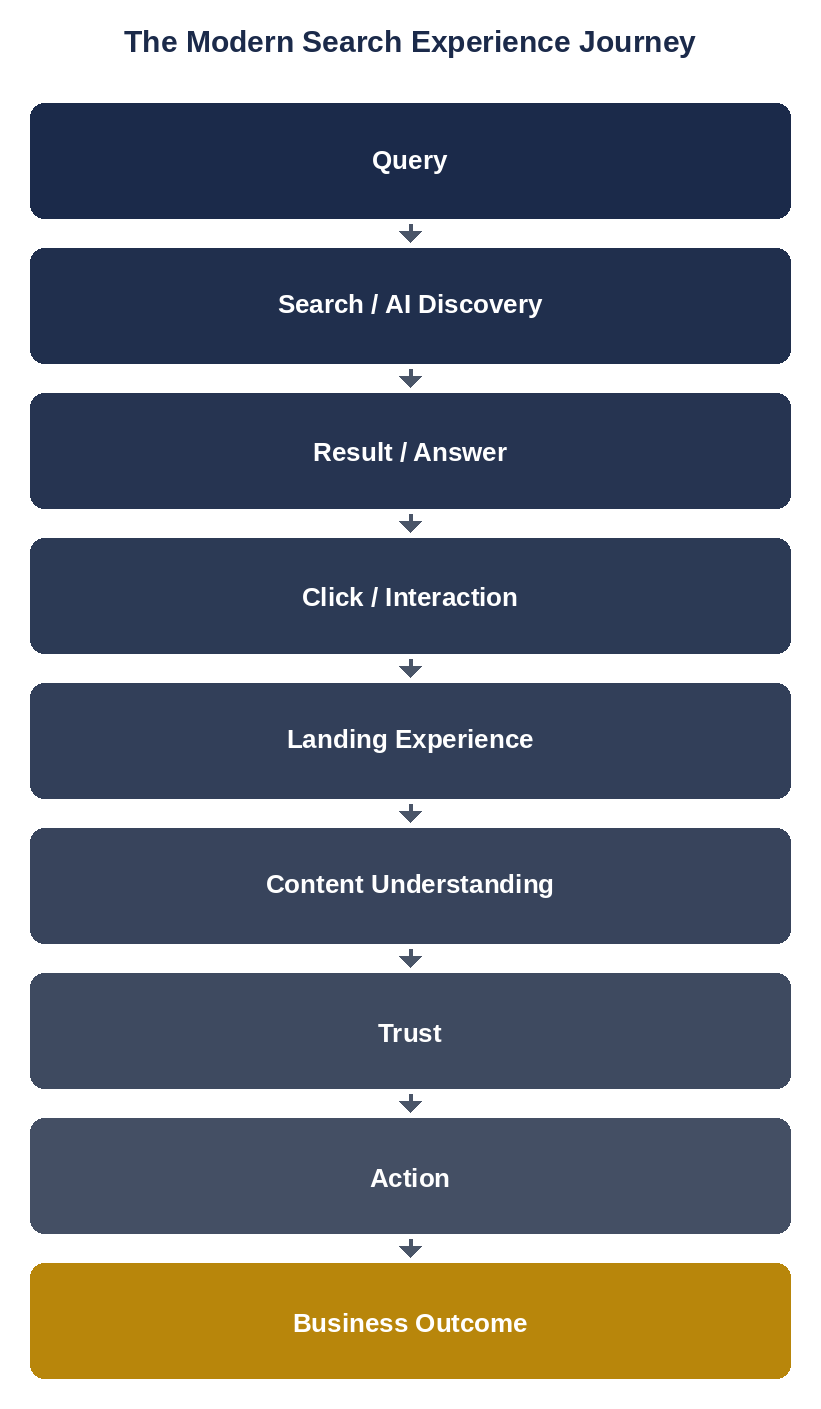
The journey in its simplest form: Search → Result → Click → Landing Page → Understanding → Action.
Consider a realistic example. A visitor searches "best accounting software for a small retail business." They scan three results, click the one whose title and description most directly match their situation, and land on a page. In the next few seconds they are evaluating, often without consciously noticing: does this page match what I was promised, can I tell what this does, do I trust this source, and can I find what I need without effort. If any of those fail, the back button is one tap away, and the next result is right there waiting.
Relevance, clarity, trust, usability, page experience, navigation, and conversion are not separate checklist items in that moment. They are experienced as one impression, formed almost instantly and revised only with effort. Treating them as separate disciplines inside a business, SEO here, design there, sales funnel somewhere else, is an organizational convenience that the visitor never experiences and does not care about.
Direct answer: SEO focuses on whether content can be discovered, understood, and surfaced by search engines. SXO extends that focus to whether the resulting experience satisfies the person who arrives and moves them toward an outcome. SXO builds on SEO. It does not replace it.
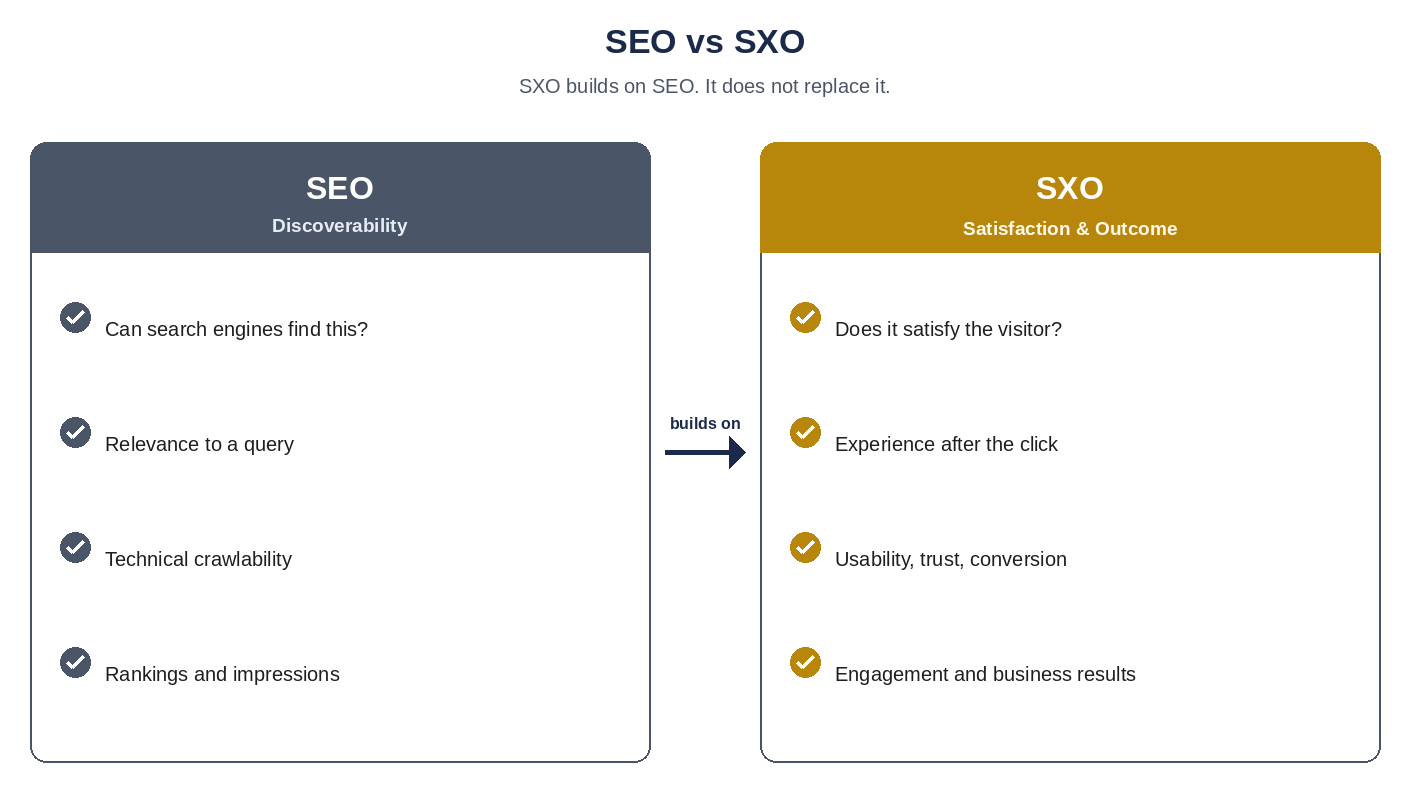
SEO is not blind to users. Google's own guidance on Search Essentials centers helpful, reliable, people-first content as the foundation of ranking well, which is itself a user-oriented standard. SXO does not correct an SEO that ignores people. It extends the same user-oriented thinking past the click, into the full experience, which is territory classic SEO metrics were never built to measure.
Direct answer: UX is the overall experience a person has with a product or website. CRO is the discipline of improving the percentage of visitors who complete a desired action. SXO is the strategic layer that connects search discovery and intent to both of them, so that the experience a visitor gets matches what brought them there in the first place.
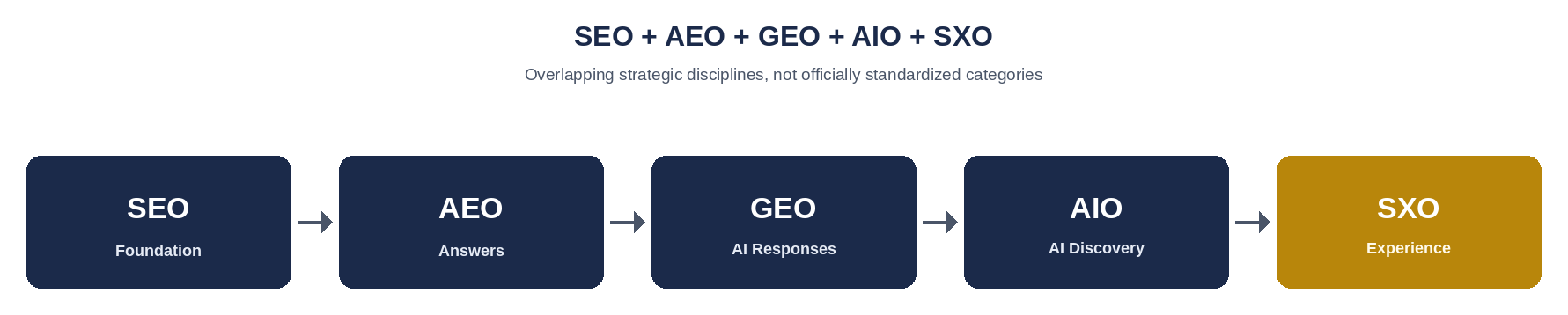
UX (User Experience): the overall experience, across an entire product or site, independent of how someone arrived. A UX team cares about usability whether a visitor came from search, a social post, or a direct visit.
CRO (Conversion Rate Optimization): the discipline of increasing the percentage of visitors who complete a defined action, often through testing variations of a page, form, or flow.
SXO (Search Experience Optimization): the strategic connection between what brought someone to a page through search and what that page then does for them. SXO draws on UX principles and CRO techniques but applies them specifically in light of search intent, the promise made in the search result or AI answer, and the journey that began before the click.
A simple conceptual model: SEO → SXO → UX + CRO. SEO earns the visibility. SXO ensures that visibility connects intent to the right experience. UX and CRO supply the craft, usability principles and conversion techniques, that make that experience work well. This is a conceptual model for explaining the relationship, not an official hierarchy any standards body has published.
Direct answer: Users form expectations before they ever reach your site, from the query they typed, the title and description they read, the URL, any visible structured information, images, brand familiarity, reviews, and increasingly from an AI-generated summary. When the landing page fails to match that expectation, the experience is damaged before the visitor has read a single sentence of your actual content.
Call this the first, often overlooked, stage: Search Result → Expectation. A title promising "complete pricing guide" that leads to a page with no pricing creates a mismatch the visitor experiences as a small betrayal, however minor. Multiply that across a site and the cumulative effect on trust and engagement is real, even though no single instance looks like a major failure.
What shapes pre-click expectation:
- Title and headline: the first and strongest promise made.
- Meta description and snippet: sets specific expectations about what the page covers.
- URL: a clean, descriptive URL reinforces or undermines the promise.
- Structured information: star ratings, prices, or FAQ-style snippets set concrete expectations.
- Images: a thumbnail or featured image implies a style and substance.
- Brand familiarity: a recognized, trusted brand earns a more patient first impression.
- Reviews and local listings: visible ratings shape trust before the click.
- AI-generated search answers: a summary from an AI Overview or assistant can set an expectation about a business before the person ever visits the site.
Message match is the practical discipline this implies: the title, description, and actual page content should describe the same thing, in the same terms, without inflation. This is not about keyword density. It is about honesty between what was promised and what is delivered, and it is one of the simplest, most underused SXO improvements available to most businesses.
Direct answer: The experience a page should provide depends entirely on why someone searched, and designing the same experience for every intent is one of the most common causes of a search visitor leaving unsatisfied.
- Informational intent: the visitor wants to learn. Provide clarity, depth, and a logically organized explanation, without pushing a premature sales message.
- Navigational intent: the visitor wants to reach a specific destination. Make that destination unmistakable and fast to reach.
- Commercial investigation: the visitor is comparing options. Provide honest comparisons, evidence, pricing context, and decision support, not just a case for why you are the only right answer.
- Transactional intent: the visitor is ready to act. Reduce friction aggressively. Every unnecessary field, step, or distraction costs conversions at this stage specifically.
- Local intent: the visitor wants a place or service nearby. Provide location, hours, directions, trust signals, and a direct way to make contact, immediately visible.
A page built for informational intent that opens with an aggressive CTA fights its own visitor. A transactional page buried under three paragraphs of brand narrative does the same in the other direction. Intent should decide the page's structure before a single word of copy is written.
Direct answer: A complete SXO journey has eleven stages, from the initial query through to the experience after conversion, and each stage has its own user need, common failure point, and optimization opportunity.
Direct answer: Content is one of the most direct levers in SXO, because how clearly and usefully it is structured determines whether a visitor's intent gets satisfied in the time they are actually willing to spend reading.
- Readability: plain language, appropriate for the audience, without unnecessary jargon.
- Hierarchy and headings: a structure that lets a visitor scan and still find the part they need.
- Short paragraphs: easier to scan on any device, particularly mobile.
- Direct answers: state the key point before the supporting explanation.
- Visuals: used to clarify, not decorate.
- Examples: concrete scenarios that make an abstract point usable.
- Tables: the right format for genuine comparisons and specifications.
- Comparison content: honest, specific comparisons support commercial investigation intent directly.
- FAQs: answer real follow-up questions, not manufactured ones.
- Definitions: defined plainly where a term might be unfamiliar.
- Summaries: a short recap for visitors who skim before committing to read fully.
- Internal links: connect to genuinely related content and next steps.
- Calls to action: present, but matched to intent rather than forced onto every page regardless of fit.
The unifying principle: content succeeds in SXO terms when it satisfies the intent that brought the visitor, not when it contains the right keywords at the right density. Keyword presence and genuine usefulness correlate, but they are not the same thing, and optimizing for the first while neglecting the second is a common and costly mistake.
Direct answer: A logical site hierarchy, clear navigation, and deliberate internal linking help both visitors and search systems understand how your content relates, which supports discovery, trust, and the ability to find what comes next.
- Site hierarchy: a structure that reflects real relationships between topics, not an arbitrary folder system.
- Navigation: menus that match how visitors actually think about your offerings, not just your org chart.
- Categories: groupings that make sense to a visitor scanning quickly.
- Breadcrumbs: help orient a visitor who landed deep in the site from search.
- Internal linking: connects related content and distributes relevance signals, benefiting both humans and crawlers.
- Topic clusters and related content: help a visitor go deeper on a subject without a frustrating search.
- Contextual navigation: links placed where they are relevant in the flow of reading, not only in a static menu.
This connects directly to semantic SEO and entity SEO, covered in depth in our Semantic SEO guide and our Entity SEO guide. A site that clearly organizes its content around real topics and entities is easier for a visitor to navigate and easier for a search system to understand, which is exactly the kind of overlap that makes SXO, semantic SEO, and topical authority mutually reinforcing rather than competing priorities.
Direct answer: Page speed, stability, and responsiveness measurably affect whether a visitor stays long enough to be satisfied, and Google tracks three specific Core Web Vitals metrics as part of its broader page experience guidance. Technical performance is one part of a larger system, not the single determinant of ranking or experience.
What Google actually measures, as of 2026:
- Largest Contentful Paint (LCP): how quickly the main content becomes visible. Good is at or under 2.5 seconds.
- Interaction to Next Paint (INP): how quickly the page responds to a user's interaction. Good is at or under 200 milliseconds. INP replaced the older First Input Delay (FID) metric in March 2024.
- Cumulative Layout Shift (CLS): how visually stable the page is while loading. Good is at or under 0.1.
These thresholds are documented on web.dev's Web Vitals documentation, and are measured using real user data at the 75th percentile, not a single synthetic test run.
An important nuance most guides skip. Google's own explanation of the role of page experience in creating helpful content states plainly that page experience was folded into its broader helpful content guidance rather than treated as a standalone "page experience update," and that the dedicated Page Experience report and its related search appearance filter were retired from Search Console. In other words, Google itself moved away from framing technical performance as an isolated score to chase, toward treating it as one contributing part of an overall helpful, people-first experience. That is the accurate, current framing, and it is a more honest one than treating Core Web Vitals as a silver bullet.
Other technical factors that affect experience directly:
- Crawlability and rendering: if a search system cannot properly render your page, neither can some visitors on constrained connections or older devices.
- Broken links and redirect chains: each one is a small trust failure and a wasted click.
- HTTPS: baseline security expectation for any modern site.
- Mobile responsiveness: covered in depth in the next section, since it deserves its own treatment.
How to check your own site. PageSpeed Insights reports both real-world field data and lab data for a given URL, and Search Console's Core Web Vitals report shows field data across your site over time.
Say it precisely. A technically fast, stable page is not sufficient on its own to produce a good experience, and it is not the single determinant of rankings. It removes a category of friction that can otherwise undermine everything else you do well.
Direct answer: Mobile experience matters because a large share of search traffic arrives on a phone, and the constraints of a small screen and touch interaction expose usability problems that barely register on desktop.
What to get right:
- Responsive design: layouts that adapt cleanly across screen sizes, not a separate, neglected mobile version.
- Touch targets: buttons and links sized and spaced for a finger, not a cursor.
- Readable typography: text sized so it does not require zooming.
- Content hierarchy: the most important information visible without excessive scrolling.
- Mobile navigation: menus that work cleanly with touch, without hidden or hard-to-reach items.
- Page speed: mobile networks and devices are typically slower, so performance matters even more here.
- Intrusive elements: avoid interstitials and popups that block content immediately on arrival.
- Forms: minimal fields, appropriate input types, and visible labels.
- CTAs: large enough to tap confidently, placed where a thumb naturally reaches.
- Images: properly sized so they do not slow the page or break layout.
- Tables: designed to remain usable on a narrow screen, through horizontal scroll or responsive restructuring, rather than becoming illegible.
Mobile SXO Checklist
- Layout adapts cleanly to small screens without horizontal scrolling of the page itself
- Text is readable without zooming
- Touch targets are large enough and adequately spaced
- No intrusive interstitial blocks content on arrival
- Forms use minimal fields and mobile-appropriate input types
- Primary CTA is reachable and visually obvious
- Images and tables remain usable on a narrow screen
- Core Web Vitals are checked specifically on mobile field data, not desktop only
Direct answer: Accessibility is part of building a usable web experience for the widest possible range of visitors, grounded in the W3C's Web Content Accessibility Guidelines (WCAG). It is not simply an SEO tactic, and meeting accessibility guidelines does not automatically produce higher rankings.
The current standard is WCAG 2.2, published as a W3C Recommendation in October 2023, organized around four principles, often remembered by the acronym POUR:
- Perceivable: text alternatives for images, captions for media, sufficient color contrast, text that can be resized without losing function.
- Operable: full keyboard accessibility, enough time to read and interact, clear navigation mechanisms, no content that triggers seizures.
- Understandable: readable text, predictable behavior, clear input assistance and error identification in forms.
- Robust: valid, well-formed markup and proper use of semantic HTML and ARIA so the page works with current and future assistive technology.
Practical priorities for most businesses:
- Alt text on meaningful images
- Sufficient color contrast between text and background
- Full keyboard navigability, without relying on hover-only interactions
- Properly labeled form fields with clear error messages
- Semantic HTML headings used in a real hierarchy, not just for visual styling
- Captions for video content
Why this belongs in SXO specifically. A visitor using a screen reader, navigating by keyboard, or reading with low vision is still a search visitor with intent to satisfy. Excluding them through poor accessibility is a direct SXO failure, independent of any ranking effect. Say this clearly: accessibility is about building a usable experience for real people, and treating it as a ranking hack misunderstands both accessibility and SEO.
Direct answer: Visitors evaluate trust quickly and largely unconsciously, based on visible signals like identity, transparency, evidence, and professionalism, and these same signals connect directly to Google's E-E-A-T framework for content quality.
Signals that build trust:
- Author information: a named, credentialed person behind the content.
- Business identity: clear information about who runs the site.
- Contact information: visible and easy to find, not buried.
- About page: a real, specific description of the business, not generic filler.
- Reviews and testimonials: genuine, not fabricated or cherry-picked beyond credibility.
- Case studies: real evidence of outcomes, or clearly labeled hypothetical examples.
- Sources and citations: links to credible evidence for important claims.
- Policies: clear, accessible terms, privacy, and where relevant, pricing transparency.
- Secure website: HTTPS as a baseline, with no obvious security warnings.
- Professional design: consistent, intentional, free of visible neglect like broken layouts or outdated content.
- Accurate information: current prices, hours, and facts that are not quietly stale.
On E-E-A-T. Experience, Expertise, Authoritativeness, and Trust is Google's framework for evaluating content quality, detailed in its guidance on creating helpful, reliable, people-first content. It is a quality framework used in human rating guidelines and reflected in ranking systems, not a single measurable score a tool can report back to you. Treat the signals above as what they are: things that build genuine trust with real visitors, which also happen to be the kinds of signals Google's quality guidance describes.
Direct answer: SXO connects search traffic to business outcomes by matching the type and placement of a call to action to the visitor's actual readiness to act, rather than applying the same conversion mechanism to every page regardless of intent.
Traffic that produces no useful action is not automatically successful marketing, even if the traffic numbers look good in a report. But the correction is not to force a hard sales CTA onto every page. An informational page that interrupts a reader mid-explanation with a "Buy Now" button fights its own purpose and can damage the trust it was starting to build.
Conversion mechanisms worth matching to context:
- CTA placement: positioned where a reader who is ready would naturally look, not forced above content they have not read yet.
- Forms: as short as the actual need requires.
- Phone calls: valuable for local and high-consideration B2B contexts, less so for simple ecommerce.
- Booking: appropriate where scheduling is the natural next step.
- Purchases: the right mechanism only where transactional intent is already established.
- Quote requests: useful where pricing genuinely depends on specifics.
- Lead generation: appropriate where the sales process benefits from a conversation.
- Downloads: useful when the content itself is the value exchange.
- Newsletter signup: a reasonable soft conversion for informational content, not a replacement for a real next step on commercial pages.
- Contact journeys: should be short, clear, and responsive.
Direct answer: A strong landing page aligns with search intent immediately, states its value clearly, builds trust progressively, and reduces friction toward a single, well-matched action.
An eleven-part framework:
- Search intent match: the page visibly addresses exactly what was searched, in the first few seconds.
- Clear headline: states what this is and for whom, without vague corporate language.
- Immediate value proposition: why this option, stated plainly.
- Supporting explanation: the detail that backs up the headline's claim.
- Trust signals: visible early, not buried at the bottom.
- Relevant visuals: images or diagrams that clarify rather than decorate.
- Benefits: stated in terms of the visitor's need, not just feature lists.
- Evidence: data, examples, or credible third-party validation.
- FAQs: answers to the real objections and questions that remain.
- CTA: one primary action, clearly presented.
- Friction reduction: every unnecessary step, field, or distraction removed.
How this plays out differently by context:
- B2B: typically needs more decision-support content, case studies, and a lower-commitment first action, such as a consultation request rather than an immediate purchase.
- Local business: needs location, hours, and contact information immediately visible, alongside trust signals like reviews.
- E-commerce: needs clear pricing, availability, and specifications close to the top, with reviews reinforcing the decision.
- Professional service: needs credibility signals and a clear description of process before asking for commitment.
Direct answer: Answer Engine Optimization makes information answer-ready; Search Experience Optimization governs what happens around and after that answer. An answer that successfully attracts a visitor but leads to a poor website experience still produces a weak business outcome.
Direct answers, question-based headings, FAQs, and concise summaries, the core techniques covered in our Answer Engine Optimization guide, help a visitor arrive with a question already partially resolved. SXO picks up from there: does the rest of the page live up to the clarity of that initial answer, does the layout support further exploration, and does the path forward make sense. A business can do excellent AEO work and still lose the visitor immediately afterward if the surrounding page is cluttered, slow, or disconnected from the question that brought them there.
Direct answer: Generative Engine Optimization increases the likelihood that useful information is discovered and represented in AI-generated responses. SXO determines what happens if that visibility leads to an actual visit. Neither discipline guarantees an AI citation or a successful outcome on its own.
A business mentioned in an AI-generated answer, through the mechanics covered in our Generative Engine Optimization guide, still depends on the landing experience to convert that visibility into something real. Source credibility, content usefulness, and a coherent experience after arrival matter just as much when the referral came from an AI assistant as when it came from a traditional search result. There is no evidence that AI-referred visitors are more forgiving of a poor experience than any other visitor, and no reasonable basis to assume otherwise.
Direct answer: Search experiences increasingly extend beyond a list of blue links into AI Overviews, AI Mode, Copilot, and conversational assistants, which changes where and how a business's information gets encountered, without eliminating the need for a good experience once someone actually visits.
Documented behavior: Google's own guidance confirms AI Overviews and AI Mode rely on its core Search systems and ranking signals, detailed in Google's AI features and your website documentation, which is covered in full in our AEO guide. Microsoft's Copilot and Bing experiences operate their own retrieval and citation behavior.
Emerging trends: conversational, multi-turn search interactions; increasing use of multimodal input, including images, as part of a query; and AI assistants that summarize or act on information gathered from multiple sources before a person ever reaches a website.
Speculation to avoid: specific claims about how much traditional click-through will decline, how any single assistant will weight experience signals, or detailed predictions about agentic commerce. These remain genuinely uncertain, and confident predictions about them, including in guides like this one, deserve skepticism.
The durable principle, regardless of how the interfaces evolve: the easier it is for a person to discover, understand, trust, and act on useful information, the stronger the overall search experience, whatever form the discovery happens to take.
Direct answer: For a local business, the search experience after discovery should immediately confirm location, hours, credibility, and the easiest way to make contact, since local intent is typically close to a decision.
Consider someone searching "digital marketing agency in Addis Ababa." They are often close to choosing, and what they need after clicking is confirmation, not persuasion from scratch: where you are, what you specifically do, whether others trust you, and how to reach you without friction.
What a strong local search experience includes:
- A complete, accurate Google Business Profile, since this is the one directly manageable entity surface a local business has, as covered in our Google Knowledge Graph guide
- Consistent business information, name, address, and phone, across the site and every listing
- Visible reviews, genuinely gathered
- Clear hours, location, and directions on the site itself, not only on third-party platforms
- Local landing pages only where a genuinely distinct service area justifies one, with real, specific content
- LocalBusiness structured data that matches the visible page
- Local FAQs addressing real regional questions, such as service areas or local pricing context
Nothing here promises a ranking or an AI mention. It describes the experience a business can control once a local searcher actually arrives, or encounters the business through a local AI-generated summary.
Direct answer: Ecommerce search experience depends on how quickly a visitor can find the right product, trust its description, and complete a purchase without friction, with search intent shaping how much comparison and reassurance a given page needs.
- Product discovery: categories and filters that match how customers actually think about products, not just internal taxonomy.
- Product pages: clear pricing, availability, specifications, and genuine reviews, positioned where a decision is actually being made.
- Comparison support: for commercial investigation intent, a comparison view or honest "which one is right for you" guidance.
- Shipping and returns: visible before checkout, not discovered as a surprise.
- Checkout: as few steps and fields as the payment process genuinely requires.
- Mobile experience: especially critical here, since a large share of ecommerce search traffic is mobile.
A product page built for someone already certain they want this exact item looks different from a category page serving someone still comparing options. Search intent should shape which of these a given visitor lands on and what that page emphasizes.
Direct answer: B2B search journeys are typically longer and more research-driven than consumer journeys, so B2B SXO usually needs more decision-support content and a lower-commitment first action than an immediate transaction.
- Research stage content: clear explanations of what the company does and for whom.
- Comparison stage content: honest positioning against alternatives.
- Trust signals: case studies, client types, and credentials appropriate to B2B buyers, who are often evaluating risk as much as fit.
- Technical information: detailed enough for a technical evaluator without losing a business-focused reader.
- Pricing and procurement questions: addressed honestly, even when the real answer is "it depends," with an explanation of what it depends on.
- Contact and demo requests: a natural, low-friction next step rather than a hard sell at first contact.
B2B visitors rarely convert on a first visit. The SXO goal is often to move them one credible step forward, not to close a sale in a single landing page.
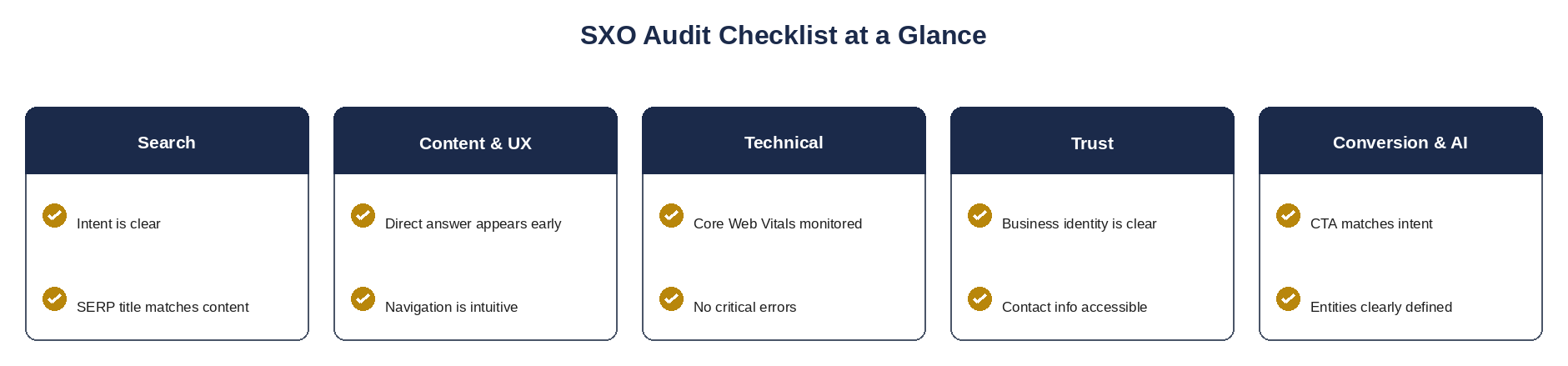
Direct answer: A practical SXO audit examines fourteen categories, each with what to inspect, the common problem found, and the recommended action.
Recommended action for every category above: fix the specific instance found during the audit, then address the underlying process that let it happen, whether that is a missing editorial checklist, a template issue, or a lack of ownership over post-publish maintenance.
Direct answer: Implementing SXO is a fifteen step process that starts with identifying your most valuable organic landing pages and ends with measuring results against the full journey, not just rankings.
- Identify high-value organic landing pages. Start where traffic and business value already intersect.
- Map search intent. Confirm what each page's visitors actually want, using real query data.
- Audit SERP expectations. Review what your title, description, and any visible structured data currently promise.
- Compare search result promise with landing-page experience. Find the gaps between promise and delivery.
- Improve content alignment. Close the gaps directly, starting with a clear, honest opening.
- Improve page hierarchy. Make the structure match how a visitor actually scans.
- Improve navigation. Ensure the path forward is obvious.
- Improve performance. Address LCP, INP, and CLS issues found in Search Console field data.
- Improve mobile UX. Test and fix the experience on an actual phone, not just a resized browser window.
- Improve accessibility. Work through the WCAG 2.2 priorities most relevant to your site.
- Strengthen trust. Add visible authorship, evidence, and contact information where missing.
- Improve conversion paths. Match CTAs and forms to intent and reduce unnecessary friction.
- Strengthen internal linking. Connect related content deliberately.
- Improve AEO and GEO readiness. Apply the practices from the companion guides where relevant.
- Measure results. Track the three-layer metrics model covered next, not rankings alone.
Direct answer: SXO is measured across three layers, visibility, experience, and business outcomes, because no single metric captures whether search traffic is actually producing value. Treating any one metric as the universal SXO KPI misrepresents what the discipline covers.
Visibility Metrics
Organic impressions, organic clicks, click-through rate, and search query coverage. These show whether you are being found, not whether the experience that follows works.
Experience Metrics
Engaged sessions, landing-page engagement, Core Web Vitals field data, and returning users. These show whether the visit itself went well, though engagement signals should be read directionally, not as precise proxies for satisfaction.
Business Metrics
Conversion rate, qualified leads, sales, phone calls, form submissions, bookings, revenue, and assisted conversions. These show whether visibility and experience actually produced something the business can use.
Limitations worth stating plainly. Impressions and clicks are the easiest metrics to get and the least informative about outcomes on their own. Engagement metrics are useful but noisy, and can be affected by factors unrelated to experience quality, such as content length. Business metrics are the most meaningful but the hardest to attribute cleanly back to a specific SXO change, especially for longer B2B journeys with multiple touchpoints. Use all three layers together, and be honest about which layer any given report is actually describing.
- The SERP is part of the user experience, not a separate space that ends once someone clicks. A misleading title damages trust before your actual content gets a chance.
- Search intent should influence page design, not just content topic. An informational page and a transactional page should look structurally different.
- A high ranking cannot compensate for a misleading landing page. It only gets more people to discover the mismatch faster.
- The best SEO content reduces cognitive effort. Clarity is a usability feature, not just a writing style preference.
- UX and SEO should not be treated as competing priorities. A page that is both discoverable and genuinely useful is not a compromise between two goals, it is the actual goal.
- A technically perfect page can still provide a poor experience. Fast loading does not fix confusing navigation or irrelevant content.
- A beautiful website can still fail search intent. Visual polish and genuine usefulness are different things, and design teams sometimes optimize for the former at the expense of the latter.
- AEO and SXO increasingly intersect as search becomes more conversational. An answer that satisfies a question still needs a coherent destination behind it.
- Conversion optimization should reflect intent rather than interrupt it. A CTA presented before a reader has enough information is friction, not persuasion.
- The strongest SXO strategies connect visibility, experience, and measurable business outcomes into one reporting view, rather than three disconnected dashboards owned by three different teams.
Hypothetical Example. This is an illustrative scenario. It does not describe a real Brand Multimedia client, and no numerical results are claimed.
The company. A fictional Addis Ababa professional services firm receives substantial informational organic traffic but converts relatively few visitors into leads.
Before
- Strong rankings and traffic for informational queries related to the firm's services
- Landing pages that answer the informational question well, then end abruptly with no clear next step
- A single generic "Contact Us" CTA repeated identically across every page regardless of content or intent
- Confusing navigation that buries the firm's actual service pages several clicks deep
- No visible author information, credentials, or client evidence anywhere on the site
- Noticeable friction on mobile, including a contact form with excessive required fields
SXO Strategy
Map each informational page to the commercial step that should logically follow it, redesign CTAs to match where each visitor actually is in their decision, restructure navigation around real service categories, add visible credentials and case study evidence, and simplify the mobile contact flow.
Implementation
- Identify which informational pages already receive strong traffic but weak engagement with commercial content
- Add a clear, intent-matched next step to each one, connecting the informational answer to a relevant service page
- Replace the single generic CTA with CTAs matched to each page's position in the journey
- Rebuild navigation around the firm's actual services, with breadcrumbs restored on deep pages
- Add named author bios, credentials, and at least one detailed, honestly labeled example of past work
- Shorten the mobile contact form to the fields genuinely required to start a conversation
- Re-audit Core Web Vitals and fix the worst-performing templates
- Set up the three-layer measurement model to track visibility, experience, and lead quality going forward
Expected types of improvement
Clearer paths from informational content into commercial consideration. More consistent, intent-matched calls to action. Reduced mobile friction at the point of contact. Better visibility into which stage of the journey is underperforming, through the three-layer measurement model. Whether lead volume or quality improves, and by how much, depends on factors outside this guide's control, and this example claims no specific result.
- Optimizing only for rankings, with no attention to what happens after the click.
- Ignoring search intent, designing the same page structure regardless of why someone searched.
- Poor message match, where the title and description promise something the page does not deliver.
- Slow pages, especially on mobile, that cost visitors before they read a word.
- Weak mobile experience, treated as an afterthought to a desktop-first design.
- Confusing navigation that buries important pages or offers no clear path forward.
- Generic content that could describe any competitor equally well.
- Excessive popups that interrupt the experience the visitor came for.
- Weak CTAs that are vague, mistimed, or absent entirely.
- Missing trust signals, including no visible author, business identity, or contact information.
- Poor accessibility, excluding real visitors through avoidable barriers.
- Keyword stuffing, which damages readability without improving genuine relevance.
- Ignoring AI search, assuming all discovery still looks like a traditional blue-link result.
- Ignoring local intent, missing the specific information a nearby searcher actually needs.
- Measuring traffic but not conversions, mistaking visibility for success.
- Treating UX as a separate department, disconnected from SEO strategy and decisions.
- Over-designing pages, where visual flourish actively works against clarity and speed.
- Hiding important information, such as pricing or contact details, behind unnecessary steps.
- Creating thin content that fails to actually resolve the intent it targets.
- Failing to update outdated information, letting stale facts quietly undermine trust.
This is Brand Multimedia's own strategic framework for approaching Search Experience Optimization. It is not an official Google or industry-standardized framework, and it should be read as a practical planning tool, not a ranking formula.
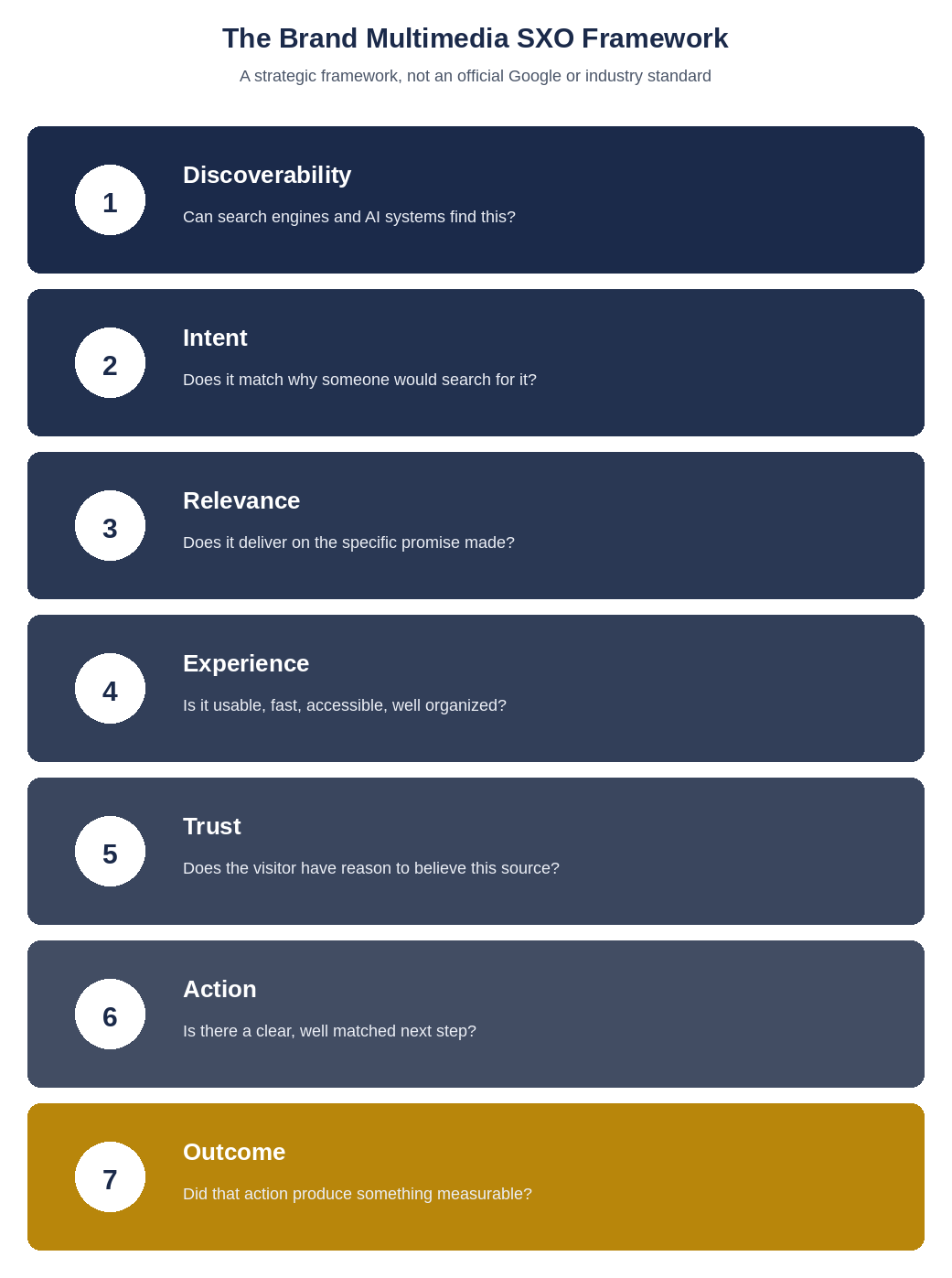
1. Discoverability. Can search engines and AI systems find, crawl, and understand this content at all? Without this layer, nothing downstream matters.
2. Intent. Does the content genuinely match why someone would search for it, across the real range of intents behind the target queries?
3. Relevance. Does the specific page deliver on the specific promise made in the search result or AI answer that brought the visitor here?
4. Experience. Is the page usable, fast, accessible, and well-organized once the visitor is actually reading it?
5. Trust. Does the visitor have reason to believe this source, based on visible identity, evidence, and credibility signals?
6. Action. Is there a clear, appropriately matched next step available when the visitor is ready for one?
7. Outcome. Did that action produce something the business can measure and value?
Each layer depends on the one before it. Excellent Action design cannot fix a failure at Trust. Strong Trust signals cannot fix a failure at Relevance. The framework is meant to be diagnostic: when a page underperforms, work backward through these seven layers to find where the chain actually breaks, rather than assuming the fix is always more content or a bigger CTA.
Search Experience Optimization (SXO) is the practice of aligning search visibility with the experience a user has after clicking, covering message match, content, usability, performance, trust, and conversion, so that visibility actually produces a useful outcome.
SXO stands for Search Experience Optimization, an industry term describing the strategic connection between search discovery and the experience that follows it.
No. SEO focuses on discoverability and relevance to a query. SXO extends that focus to the experience after the click, including usability, trust, and conversion. SXO builds on SEO rather than replacing it.
SEO asks whether search engines can find, understand, and surface content. SXO asks whether the resulting experience actually satisfies the visitor's intent and helps them accomplish something.
No. UX covers the overall experience of a product or site regardless of how someone arrived. SXO specifically connects that experience to what brought the visitor there through search.
CRO focuses on improving the percentage of visitors who complete a desired action. SXO is the broader strategic layer that ensures the experience, including its conversion elements, actually matches the search intent that led to the visit.
There is no official "SXO ranking factor." However, elements associated with SXO, such as helpful content and page experience, are part of Google's documented guidance on what makes content perform well in Search.
Because the right experience depends entirely on why someone searched. The same page structure cannot serve informational, commercial, transactional, and local intent equally well.
Start by confirming the page matches real search intent, then align the title and description with the actual content, improve clarity and structure, strengthen trust signals, and match the call to action to how ready the visitor is to act.
Message match between the search result and the page, genuine intent alignment, usability, trust signals, and a conversion path appropriate to the visitor's stage in their journey.
Yes, as one contributing factor. A slow page actively damages the experience, but speed alone does not guarantee a good one.
Yes. LCP, INP, and CLS measure loading speed, responsiveness, and visual stability, and Google documents these as part of its broader page experience guidance, though not as the sole determinant of ranking or success.
Mobile experience affects a large share of search visitors directly. Poor responsiveness, small touch targets, or slow mobile load times actively undermine an otherwise strong page.
Accessible design, following WCAG 2.2 guidance, ensures a usable experience for the widest range of visitors. It is a usability requirement in its own right, not primarily an SEO tactic.
By matching the type, placement, and friction level of a call to action to what the visitor's search intent and journey stage actually call for, rather than applying one generic CTA everywhere.
AEO makes information answer-ready. SXO governs the experience around and after that answer, so that a successful answer does not lead to a disconnected or frustrating website experience.
GEO increases the likelihood of being discovered and represented in AI-generated responses. SXO determines what happens if that visibility leads to an actual visit, since discovery alone does not guarantee a good outcome.
As search experiences increasingly include AI Overviews, AI Mode, and conversational assistants, SXO extends naturally: the same principles of clarity, trust, and usability apply regardless of how a visitor was referred.
Across three layers: visibility metrics like impressions and clicks, experience metrics like engagement and Core Web Vitals, and business metrics like conversions and revenue. No single metric captures all of SXO.
Yes. Many SXO improvements, such as message match, clear CTAs, and visible trust signals, require no significant budget, only deliberate attention to the full journey rather than SEO alone.
Local SXO ensures that once a nearby searcher discovers a business, the experience immediately confirms location, hours, trust, and an easy way to make contact.
Optimizing only for rankings, ignoring search intent, poor message match between search results and pages, slow or weak mobile experiences, and measuring traffic without measuring conversions are among the most common.
There is no fixed timeline. Message match and CTA fixes can happen quickly. Deeper structural, technical, and trust improvements take longer and should be prioritized by business value.
Not necessarily. Many SXO principles can be implemented by an internal team with SEO, design, and content collaboration. An agency helps when a business lacks the capacity or cross-functional alignment to connect those efforts.
Yes, in the sense that SEO without attention to the post-click experience risks earning visibility that never converts into value. SXO is best understood as a more complete way of doing search strategy, not an optional add-on.
Search is extending beyond a results page into AI Overviews, conversational interfaces, multimodal discovery, and increasingly agentic experiences that can act on a person's behalf. None of that changes the underlying principle this guide has argued throughout: the easier it is for users to discover, understand, trust, and act on useful information, the stronger the overall search experience, regardless of which interface mediates that discovery.
Specific predictions about how quickly these interfaces will shift user behavior, or how much any single platform will weight experience signals, remain genuinely uncertain, and this guide deliberately avoids making them with more confidence than the evidence supports.
SEO should not end when a user clicks. The real objective is a coherent journey from query to discovery, through understanding and experience, to trust and action. SXO is not a replacement for SEO, AEO, GEO, UX, or conversion optimization. It is the discipline of making sure those efforts connect into one experience instead of operating as disconnected departments that each optimize their own piece and wonder why the whole does not add up.
Is Your Search Traffic Turning Into Real Business?
Brand Multimedia helps businesses connect search visibility with better digital experiences through SEO, AEO, GEO, AI optimization, SXO, content strategy, technical SEO, UX-focused web development, conversion optimization, and local SEO. We will not tell you a ranking is the finish line, because it never was.
Or read our other digital marketing guides to continue with the companion articles referenced throughout this one.
Ready to grow your business? Reach out to our team today on WhatsApp and let’s discuss how we can help. Click here to chat with us