Executive Summary
What they are. Google AI Overviews are a Google Search feature that presents an AI-generated summary for some queries, with links to supporting pages. Google's help documentation lists them as a core part of Search, available in a long list of countries that includes Ethiopia, and in languages that include Amharic and Oromo.
Why Google shows them. According to Google's documentation for site owners, they appear only when Google's systems determine they are additive to classic Search. That is why many queries never trigger one.
How they relate to classic Search. They are not a separate engine. Google says they build on its core Search systems, and the same SEO fundamentals remain relevant. Classic results, AI Overviews, and AI Mode now coexist.
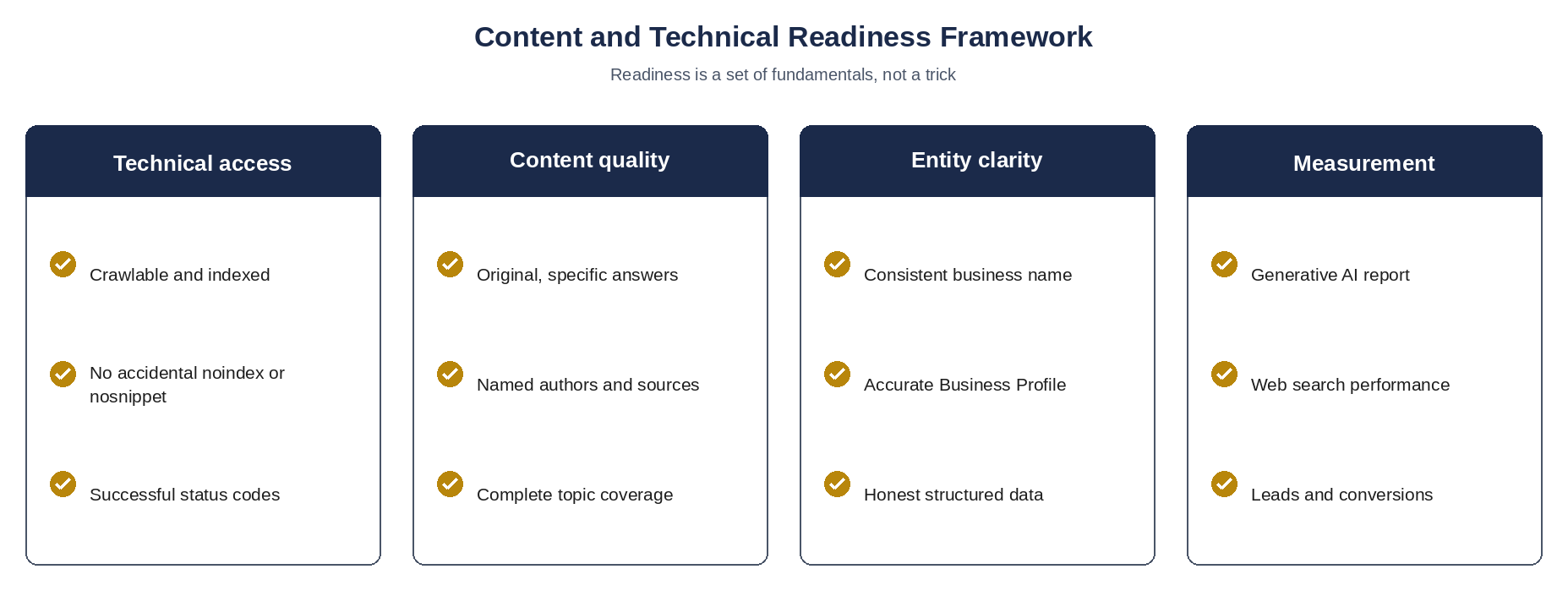
What website owners should prioritize. Technical accessibility so pages can be crawled, indexed, and shown with a snippet. Helpful, original, people-first content. Accurate business information. Internal links that help Google find pages. Structured data only where it truthfully describes visible content.
What is and is not known. Google documents the relationship to Search, the use of query fan-out and retrieval, the eligibility rules for supporting links, and a Search Console control and report. It does not publish an AI Overview ranking formula, a selection threshold, or any score a marketer can optimize.
How to measure. Search Console now offers a dedicated Generative AI performance report. Its documentation describes impressions across pages, countries, dates, and devices. It does not provide query-level or click data for AI features, so analytics, conversion data, and manual testing still matter.
The most important recommendations. Do not optimize for an imagined AI algorithm. Fix eligibility problems first, publish content only your business can write, keep information accurate and consistent, review the Search Console inclusion control, and measure business outcomes alongside visibility.
Key Takeaways
- AI Overviews are part of Google Search, not a new search engine with a published ranking formula.
- Google says no additional requirements or special optimizations exist beyond standard Search eligibility.
- No schema type, text file, word count, or agency can guarantee inclusion.
- Measure what Google actually reports, and be honest about what cannot be tracked.
"We can guarantee your business a place in Google's AI Overviews." Variations of that sentence now land in the inboxes of business owners every week, usually attached to a monthly retainer.
It is worth pausing on what that sentence would have to mean to be true. Google would need to have published a way for outsiders to buy or engineer placement in a feature its own systems decide to show or withhold query by query. Google has done the opposite. Its documentation for site owners says AI Overviews appear only when its systems judge them useful, that no special optimizations are required, and that the foundations are the same ones that govern the rest of Search.
That does not make AI Overviews irrelevant. They are a visible, evolving part of how people now meet your business in search, and Google has been shipping real tools for site owners to understand them. This guide separates three things that most coverage blends together: what Google has officially documented, what is reasonable strategic practice, and what is unproven. Where evidence runs out, it says so.
Direct answer: Google AI Overviews are AI-generated summaries that appear within some Google Search results, offering a synthesized answer with links to supporting pages. They are a feature of Google Search, not a separate product with its own public ranking system.
According to Google's AI Overviews help page, the feature is a core part of Search, similar in standing to knowledge panels, and it is available in a long list of countries and in many languages. That list includes Ethiopia, and the language list includes Amharic and Oromo. The page lists countries and languages separately, so it does not promise that every language works in every country. Test the queries your customers actually use.
How it differs from a result snippet. A traditional snippet or Featured Snippet quotes or summarizes text from one page. An AI Overview is generated, and may draw on several sources at once. The supporting links are how a reader checks the source and continues.
Why not every query triggers one. Google's documentation on AI features and your website says AI Overviews are shown when Google's systems determine they are additive to classic Search, and that they often do not trigger. A simple navigational query, such as typing a company name to reach its homepage, rarely benefits from a generated summary. A multi-part question usually does.
Why presence and appearance vary. The experience differs by query, country, language, device, account, and over time as Google changes the product. Treat any single screenshot, including ones shared in the industry, as one observation, not the rule.
A simple hypothetical example. This is an illustration, not a screenshot of a live result. Imagine someone searches "what should I check before hiring a web design agency." That question has several parts: portfolio, pricing, process, ownership of the finished site, and support. A Google AI Overview might summarize those themes and show links to pages that address them. A different query, such as a specific agency's name, would most likely return ordinary results.
Direct answer: Google says AI Overviews rely on its core Search systems: the query is interpreted, relevant pages are retrieved from the Search index, a response is generated from them, and supporting links are shown. The detailed selection logic is not public.
What is documented.
- Relationship to Search. Google's guide to optimizing for generative AI features (last updated July 10, 2026) states that its generative AI features use Search ranking and quality systems. Optimizing for them, in Google's framing, is optimizing for the search experience, and so still SEO.
- Retrieval and grounding. The same guide describes retrieval-augmented generation, also called grounding: Google retrieves relevant, current pages from the Search index, reviews specific information from them, and produces a response with supporting links.
- Query fan-out. The AI features documentation says AI Overviews and AI Mode may use a query fan-out technique, running multiple related searches across subtopics and data sources to build a response. Google's own illustration is a question about fixing a weedy lawn, which can fan out into searches about herbicides, chemical-free removal, and prevention.
- Supporting links. The documentation says these features can show a wider and more diverse set of supporting links than a classic search.
What remains proprietary or uncertain.
- How Google decides whether to show an Overview for a given query
- How retrieved passages are weighed against each other
- How many links appear and which pages receive them
- Whether any specific content trait raises or lowers selection odds
Variation between experiences. AI Overviews, AI Mode, and Google's other generative features share a foundation but are different products. Their behavior, availability, and reporting should not be assumed to be identical, which the next section addresses.
Direct answer: AI Overviews and traditional results coexist on Google Search. One synthesizes an answer with supporting links, and the other lists ranked pages for the searcher to evaluate. Neither replaces the other, and traditional SEO is not obsolete.
The practical conclusion is not to choose between them. A page that is crawlable, helpful, and trustworthy can serve both, and the systems that retrieve it for an AI feature are the same Search systems that rank it elsewhere.
Direct answer: AI Overviews appear within regular Search results for some queries. AI Mode is a separate, conversational Google Search experience for deeper questions. Google says AI Mode expands what AI Overviews can do, with more advanced reasoning and more ways of interacting.
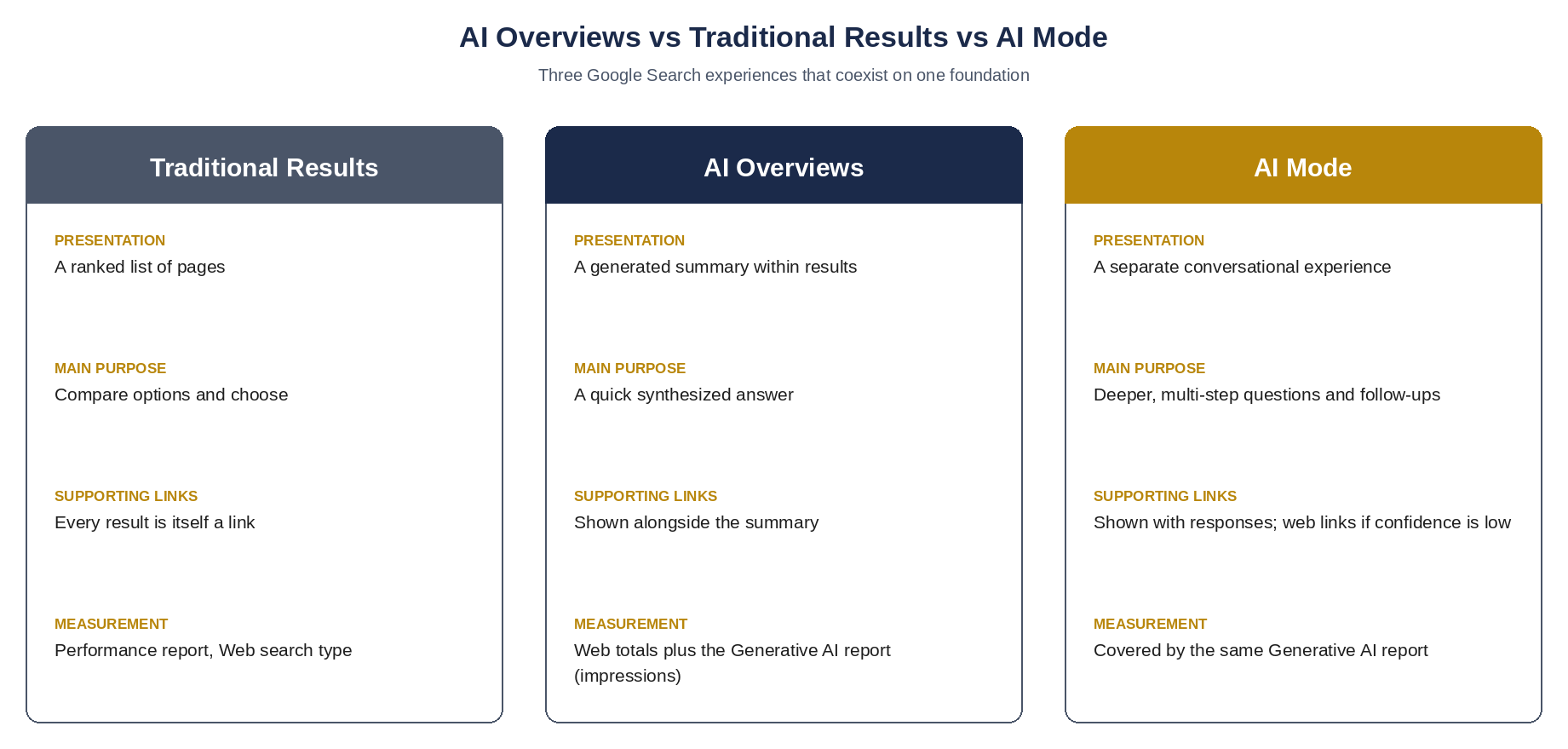
Based on Google's AI Mode help page:
Do not conflate them. Both use query fan-out and Search's retrieval systems, and Google's inclusion control and performance report cover both. But they are different surfaces with different behavior. The AI Mode page also describes selectable model options, with a premium one available to subscribers in a list of countries. When I read that page, Ethiopia appeared on the main AI Mode availability list but not on the premium model list. The practical lesson for businesses in Addis Ababa is that what your customers see may differ from what a colleague abroad sees, so check from local devices and accounts.
Direct answer: AI Overviews change how and where people encounter information about your business, which affects discovery, brand visibility, and how research turns into a visit. They create both opportunity and risk, and neither is as large or as uniform as headlines suggest.
Opportunities.
- A supporting link can introduce your brand to someone researching a topic you know well.
- Complex informational and commercial research is where these features are most likely to appear, so useful depth is rewarded in a way thin pages are not.
- Google says visits that come through AI features tend to be higher quality. That is Google's own statement and should be treated as a hypothesis to check against your analytics.
Risks.
- A good summary can satisfy a searcher without a visit. How often this happens varies by query type, and no universal figure is supported here.
- Your information can be summarized inaccurately if your own pages are unclear or contradictory.
- Reporting is thinner than for classic search, which makes it harder to prove value.
On traffic studies. Many third-party studies claim large click-through declines or gains for queries with AI features. They differ in method, sample, time period, and definitions, and some come from vendors with a commercial interest. This guide does not rely on them. If you cite one, state its date, scope, and method, and prefer your own Search Console and analytics data.
What this means for strategy. Content that merely restates what is already widely available adds little reason to click. Content that contains original examples, data, process detail, or first-hand experience gives a searcher a reason to continue to your page, and Google's own guide emphasizes this kind of non-commodity content.
Direct answer: Google's documentation says there are no additional requirements to appear in AI Overviews or AI Mode, and no special optimizations are necessary. To be eligible as a supporting link, a page must be indexed and eligible to be shown in Google Search with a snippet. Eligibility does not guarantee inclusion.
The core sources are the AI features and your website page (last updated December 10, 2025) and the generative AI optimization guide (last updated July 10, 2026), both linked above.
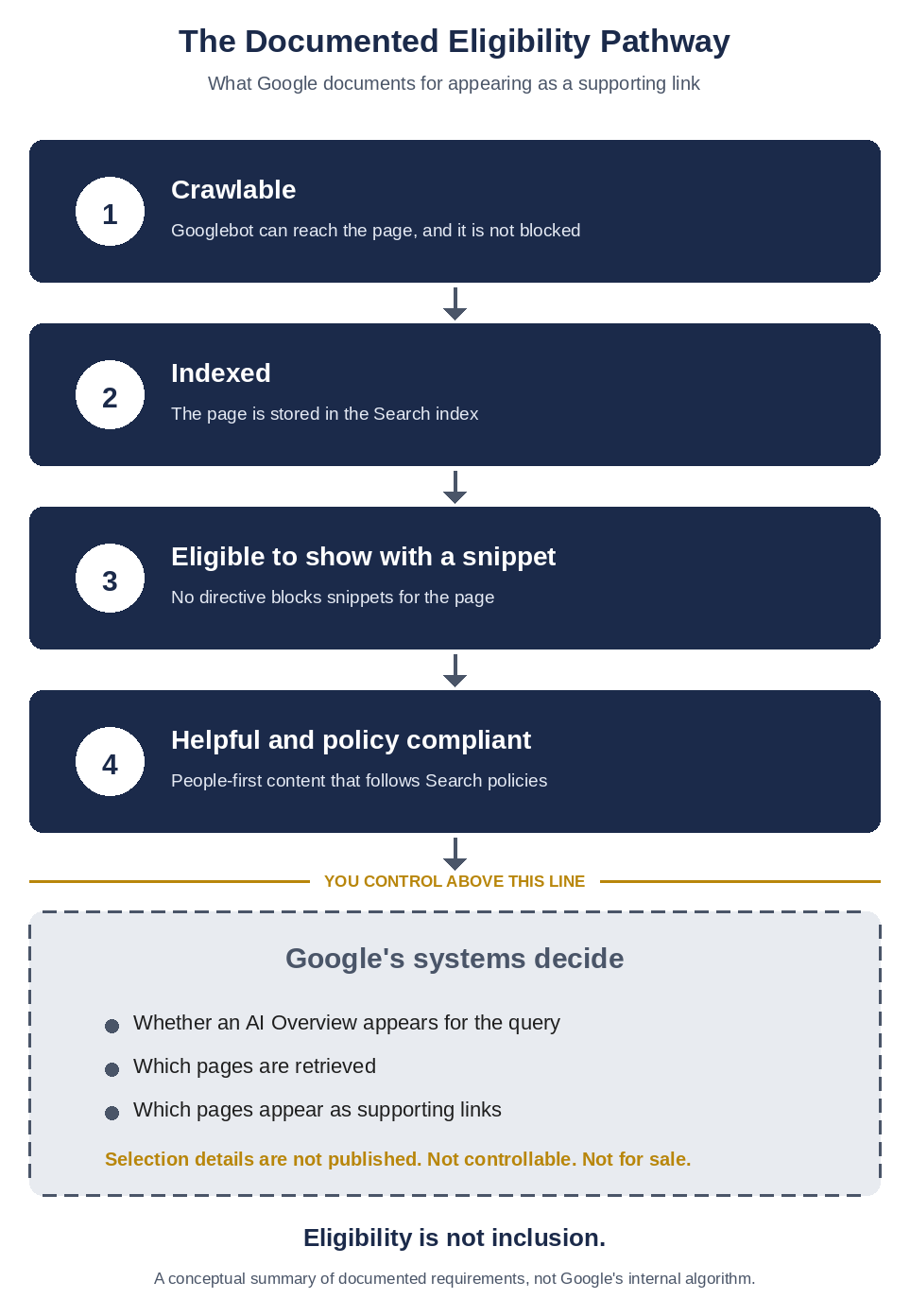
What the documentation establishes.
- Eligibility in Search. Standard Search eligibility is the entry point, including the technical requirements and spam policies in Google Search Essentials.
- Indexing. A page that is not indexed cannot be retrieved. Indexing is not guaranteed even for eligible pages.
- Snippet eligibility. A page must be eligible to appear in Search with a snippet. Directives that block snippets can therefore limit participation.
- Helpful, reliable, people-first content. Google's guidance on helpful content remains the content standard.
- Internal discoverability. Pages should be reachable through crawlable links, so Google can find them.
- Text availability. Important information should exist as text, not only inside images or video, with images and video supporting the text.
- Page experience. A good experience supports helpful content as part of the overall picture, not as a standalone switch.
- Accurate structured data. Markup, where used, must match visible content. It is not required for these features.
- Business information. For local and product queries, Google notes that Business Profile and Merchant Center information can help businesses and products appear in AI responses and other results, so keep both current.
- Site owner control. In Search Console, a site can choose to include or exclude itself from generative AI features. Details are in the measurement section.
Eligibility is not inclusion. Meeting every point above makes a page a candidate. It does not guarantee crawling, indexing, inclusion, or display, and Google does not say otherwise.
What has changed over time. Google's guidance has become more specific across 2025 and 2026: a dedicated optimization guide published in mid-2026 that names AEO and GEO and treats the work as SEO, Search Console generative AI reporting introduced in June 2026 and available to all websites by August 31, 2026, and updated guidance on AI-generated content on October 1, 2026. Earlier Search Central writing on succeeding in AI experiences also exists; I did not re-read it for this guide, so it is not relied on here.
Direct answer: No special, publicly documented AI Overview ranking algorithm exists for site owners to optimize. Google says these features rely on core Search systems. Anything described as an "AI Overview score" for marketers is unsupported.
What Google states and what it does not: it documents the relationship to Search, retrieval, query fan-out, and eligibility. It does not publish selection thresholds, weighting, or a formula.
Here is how common industry claims hold up. Status key: Documented means Google's official documentation addresses it. Reasonable practice means sensible SEO that is not specific to AI features. Unproven means no reliable support exists.
Do not read "unproven" as "useless." Clear writing, current information, and a trustworthy site are good practice regardless of how any single feature chooses its sources. The point is to keep the claim honest.
Direct answer: Create content that genuinely helps people and that only your business could write. Search systems can then understand it, and readers have a reason to click through. No approach guarantees citation.
Practices that serve both readers and systems.
- Original insight. A point of view, a process, a measurement, or a worked example that is not available everywhere else.
- Complete topic coverage. Address the main question and the predictable follow-ups, since complex queries involve several subtopics.
- Clear definitions. Define terms in plain language where they first appear.
- Evidence. Cite primary sources, show your data, and state limits.
- Relevant examples. Concrete scenarios, not generic filler.
- Specific answers. Say how long, how much, who it suits, and when it does not apply.
- Helpful structure. Headings, short paragraphs, tables where content is tabular.
- Subject expertise. Named authors with real experience.
- Appropriate freshness. Update pages where facts change, and show honest update dates.
- Alignment with intent. Match the format to what the searcher is trying to do.
Why paraphrasing existing results is weak. A page that rewrites what the top results already say offers a summarizing system nothing it does not already have, and offers a reader no reason to visit. Google's guide describes this as commodity content. That is a strategic risk, not a penalty documented for AI Overviews specifically.
None of this guarantees an AI Overview citation. It is simply the most defensible way to build a page worth citing, and worth visiting.
Direct answer: Search intent (informational, commercial investigation, transactional, navigational) shapes whether an AI feature appears and what a good page looks like. Complex questions often involve several related subtopics, so coverage matters more than a single keyword match.
- Informational: the searcher wants to learn. AI features appear most often here.
- Commercial investigation: the searcher is comparing options. Comparison, evidence, and decision support matter.
- Transactional: the searcher is ready to act. These queries usually need a clear path, not a summary.
- Navigational: the searcher wants a specific site. AI features add little.
For a deeper treatment of intent and topic structure, see our Semantic SEO guide.
A question-mapping framework
Map each priority question to the related questions, supporting concepts, concerns, decision stage, and the content format that serves it. A hypothetical example for a professional services business, an Addis Ababa accounting and business advisory firm:
The point of the framework is not to create one page per row. It is to make sure each important page answers its primary question well and anticipates what a searcher will ask next. Creating a separate near-duplicate page for every possible variation of a query risks the scaled content problems covered in the AI-generated content section.
Direct answer: Technical eligibility is foundational: if Google cannot crawl, index, and show a page with a snippet, it cannot be a supporting link. It does not guarantee visibility.
- Crawlability. Do not block important pages in robots.txt.
- Indexability. Avoid unintended noindex, and check that important pages are indexed.
- Canonical URLs. Make sure duplicate versions consolidate to the preferred URL. See Google's guidance on canonicalization.
- JavaScript rendering. If content depends on JavaScript, confirm it is visible after rendering. See JavaScript SEO basics.
- Internal linking. Every important page should be reachable through crawlable links.
- HTTP status codes. Important pages should return a successful status, and removed pages should return an appropriate one.
- Accessible text. Key information should exist as text.
- Page availability. Frequent downtime undermines everything else.
- Snippet directives. Check that nosnippet or restrictive max-snippet rules are not applied by a template or plugin by accident, because Google ties eligibility for these features to snippet eligibility.
- Search Console diagnostics. Use the URL Inspection tool and the indexing reports to confirm what Google sees.
Pages for this guide's links in this section appeared as official navigation entries on Google Search Central pages I opened. They were not each opened individually, so confirm them before publishing.
Direct answer: Descriptive headings, clear definitions, direct answers where useful, and readable paragraphs make pages easier for people to use and easier for systems to interpret. They are sound editorial practice, not guaranteed AI Overview tricks.
- Descriptive headings that say what the section answers
- Clear definitions of unfamiliar terms
- Direct answers near the top of sections that answer a question
- Contextual explanations that say when the answer changes
- Comparison tables for real comparisons
- Process steps for real processes
- Original examples from your own work
- Meaningful internal links to genuinely related pages
- Readable paragraphs of two to four sentences
Google's guide says you do not need to chunk content for generative AI search and should write for your audience. Treat these as habits for readers first. The related answer-first approach is covered in our Answer Engine Optimization guide.
Direct answer: Clear entities, consistent business information, and well-organized topical coverage make it easier for any information system to interpret who you are and what you know. This is a conceptual model, not a description of Google's undisclosed internal systems.
- Entities and relationships. Your organization, people, services, and locations are things that facts attach to. Making them clear and consistent supports understanding. See our Entity SEO guide.
- Semantic context and topical coverage. Covering a subject thoroughly, with related concepts connected, helps pages be understood in context. See our Semantic SEO guide.
- Brand identity and consistent business information. The same name, description, and details everywhere reduce contradictions.
- Knowledge Graph concepts. Google's Knowledge Graph is a database of entities and relationships, but it is not something a business can submit itself to, and Google has not published how it is used inside AI features. See our Google Knowledge Graph guide.
The distinction that matters. The model above is a useful way to think. It is not a claim that Google's AI features consume a Knowledge Graph in a particular way, which Google has not documented.
Direct answer: Structured data is machine-readable markup, usually JSON-LD using the Schema.org vocabulary, that describes what a page contains. Google says it is not required for its generative AI features, and no special Schema.org type guarantees inclusion in AI Overviews.
- What it is. Code that states facts about a page in a standard format.
- What Schema.org provides. The shared vocabulary, maintained at Schema.org.
- What JSON-LD does. It carries the markup in a script block separate from the visible page.
- How markup should correspond. It must match visible content, as Google's structured data documentation explains.
- Relevant types. Article, Organization, Person, BreadcrumbList, and LocalBusiness where they honestly apply. Service is valid vocabulary, but check Google's current structured data gallery before assuming it produces a search feature.
- Google's actual supported features. Only specific types trigger specific Search features, and that list changes. FAQ rich results, for example, were restricted in 2023, as Google's announcement on HowTo and FAQ changes explains, and retired in 2026.
There is no special Schema.org type that guarantees inclusion in AI Overviews. Do not add markup solely to target AI search. Add it where it accurately describes the page and supports an existing feature or clearer understanding. Our Schema Markup guide covers implementation and validation in depth.
Direct answer: E-E-A-T, meaning Experience, Expertise, Authoritativeness, and Trust, is a framework for evaluating content quality. It is not a single, publicly measurable AI Overview score.
- Author attribution. Named authors with real credentials and short bios.
- Original research. Data you gathered, clearly described.
- Transparent sourcing. Links to the primary sources behind important claims.
- Demonstrated experience. First-hand detail that could not be written without having done the work.
- Contact information and business identity. Easy to find and consistent.
- Editorial review. A visible process for checking accuracy.
- Accurate claims. Never invent credentials, awards, or results.
- Useful examples. Concrete and specific.
- Case studies with verifiable evidence. Real ones, or clearly labeled hypothetical ones, never fabricated.
Google's helpful content guidance is the source for these ideas, and it describes quality, not a number you can read off a dashboard.
Direct answer: SEO, AEO, GEO, AIO, and SXO are overlapping industry terms for related work. They are not interchangeable, and they are not official stages of any Google algorithm.
- SEO makes content discoverable, understandable, and useful in search.
- AEO (Answer Engine Optimization) focuses on making information answer-ready. See our AEO guide.
- GEO (Generative Engine Optimization) focuses on visibility within generative responses. See our GEO guide.
- AIO / AI SEO is a broader umbrella for optimizing for AI-driven discovery, including technical access.
- SXO (Search Experience Optimization) addresses what happens after someone arrives. See our SXO guide.
How they fit together for AI Overviews. SEO keeps pages eligible. AEO sharpens answers. GEO and AIO widen the lens to other generative systems. SXO ensures a visit from a supporting link ends well. Google's own guide folds the first three into SEO, which is a useful reminder not to buy them as separate products.
Direct answer: For local businesses, accurate and consistent business details, a complete Google Business Profile, genuine reviews, and useful local content give Google dependable information to work with. Nothing guarantees placement in a local AI answer.
- Accurate business details across the website, profile, and listings
- Google Business Profile complete and current, see Google's guidance on business details in Search
- Location-specific service pages only where you genuinely serve a distinct area, with real content
- Genuine reviews gathered ethically. Never fabricate or buy reviews
- Useful local information such as directions, parking, and service areas
- Relevant photographs of your real premises and work
- Opening hours and service descriptions that are accurate
- Consistent business identity everywhere
A hypothetical Addis Ababa example. This is an illustration, not a real business. A co-working space in Bole publishes a page that clearly lists its address, hours, desk and meeting-room options, what is included, and how booking works. Its Business Profile matches that page exactly. It answers real questions on the site, such as whether visitors can use meeting rooms by the hour, and it has photographs of the actual space. None of this promises a local AI answer, but it gives Google and any searcher accurate, consistent information.
Availability and behavior. Google's help pages list Ethiopia for both AI Overviews and AI Mode. The AI Mode documentation also describes a feature that can check local availability and pricing, in some cases by contacting businesses. I read that detail in an excerpt of Google's help page and did not verify its availability in Ethiopia, so treat it as something to watch, not a certainty. The practical advice is simple: keep phone numbers, hours, and prices accurate.
Direct answer: The principles are the same, but the content that earns attention differs by business model.
B2B businesses
Focus on technical questions buyers actually ask, honest comparisons, demonstrated expertise, and evidence for buying decisions. B2B buyers research for a long time before contacting anyone, and AI features are a natural place for early research. Specific, accurate technical content is more useful than broad marketing language.
E-commerce
Focus on complete product information, specifications, availability, comparisons, imagery, and current merchant information. Google notes that Merchant Center data can help products appear in AI responses and other results, so keep feeds consistent with product pages. Inconsistent price or availability between a feed and a page is a common, avoidable weakness.
Professional services
Focus on clear service descriptions, answers to real customer questions, qualifications, process explanations, and trust signals. A prospect evaluating a lawyer, accountant, or consultant wants to understand how the work happens and whether you are credible. Pages that explain process and show expertise do more than pages that list services.
Do not treat every business model identically. A retailer, a software company, and a consultancy need different pages answering different questions.
Direct answer: Google does not prohibit AI-generated content, and it does not favor it automatically. Its guidance, updated October 1, 2026, says quality, purpose, and compliance matter. Mass-producing low-value pages is a spam risk.
Based on Google's guidance on generative AI content on your website:
- Accuracy. Generative models can produce plausible-sounding mistakes, so verify facts. Google extends this to metadata, structured data, and alt text.
- Originality and relevance. Content should serve users, not just exist.
- Editorial review. Human review should catch errors and add judgment.
- First-hand expertise. AI cannot supply experience you do not have.
- Mass-produced low-value content. Generating many pages mainly to manipulate rankings can violate Google's scaled content abuse policy.
- Disclosure where useful. Google suggests giving users context about how content was created where that helps them.
- Human accountability. A person or business is responsible for what is published.
The guidance does not say AI use is penalized, and it does not say AI content is rewarded. The same question applies to any content: is it accurate, original, and useful?
Direct answer: Google Search Console now offers a dedicated Generative AI performance report for impressions in AI features, alongside the standard Performance report. It is useful, but it does not give clicks or queries for AI features, so you still need analytics and manual testing.
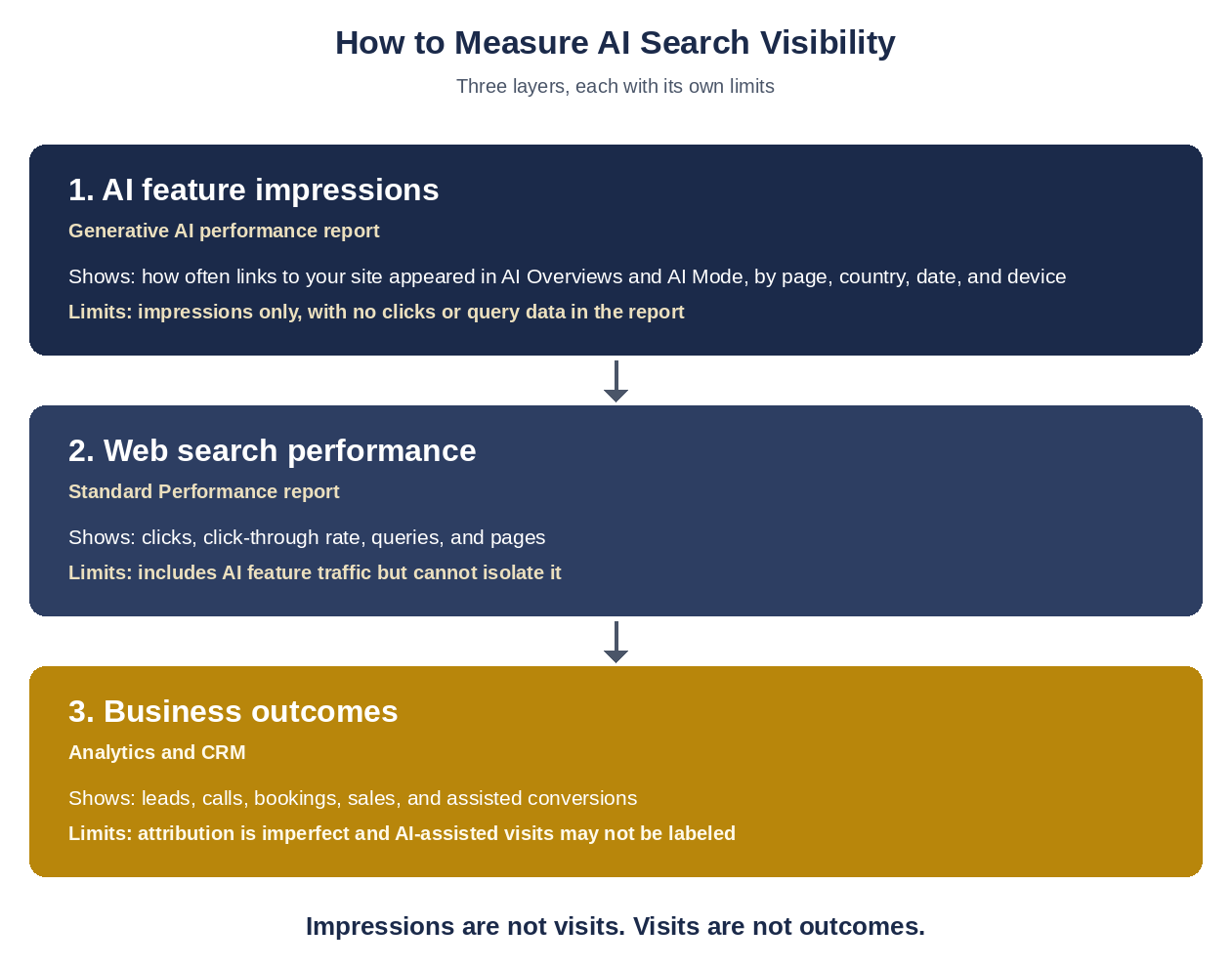
What Google documents. The Search Console Help page for the Generative AI performance report describes a report of impressions, meaning how often links to your site appeared in a generative AI feature, with dimensions for pages, countries, dates, and devices, and a text versus multimodal filter. Google announced the reports on its Search Central Blog in June 2026, and the Help documentation says they are available to all websites worldwide as of August 31, 2026. I read the Help page directly. I did not read the body of the June blog post, which returned only site navigation when fetched, so this section relies on the Help page.
What it does not expose, per the documentation I read. It does not describe click, click-through rate, or query data for AI features. It covers AI Overviews and AI Mode together, and I did not find a documented way to split them, so check your live report.
Separately, the inclusion control. The Search generative AI control lets a site include itself (the default), exclude itself, or inherit a setting. Google says excluding prevents your links and content from appearing in and grounding these features, covers AI Overviews, AI Mode, and generative features in Discover, is not a ranking signal for other parts of Search, and does not affect AI training, which is controlled separately.
Dedicated reporting vs broader Web data. Google's AI features documentation describes traffic from these features as counted within overall Web search performance. That means the standard Performance report cannot isolate AI traffic, and the dedicated report cannot show clicks. Read them side by side, and do not assume one explains the other.
Metrics and their limits.
- Impressions. Show visibility, not value. Documented in the dedicated report.
- Clicks and CTR. Available in the standard report, not specific to AI features.
- Query and page analysis. Page-level for AI features. Query-level only in the standard report.
- Brand visibility. Branded query trends in Search Console, and manual checks.
- Referral traffic, conversions, assisted conversions. From analytics, with imperfect attribution. A visit that began with an AI summary may not be labeled as such.
Do not invent a score. There is no official AI visibility score. Third-party tools that offer one are using their own method. Google's guide warns about tools claiming to use internal Google metrics, so treat any such number as that vendor's estimate. Microsoft offers comparable first-party reporting for its own surfaces, covered in Bing's AI Performance announcement, but it does not cover Google. Connecting visibility to outcomes is the subject of our SXO guide.
A practical monthly reporting template
Direct answer: A realistic plan starts with eligibility, moves to improving priority pages, then measures and refines. It promises no particular result within 90 days.
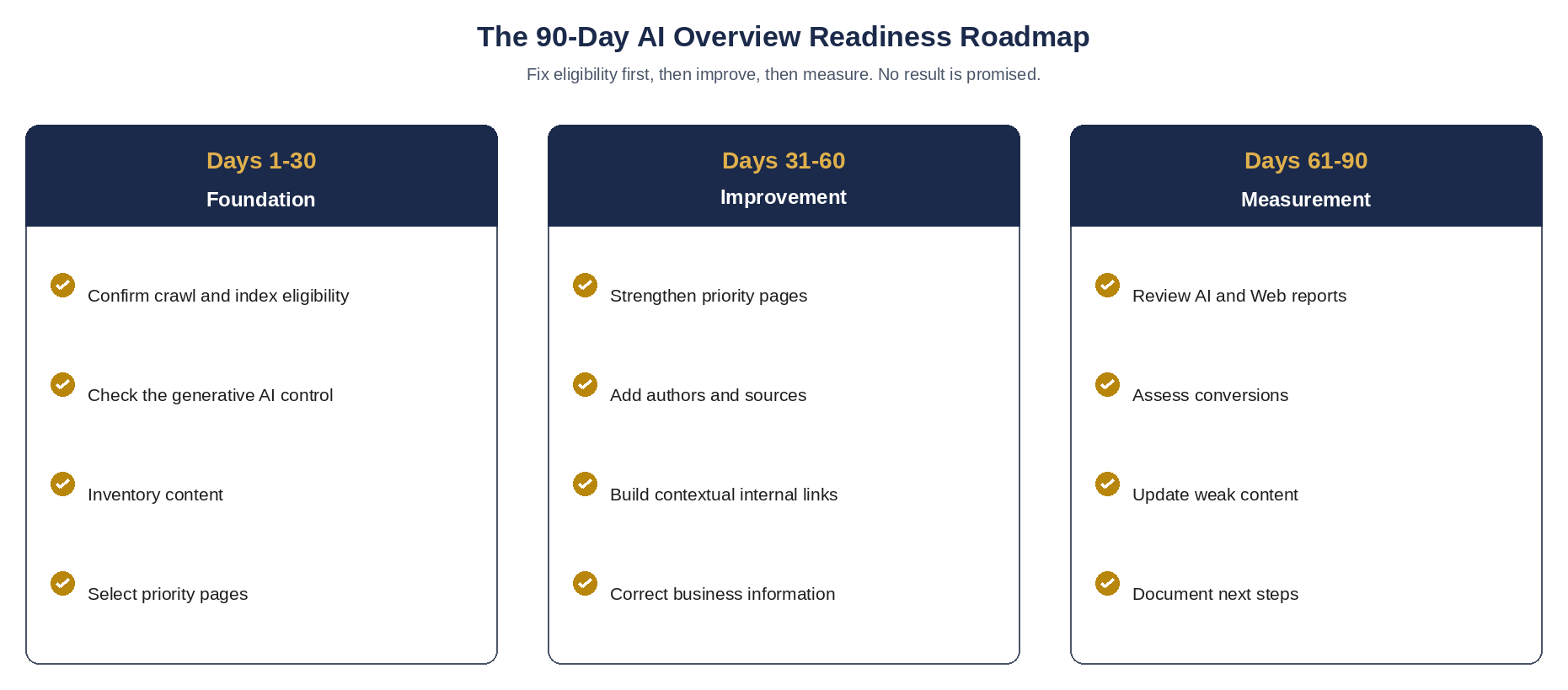
Days 1 to 30: Foundation
- Confirm technical eligibility: crawlability, indexing, and snippet settings
- Verify Search Console and check the generative AI control setting
- Take a content inventory and flag thin, duplicated, or outdated pages
- Map search intent for your most valuable topics
- Select priority pages that tie to business outcomes
Days 31 to 60: Improvement
- Strengthen priority pages with original examples, evidence, and clearer answers
- Add named authors and sources where they are missing
- Build contextual internal links between related pages
- Resolve technical issues found in the first phase
- Correct business information across the site, Business Profile, and listings
Days 61 to 90: Measurement and refinement
- Review the Generative AI performance report and standard Performance data
- Analyze which pages and queries show movement
- Assess conversions and lead quality
- Update underperforming content, and retire pages that add nothing
- Document findings and decide what to do in the next cycle
The sequence is a sensible default, not a law. If your audit finds a serious indexing problem, fix that first and delay everything else.
Direct answer: AI-powered search will keep changing, so build on durable principles, not on any single product behavior.
Established product behavior. AI Overviews and AI Mode exist, are linked, and are reported on by Search Console. Google continues to add capabilities to AI Mode, with its help pages describing features such as follow-up conversation, file and image inputs, and tasks like checking local availability. These details change often, so confirm them against current documentation.
Emerging. Google's own guide acknowledges agentic experiences, in which AI acts on a user's behalf, and the capabilities of AI Mode are expanding in that direction.
Speculation to treat cautiously. How fast behavior shifts, whether reporting will deepen, and how publishers' economics will change are not knowable from current evidence.
The durable principles. Be technically accessible, publish original and accurate content, keep your information consistent, earn trust, and measure outcomes. These hold regardless of interface.
Hypothetical Example. This is an illustrative scenario. It does not describe a real Brand Multimedia client, and no numerical results are claimed.
The company. A fictional Addis Ababa accounting and business advisory firm serving small and medium businesses.
The initial situation.
- Around forty service and blog pages, many with near-identical wording
- Articles that paraphrased generic public advice, with no named authors
- The firm's name written three different ways across the site and its profiles
- A template error that left a key section marked noindex
- Outdated hours and a changed phone number on its Business Profile
- No structured data and little internal linking
The technical and content audit. Review indexing and discover the noindex error. Compare the pages and identify duplicates. Check business information across the site, profile, and listings. Review the Search Console generative AI control and confirm the site is included.
The strategy. Fix eligibility first, consolidate duplicate content into fewer, stronger pages, then rebuild the remaining pages around questions only this firm can answer well, using its own process and the real questions clients ask.
The implementation.
- Remove the erroneous noindex and request reindexing of affected pages
- Merge duplicate pages and redirect old addresses appropriately
- Rewrite key pages with process detail, plain-language definitions, and honest limits
- Add named authors with credentials and short bios
- Standardize the firm's name and description everywhere
- Update the Business Profile and align it with the website
- Add Organization and relevant page-level structured data that matches visible content
- Build contextual internal links between related pages
The measurement plan. Record a baseline in the Generative AI performance report and the standard Performance report, track leads and calls in analytics, and log manual test queries monthly.
Potential lessons. Fixing basic eligibility often matters more than any AI-specific tactic. Original, specific content gives a reason to click. Measuring honestly means accepting that some value, such as being mentioned without a visit, is hard to see. Whether any page appears as a supporting link remains Google's decision, and this example claims no result.
- "AI Overviews replace SEO." Google says they build on core Search systems, and the fundamentals still apply.
- "A special AI schema guarantees citations." No such markup exists, and Google says none is needed.
- "Every query triggers an Overview." Google says they appear only when additive and often do not trigger.
- "A high organic ranking guarantees inclusion." No documentation links ranking position to being a supporting link.
- "A specific answer length guarantees visibility." Google's guide says there is no ideal length. Write for the reader.
- "More pages mean more citations." Mass-producing pages risks scaled content abuse and adds no value.
- "Generic AI-generated content is enough." Commodity content gives neither systems nor readers a reason to choose you.
- "Keyword repetition wins AI citations." No support exists for this, and it harms readability.
- "A website needs a special AI text file." Google's guide says its Search does not use files such as llms.txt.
- "FAQ markup guarantees inclusion." FAQ rich results were retired in 2026, and the markup is not a documented route.
- "Every citation produces traffic." A link may be shown and not clicked. Impressions are not visits.
- "Traditional SEO measurement no longer matters." The standard Performance report still contains your AI feature traffic.
- "An agency can guarantee inclusion." Inclusion is decided by Google's systems and cannot be bought.
- "Every third-party AI visibility score is authoritative." They are vendor estimates, and Google cautions about tools claiming internal metrics.
- "Structured data alone creates authority." Markup describes content. It does not create trust.
- "Opting out hurts my rankings." Google says the inclusion control is not a ranking signal for other parts of Search, though excluding yourself removes you from these features.
Google AI Overviews are AI-generated summaries shown within some Google Search results, with links to supporting web pages. Google describes them as a Search feature that appears only when its systems judge it additive to classic Search, so many queries do not trigger one.
Google says AI Overviews rely on its core Search systems, may use a query fan-out technique that runs several related searches, and present a response with links to supporting pages. The internal selection and ranking details are not published.
Google states there are no additional requirements or special optimizations beyond being indexed and eligible to appear in Search with a snippet. Focus on helpful, original content, technical accessibility, and accurate information. Appearance cannot be guaranteed or purchased.
No. Google presents AI Overviews as part of Search, not a replacement. Classic results, AI Overviews, and AI Mode coexist, and Google's own documentation says AI features build on core Search systems.
AI Overviews are summaries that appear within Search results for some queries. AI Mode is a separate conversational experience for deeper questions that supports follow-ups, images, and files. Google says AI Mode expands on what AI Overviews can do, and users can move from an AI Overview into AI Mode.
They change how some searches are presented and measured, but not the fundamentals. Google's guidance tells site owners that the same SEO practices remain relevant, and Search Console now offers a dedicated report for impressions in these features.
No. Google does not document a link between a classic ranking position and inclusion as a supporting link. These features use Search systems, but selection depends on the query and the system's judgment, and nothing in the documentation promises placement.
Google has not published one. Its documentation says AI Overviews rely on core Search systems and ranking, and any claim of a secret AI Overview score available to marketers is unsupported.
Google says structured data is not required for its generative AI features and no special schema exists. Accurate markup that matches visible content still supports other Search features and clearer machine understanding, so use it where it fits.
No. Google's documentation states no special markup is needed. Standard Schema.org types such as Organization, Article, and BreadcrumbList can describe your content accurately, but none guarantees inclusion.
No. Google retired FAQ rich results in Search in 2026, and it does not document FAQ markup as a route into AI Overviews. Visible, genuinely useful FAQ content can help readers, and accurate markup does no harm, but it is optional.
No. Google's July 2026 guide says its Search does not use files such as llms.txt, and that no special AI text files are needed for its generative AI features. Other services may read them, so keeping one is optional, not a Google tactic.
It is foundational. A page must be crawlable, indexed, and eligible to appear with a snippet to be a supporting link. Technical health makes eligibility possible but does not guarantee inclusion.
Yes. Google's documentation says AI Overviews and AI Mode may use query fan-out, issuing multiple related searches across subtopics and data sources to build a response.
Google's guide emphasizes non-commodity content. Pages that add original insight, first-hand experience, or data give users a reason to click beyond a generic summary. No technique guarantees citation.
Google does not prohibit AI-generated content. Its guidance says AI assistance is acceptable when content is accurate, reviewed, helpful, and compliant with spam policies, and it warns against scaled content abuse. Appearance depends on the same quality and eligibility factors as any page.
Keep the website crawlable, make each important page genuinely useful and specific, keep business information accurate and consistent, and add real evidence such as photographs, examples, and customer questions answered. Then measure in Search Console and improve.
Keep Google Business Profile accurate and complete, keep website details matching it, publish useful local content, and gather genuine reviews. Google notes Business Profile information can be used in these experiences, but placement cannot be promised.
Use Search Console's Generative AI performance report for impressions in AI features, the standard Performance report for Web search clicks, and analytics for sessions and conversions. Referral attribution is imperfect, and clicks specific to AI Overviews cannot be isolated with certainty.
Besides the standard Performance report, the Generative AI performance report shows impressions in AI Overviews and AI Mode by page, country, date, and device, with a text versus multimodal filter. Google's documentation describes impressions, not clicks or queries, for this report.
The evidence is not settled. Google says clicks from AI features are higher quality, which is Google's own claim. Independent studies vary in method and scope, so measure your own data rather than assume a universal decline.
They are industry terms for work that overlaps heavily with SEO. Google's guide treats optimizing for generative AI search as optimizing for the search experience, so AEO and GEO practices are useful when they improve clarity, usefulness, and access, not as special tricks.
SXO addresses what happens after someone clicks a supporting link. A visit from an AI feature still needs a page that matches the promise, loads well, builds trust, and offers a clear next step.
There is no reliable timeline. Technical fixes can be recrawled within days or weeks, but visibility depends on indexing, competition, and how often features appear for your queries. Plan in months and track trends.
No. Inclusion is decided by Google's systems and is not for sale. Any provider promising guaranteed placement is misdescribing how the feature works.
The honest summary is shorter than most guides make it. Google AI Overviews are a feature of Google Search. Google documents that they rely on core Search systems, that no special optimization is required, and that eligibility starts with being indexed and shown with a snippet. Everything beyond that is either good practice or guesswork, and it helps to know which is which.
Businesses should focus on technically accessible websites, genuinely useful and original content, clear information, topical relevance, strong internal linking, accurate structured data where it applies, visible trust and expertise, and measurable business outcomes. None of that is a trick, and no single trick controls an AI Overview.
Building Search Visibility for the AI Era
Brand Multimedia is a professional digital marketing agency in Addis Ababa working with businesses across Ethiopia and internationally. We help connect SEO, AEO, GEO, AI SEO, and SXO with technical optimization, content strategy, local search, and digital marketing, so visibility becomes something your business can measure. We will not promise AI Overview placement, because no honest provider can.
Or read our other digital marketing guides to continue with the companion articles referenced throughout this one.
Ready to grow your business? Reach out to our team today on WhatsApp and let’s discuss how we can help. Click here to chat with us